
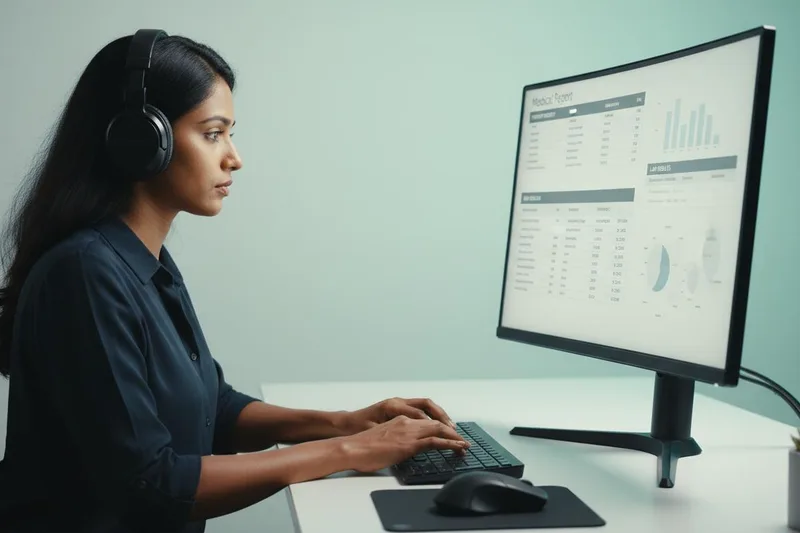
When you go to see a doctor, the doctor talks about your symptoms and the medications he or she is giving you. After you leave, if you look at your medical record the next day or a week later, you will see that everything that was discussed that day is written down neatly and clearly. Have you ever wondered who writes these things down so accurately? When the doctor is so busy, does he or she have time to write all this? There is someone out there who we cannot see, but who does a very important job in the health sector. Today we are talking about that person, a ' medical transcriptionist '.
Simply put, who is this Medical Transcriptionist?
A Medical Transcriptionist is someone who listens to voice recordings of doctors and other healthcare professionals and transcribes them into accurate, legible written medical records. Imagine that the doctor has finished examining you, goes to his office, and records your details into a small recorder. "This patient came in today with a fever and a cough that have been going on for two days..." he says in the description. This voice recording is what ends up in the hands of a Medical Transcriptionist.
These people are like the actors behind the scenes of a play, helping to make it a success. We don't see them, but without them, this important work wouldn't happen.
This job is not as easy as you might think. The person doing this job must have a good knowledge of medical terminology, diseases, and medications. Because even the smallest mistake in a medical report can have a big impact on your health. For example, if you hear the doctor's prescription number of milligrams wrong, how dangerous can it be? Therefore, this is a very responsible and stressful job .
This field is changing with new technology. Some software can convert audio recordings directly into written reports. So, hiring new employees for this job may be less than it used to be. However, it is still an indispensable and very important role in the healthcare field.
Where do these people work?
Medical transcriptionists work in a variety of locations.
- In hospitals
- In doctors' private offices
- Medical and diagnostic labs
- In the administrative offices of companies that provide copywriting services
- Some people do this job from home.
What are the main duties of a Medical Transcriptionist?
Their job is not just to listen to a recording and type it. There's a lot more to it than that. Let's see what that is.
| The work being done | Description |
|---|---|
| Listening carefully and comparing | We listen carefully to the audio recording and compare it with the draft of the report prepared by the software. We make sure that everything is 100% correct. |
| Correction of errors | Any grammatical, spelling, or medical errors in the report will be corrected. |
| Finding inconsistent or missing information | They are checking to see if the doctor forgot to mention something or if there are any inconsistencies in the report. These could pose a risk to the patient's health. |
| Simplifying medical language | The abbreviations and jargon used by doctors are transformed into clear terms that everyone can understand. |
| Submission for approval | The completed report is sent to the relevant doctor for re-examination and approval. |
| Protecting confidentiality | We ensure the confidentiality and security of your medical information, following legal guidelines. |
Are Medical Transcriptionist and Medical Scribe the same thing?
Yes, these two have different roles. You may get confused between the two.
- Medical Transcriptionist: These people work behind the scenes . After you see the doctor, they prepare your report from a different location. You will never meet this person.
- Medical Scribe: These people work directly with the doctor. They sit in the same room as you meet the doctor and immediately take notes of what the doctor says and the tests he or she does. This allows the doctor to focus on you without having to spend time on paperwork.
What skills are needed for this profession?
To be a successful Medical Transcriptionist, you need to have several special skills.
- Medical knowledge: A good understanding of the functioning of the human body (Anatomy and Physiology) and the language used in medicine is essential.
- Critical thinking: This ability is needed to accurately identify errors and inconsistencies in a report.
- Writing and grammar skills: Good language skills are required to write reports accurately and clearly.
- Listening skills: You need to be able to understand the different voices and pronunciations of doctors and grasp the true meaning of what they are saying.
- Computer skills: Good knowledge of using Electronic Health Records (EHR) systems and related software is required.
- Time Management: Ability to prepare reports quickly and accurately, within the stipulated time.
How to become a Medical Transcriptionist?
There are several steps that someone who wants to enter this field can follow.
1. Basic education: Generally, passing the Advanced Level is sufficient.
2. Professional Training: It is very important to take a Medical Transcriptionist certificate course. These courses can be done online or in-person. Most courses can be completed in less than a year.
3. Obtain professional certifications: Although this is not mandatory, many employers prefer those with professional certifications. It proves that you have the knowledge and training needed to do the job well.
The Association for Healthcare Documentation Integrity (AHDI) offers several recognized certifications in this regard.
- Registered Healthcare Documentation Specialist (RHDS): This is suitable for those who have completed the course or have less than two years of experience in the field.
- Certified Healthcare Documentation Specialist (CHDS): This certification is available to those who have the RHDS certificate and at least two years of experience in a hospital or various specialty areas.
- Certified Healthcare Documentation Professional (CHDP): A certification available to anyone involved in healthcare documentation work.
What is the future of this job?
As we've discussed before, some people are of the opinion that the demand for this job may decrease somewhat with the advancement of technology. But we need to understand the other side of it as well.
Imagine you have a very important phone call. As soon as the call ends, the details are clear in your head. But after a couple of days, you start to forget some things. After a few months, it's very difficult to remember the exact details of that call, isn't it?
The medical field is the same. The doctor's instructions and the details you tell him may be remembered at the time, but over time, they may be forgotten. That's why it's so important to have an accurate written record . A Medical Transcriptionist turns those words into a lasting, accurate, and organized record. These records are what allow doctors to provide you with the best treatment you need in the future.
Take-Home Message
- A Medical Transcriptionist is a very important member of your healthcare team, one that you may not see.
- Their main job is to listen to doctors' audio recordings and turn them into accurate written medical reports.
- Accuracy is extremely important in their work. Even a small mistake can affect a patient's life.
- This is a profession that requires medical knowledge, good listening skills, and meticulous attention to detail.
- Even as technology advances, there is still room for skilled professionals in this field, as the importance of accurate and clear medical records in patient care never diminishes.


💬 Comments (0)
No comments yet. Be the first to share your thoughts here.
Add Your Comment