

Do you feel a little sad and anxious when you look in the mirror at the acne scars, fine lines, and wrinkles on your face? Do you ever feel like your skin is a little dull and lacks the radiance it once had? If so, you've probably heard of a new treatment that's being used to rejuvenate your skin. It's called microneedling. So today, let's talk about it all in a simple, easy-to-understand way.
Simply put, what is microneedling?
Microneedling is a simple, minimally invasive treatment for your skin. It involves your doctor or a qualified technician using very fine, thin needles to create tiny punctures in the top layer of your skin. Now you might be thinking, "Oh, needles?" Yes, but they're so small that they don't hurt much.
In this way, when we do a little "damage" to the skin, our body's natural healing process is activated. Just like when we get a small wound, our body works to heal it. When this process is activated, the skin starts producing new proteins called collagen and elastin . These two proteins are the main ones that help keep our skin tight, smooth, and healthy. As we age, the production of these decreases, which is why the skin starts to sag and wrinkle. So microneedling stimulates that process again.
Although most people get this treatment on their face, you can have it done on any area of your body that is damaged or looks aged, such as your legs, back, or neck. But keep in mind that you will often need to have multiple treatments to get the results you want.
What is the difference between Microneedling and Microdermabrasion?
These two names are a bit similar, so you might get confused. Both of these work to improve the appearance and texture of the skin. But the two methods are completely different.
- Microdermabrasion: No needles are used here. Instead, the doctor uses a special device, similar to sandpaper, to remove (exfoliate) the top layer of dead skin cells from your skin. This is a treatment that works on the surface of the skin.
- Microneedling: As we discussed earlier, here, fine needles penetrate the surface layer of the skin and affect the layers beneath.
Simply put, microneedling goes deeper into the skin than microdermabrasion, so it can be more effective for problems that are below the skin's surface, such as deep scars caused by acne .
Who is this treatment really suitable for?
Microneedling is a treatment that is used for both cosmetic and medical purposes. If you are concerned about the following issues, you may want to consider this treatment.
| Skin problem | Simple explanation |
|---|---|
| Enlarged pores | If your pores are large, reduce their appearance. |
| Fine lines or wrinkles | Reduce the appearance of fine lines and wrinkles on the face that occur with aging. |
| Loose or crepey skin | If the skin has lost its firmness and is sagging. |
| Mild scars | Especially scars caused by acne or burns. |
| Skin discoloration | If the skin has changed color in different places, like spots. |
| Stretch marks | Stretch marks caused by weight gain/loss or pregnancy. |
In addition, this treatment also helps those with certain medical conditions.
- Alopecia areata: This is a condition in which hair falls out in patches due to a problem with the immune system.
- Hyperhidrosis: This is a condition in which the body sweats excessively.
In some cases, doctors also use this microneedling technique to deliver certain medications or injections to the skin.
Who should not have microneedling treatment?
Although this is a very safe treatment, it is not suitable for everyone. If you have any of the following conditions, you should definitely talk to your doctor before undergoing the treatment.
- If you currently have active acne or are taking medication for acne.
- If you have blood-related diseases or are taking anticoagulants .
- If you are receiving chemotherapy or radiation therapy for cancer.
- If you have frequent skin rashes, blisters (e.g. contact dermatitis ) or conditions such as herpes (cold sores).
- If you have a keloidal tendency (skin that is prone to scarring and swelling) .
- If your skin lesions, such as warts, birthmarks, or skin tags, change in size or shape, or if they bleed.
- If you have skin conditions like eczema or psoriasis .
If you have even the slightest doubt about anything like this, don't make decisions on your own. It's wiser to talk to your doctor, ask him/her for advice, and then seek treatment.
What happens before treatment?
Once you have decided to undergo the treatment, the first thing that should happen is a consultation with a doctor or a qualified specialist. This treatment is usually performed by a dermatologist, plastic surgeon, or a well-experienced esthetician. Whoever is performing this treatment, it is your responsibility to find out if they have good experience in this field.
In this discussion,
- Your skin will be examined.
- They will ask about your health history (medications you take, illnesses you have).
- This will talk about what you expect from the treatment.
- You may want to take some pictures of your skin before and after treatment to compare.
This is the best time to ask and answer all the questions you have in mind. For example,
- Are there any risks or side effects to this?
- Does the treatment hurt?
- How long does it take to see results?
- Is there any downtime after treatment?
- How many treatments will I need?
About a month before treatment, your doctor may tell you to apply a cream containing vitamin A or C to your skin. These will kick-start that collagen production process we talked about.
What happens during treatment?
On the day of the treatment, your skin will be thoroughly cleansed. Then, a numbing cream or ointment (such as Lidocaine gel) will be applied. This should be left on for about 30-45 minutes to allow it to take effect.
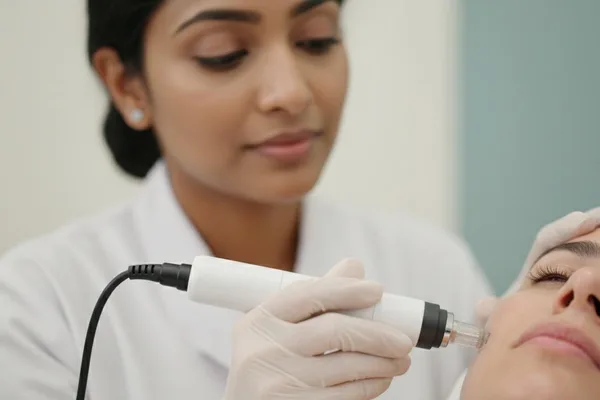
Then the real work begins. The doctor uses a hand-held roller or an electric device to create those tiny holes in the skin.
- The roller: It has many tiny needles attached to it. It slowly and gently rolls over the surface of your skin.
- Electric: The needles move up and down rapidly, piercing the skin. One advantage of this device is that you can adjust the length of the needles. If you have something like deep acne scars, you may need to use slightly longer needles (those that go deeper into the skin). The length of these needles can vary from 0.5 millimeters to about 2 millimeters.
When the treatment begins, you may feel a warm or tingling sensation on your skin. Some people may feel a little uncomfortable when the needles are inserted into bony areas, such as the cheekbones. During deep treatments, there may be a small amount of blood drawn into the area.
Depending on the size of the area being treated, the entire process can take anywhere from 15 minutes to several hours .
What happens after treatment?
This is not an outpatient procedure. This means you can go home after the treatment. After the treatment, your skin may be red and slightly swollen for about 5 days. An ice pack can help to reduce this discomfort.
Most people can wear makeup the day after treatment. However, you should avoid sun exposure until your skin is completely healed. In a sunny country like ours, using a good sunscreen is a must when going out.
What are the benefits and risks of this?
Like any medical treatment, microneedling has benefits and minor risks.
| Benefits | Risks |
|---|---|
| The appearance and texture of the skin improves. | Bruising. |
| Reduces stretch marks, scars, wrinkles, and other skin problems. | Scarring - (very rare). |
| Unlike some treatments that use heat, light, or lasers, there is no risk of skin discoloration, making it ideal for those with darker skin tones. | Skin infection - (if cleanliness is not taken care of). |
The most important thing is that if this treatment is performed by a qualified, experienced person and using clean equipment, the likelihood of risks is very low.
When should you see a doctor?
The redness and swelling that usually occurs after treatment will subside within a few days. However, if you notice any of the following, contact your doctor immediately.
- If the treated area bleeds for more than 24 hours .
- If blisters appear on the skin.
- If the swelling persists for more than a week .
- If pus oozes from the treated area, the pain increases, or you develop a fever (these may be signs of an infection).
Take-Home Message
- Microneedling is a safe, simple treatment that can improve the appearance of the skin.
- This stimulates the production of collagen and elastin, solving problems such as wrinkles, scars, and stretch marks.
- To achieve the best results, you will usually need to have several treatments spaced 3-8 weeks apart.
- It can take about 3-6 months to see results, so it's important to be patient.
- Before undergoing this treatment, be sure to talk to your doctor about whether it's right for you and what the risks are.
- It is always safest to have this done by a qualified professional rather than using DIY kits.




💬 Comments (0)
No comments yet. Be the first to share your thoughts here.
Add Your Comment