
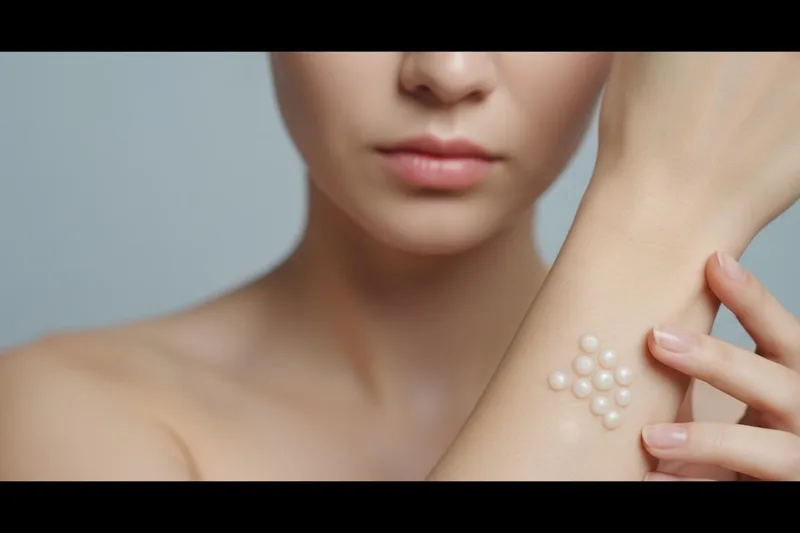
Have you ever noticed small, shiny, pearl-like blisters on your little one's skin, or on your own? Sometimes these can be a little scary to see. But don't worry. Most of the time, they're not serious. We medically call this condition Molluscum Contagiosum. Today, we'll talk about it in a simple way that you can understand.
Simply put, what is Molluscum Contagiosum?
Molluscum Contagiosum is a contagious skin disease caused by a virus. Specifically, it is caused by a virus that belongs to the poxvirus family. When this virus enters the skin, it causes small, raised, pearly bumps (bumps) to form on the skin. These bumps are usually white, but can sometimes be the same color as your skin, pink, or purple.
Although these blisters can appear anywhere on the body, they are most commonly seen on the face, neck, arms, legs, and genital areas.
Who is most likely to develop this condition?
Actually, this disease can develop in anyone, regardless of age. However, it is most often seen in children under the age of 10. In addition, some people are at a slightly higher risk of developing this disease. Let's see who they are:
- People with weakened immune systems: This means people with reduced resistance to disease (for example, those with conditions such as AIDS).
- People with skin conditions such as eczema: The protective layer of the skin of such people is weak, making it easier for the virus to enter.
- People living in hot, humid climates: This condition is common in countries like Sri Lanka.
- People who live in crowded, crowded environments: For example, in places like schools and daycare centers, there is a greater chance of transmission from one another.
Molluscum Contagiosum is a very common condition. And, it often goes away on its own over time without any treatment. So there's no need to worry too much about it.
What are the symptoms? How do you diagnose it?
The main symptom of this disease is the pearly blisters we talked about earlier. Let's take a closer look at some of the special features of these blisters. This description will help you identify them.
| Characteristic | Description |
|---|---|
| Appearance and size | A small bump that protrudes from the skin, like a pimple. Usually about 2-5 millimeters in size. |
| Color | It can be white, skin-colored, pink, or maybe even purple. |
| A special feature | Many blisters have a small dimple in the middle . This is an important feature to identify this disease. |
| Nature | They may feel a little hard to the touch at first, but they may soften over time. Sometimes, a white liquid may ooze from inside them. |
| Itching | Some people may scratch the blisters. |
What happens if you pop a blister?
This is the most important thing we need to be careful about. Scratching or picking at these blisters can spread the virus to the surrounding skin, causing new blisters to form. This can then:
- Another cluster of blisters forms right next to the original blister.
- The skin around the blisters may become swollen and red.
- Sometimes there may be pain.
Is this a contagious disease? How is it transmitted?
Yes, Molluscum Contagiosum is definitely a contagious disease. There are several ways this virus can spread from person to person:
- Skin-to-skin contact: The skin of a person with the disease touches the skin of a healthy person.
- Through infected items: By another person using items such as towels, clothes, and toys used by the patient.
- Sexually: If there are blisters in the genital area, it can also be transmitted during sexual intercourse. Therefore, it is also considered a sexually transmitted disease (STI). However, it is most often transmitted through casual, non-sexual contact.
It is believed that as long as these blisters remain on the skin, the disease can be transmitted to another person.
How does a doctor diagnose this?
A doctor can usually tell if you have Molluscum Contagiosum by examining the blisters on your skin. That characteristic we talked about, the small pit in the middle of the blister, is very helpful in identifying this.
Very rarely, if necessary to confirm the diagnosis, the doctor may take a very small piece of skin from the blister and examine it under a microscope. We call this a ``skin biopsy''.
What are the treatments for this?
The good news here is that most of the time, no treatment is needed for Molluscum Contagiosum, as the infection clears up on its own.
However, in some cases, a doctor may recommend treatment. For example:
- If the child goes to school or daycare, stop infecting others.
- If there is pain or discomfort due to the blisters.
- If someone with a weak immune system has it.
There are several types of treatment that can be done in such a case:
1. Removing blisters: A doctor can remove these blisters using various methods.
- Cryotherapy: Using extreme cold (such as liquid nitrogen) to freeze the wart off.
- Curettage: Scraping out the blister using a special instrument.
- Laser therapy: Removing blisters using laser beams.
Warning: Never try to squeeze, pop, or remove these blisters yourself at home. Doing so can spread the virus, causing more blisters, or causing wounds and bacterial infections. These should definitely be done by a doctor.
2. Medications: Sometimes the doctor may recommend oral medications, especially for young children.
3. Topical creams: Your doctor may recommend various topical creams that can help speed up the healing process and reduce itching. For example, creams containing salicylic acid and benzoyl peroxide.
How long can this situation last?
Without treatment, these blisters can take about 6 to 12 months to go away on their own. However, in some people they can last for several years. With treatment, this time can be shortened. It may take longer for someone with a weakened immune system to heal.
The most important thing is that after the blisters heal, there are usually no scars left.
How to protect yourself from Molluscum Contagiosum?
There are a few simple things we can do to prevent the spread of this disease:
- Wash your hands thoroughly: It is very important to wash your hands regularly with soap.
- Do not share items: Do not share items such as towels, clothes, and razors with others.
- Don't pop blisters: If you or your child has blisters, try your best not to pop or scratch them.
- Cover blisters: Keep blisters covered with clean clothing or a bandage. This is especially important if you are going to a swimming pool or exercising.
- Safe sex practices: If you have blisters in your genital areas, it is wise to avoid having sex until they are completely healed.
Do you want to see a doctor?
Although this is usually not a serious condition, you should definitely see a doctor if:
- If the pain is severe: If the blisters hurt.
- If you suspect an infection: If the blister is swollen, red, and oozing a yellow fluid like pus, it could be a bacterial infection.
- If you have blisters around your eyes: If you have blisters on your eyes or eyelids.
- If the disease is spreading: If the blisters spread rapidly throughout the body.
- If you are immunocompromised: If you have a disease or condition that lowers your immunity.
- If you have any doubts: If you're not sure what these are, it's best to see a doctor to find out exactly what they are.
Talk to your doctor and get the treatment and advice that's best for you.
Take-Home Message
- Molluscum Contagiosum is a common skin disease caused by a virus, especially among young children.
- The main characteristic of this is a pearl-like blister on the skin with a small hole in the middle.
- This condition is usually not dangerous and will resolve on its own within 6-12 months without any treatment.
- The most important thing is not to pick or scratch the blisters, as this can spread the virus.
- Avoid sharing items like towels and clothes with others.
- If the blisters are causing discomfort, spreading, or if you suspect they are infected, be sure to see your doctor.




💬 Comments (0)
No comments yet. Be the first to share your thoughts here.
Add Your Comment