
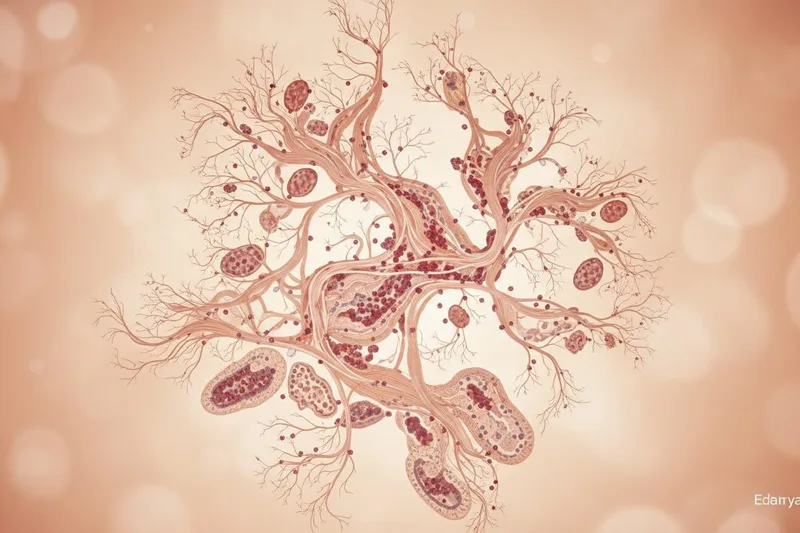
Have you ever thought about these amazing parts inside our bodies, the organs? Not just the ones we always talk about like the heart, brain, and liver, but how many other things are there in our bodies? So today, let's talk simply and precisely about what these organs are, how they work, and how they are important to us. Just like talking to a friend.
What exactly are organs?
Simply put, an organ is a structure inside our body that performs a specific function. Think of your heart, brain, or liver. These are the organs we are most familiar with. But there are many other things that are considered organs. Some of them you may not have even thought about. For example, your skin is an organ!
To understand this, think of it this way. Each cell in our body is like a single worker, doing a specific job. Then, cells that do the same job come together to form a group in the same place. We call them tissues . So, an organ is a group of these tissues that come together, work together, and do an even bigger, more complex job. It's like each department in a big company. Everyone works together to do the work of the whole company.
What are the main organ systems in our body?
Organs do not work alone. They are connected to each other and work as large systems. Some organs can be connected to more than one system. Let's look at some of the major organ systems and what other organs they belong to.
- Cardiovascular system: The main organ of this system is your heart . In addition, the large blood vessels, called arteries and veins , as well as very fine capillaries, belong to this system. This is what sends blood throughout the body.
- Digestive system: This includes your stomach and intestines - the small intestine and the large intestine . It also includes the esophagus , mouth, and anus . It is this system that helps us digest and absorb the food we eat.
- Endocrine system: This includes a number of glands, such as the pancreas and the thyroid gland , and the adrenal glands . These are the ones that produce hormones that control various functions in our body.
- Immune system: This includes your spleen and bone marrow . Bone marrow makes various blood cells, especially immune cells that protect us from disease.
- Musculoskeletal system: This includes your muscles and all the bones in your skeleton. It also includes connective tissue like ligaments and tendons . This system helps us move and walk.
- Nervous system: The main organs of this system are the brain and the spinal cord . In addition, the nerves throughout the body, your sensory organs such as the eyes , ears , and nose , are also connected to this system. Everything that controls our body, such as thinking and feeling, happens through this system.
- Reproductive system: This includes organs such as the ovaries , vagina , and uterus in women and the penis , prostate , and testicles in men.
- Respiratory system: This includes openings like your nose and mouth , and internal organs like your lungs . We breathe through this system.
- Urinary system: This includes internal organs such as the kidneys and bladder , and external genitalia such as the penis in men. It removes waste products from the body as urine.
You see, how many organs are connected to each system! Some organs exist as a single structure, like the heart. But sometimes many structures of the same type are considered an organ. For example, our bones are an organ. Also, the bone marrow inside many bones is also an organ.
How many organs do we have in our body?
The answer to this question may vary depending on who you ask. Before 2016, the number of organs was accepted as 78. However, with new discoveries in medical science, this number has changed. Today, if you ask an expert how many organs you have in your body, the answer may range from 78 to 80.
This controversy is caused by two findings, explained in two research papers in 2016 and 2018. These are two senses that are gaining new recognition, but are still somewhat controversial:
- The Mesentery: This is a membrane that surrounds our intestines. It is said to contribute to our immune system, lymphatic system, and digestive system. In the 2020 edition of the famous medical book `Gray's Anatomy`, this `Mesentery` has been recognized as a real organ. Then the number of organs becomes 79.
- The Interstitium: This is a network of fluid-filled spaces between our cells. It is now discovered to be spread throughout the body, in and around the major organs.
There is still a lot of research being done on how these organs work and what they do, and with advances in technology and medicine, there is a chance that more new things will be discovered.
What are the vital organs?
Vital Organs are the organs that are essential for us to survive. Without them, our body cannot function. Some of the vital organs are:
- Brain
- Heart
- Kidney - at least one
- Lungs - at least one
- Liver
If any of these organs are not working properly, it can affect our entire life. Therefore, it is very important to take care of them.
Are there any organs that are located only on one side of the body?
Yes, while some of our body's organs are located in the middle, some are clearly meant to be on one side.
Several organs located in the middle of the body:
- Brain
- Bladder
- Heart - This is mainly located in the middle, slightly heavier on the left side. However, in rare cases such as `(Dextrocardia)`, it can also be located on the right side.
Some of the organs located on the left side:
- Pancreas
- Stomach
- Spleen
Some of the organs located on the right side:
- Appendix
- Gallbladder
- Liver
Also, we have several sense organs that are located in pairs . That is, one on each side.
- Lungs
- Kidneys
- Eyes
- Ears
- Reproductive organs - that is, external ones like the testicles and internal ones like the ovaries .
What sense organs can we live without?
Don't be surprised, we can live without several of our senses. Such senses are:
- Appendix
- Gallbladder
- Ovaries and/or uterus
- Spleen
- Testicles
- Large sections of your bowels or the entire colon
Also, we can survive with only one of the paired organs, for example, with one lung or one kidney.
But, we cannot live without a heart, or at least one kidney. However, there are artificial things that can do the same job. Artificial hearts can be used in the long term to replace diseased hearts. Also, dialysis can help the kidneys function in the long term (but it is not a permanent replacement).
What are 'Accessory Organs'?
Accessory organs are organs that contribute to a body system, but may not be an obvious part of that system. One example is your gallbladder . It helps with digestion. Another example is your breasts . They contribute to the reproductive system during breastfeeding.
But, just because it's an accessory organ doesn't mean it's not important. Even though your liver is an accessory organ to the digestive system, we couldn't live without it. Got it?
What is the largest organ in our body?
The largest organ in your body is your skin . It makes up about 15% of your total body weight! But if you look at the internal organs, the largest one is the liver .
Sense organs are not just something inside your body. Many things on the outside of your body, like your eyes and other parts of your face, are also sense organs. When everything is working well, we don't think about them much, right? But when you're sick and there's a problem with one of your senses, it can be so overwhelming that you can't think about anything else.
So, what are the most important things we need to remember about these organs? (Take-Home Message)
Okay, so we've talked a lot about the senses today, haven't we? Here are some of the most important things to remember:
- Organs are very complex structures in our bodies that perform specific functions.
- Cells form tissues, tissues form organs, and organs form systems. We are healthy because all of these things work together.
- Just like the vital organs that we need to survive , we can live without some organs.
- The skin is the largest organ in our body. The liver is the largest internal organ.
- Our senses are not just things that exist. It is our responsibility to take care of them properly and keep them healthy.
- If you have any concerns about the health of your organs, be sure to talk to a doctor. He or she can guide you on how to best take care of your organs and overall health.
So, I hope you have gained a good understanding of the senses from what we have discussed today. Our bodies are truly amazing, aren't they?
` Organs, limbs, body systems, heart, brain, liver, kidneys, lungs, cells, tissues, digestive system, nervous system


💬 Comments (0)
No comments yet. Be the first to share your thoughts here.
Add Your Comment