

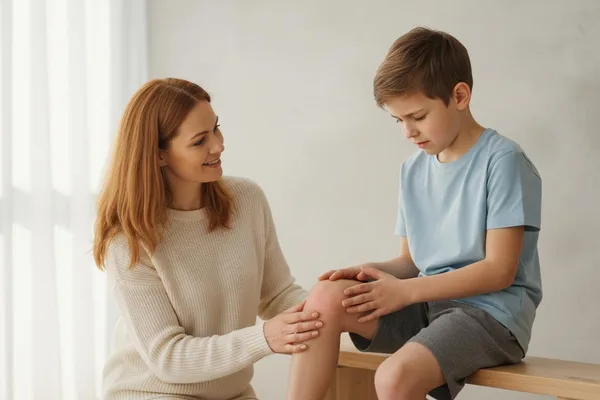
Does your child often say, "Mom, my knee hurts" after coming home from playing sports? Does he feel pain when you touch the front of his leg, especially just below the kneecap? Is there a small lump or swelling in that area? Although this may sound a little scary, most of the time it is a non-serious condition that occurs during a child's growth spurt. Today, let's talk about what Osgood-Schlatter Disease is.
Simply put, what is Osgood-Schlatter Disease?
This is not really a dangerous "disease". It is a painful swelling in the knee. Specifically, the pain occurs at the junction of the kneecap (patella) and the shin bone (tibia) below it. This condition is most common in children during a period of rapid growth, around the ages of 11-14.
Think about it, when a child is growing rapidly, their bones, muscles, and tendons are all growing rapidly. These tissues are a bit sensitive at this time. So if a child is involved in a sport that involves running and jumping, the constant pressure on the knee can cause that sensitive area to swell and hurt. Some people call this "growing pains."
Most importantly, this does not cause permanent damage to the child's knees or bones. This condition will almost completely disappear once the child is fully developed.
What are the symptoms of this condition?
If your child has this condition, they may experience one or more of the following symptoms. These may occur in one or both knees.
| Symptom | Description |
|---|---|
| Knee pain | The pain occurs especially under the kneecap, above the kneecap. This pain is worse when running, jumping, or kneeling. |
| Swelling and redness | The area of pain may be swollen, sometimes red, and feel warm to the touch. |
| Sensitivity to touch | When I press the swollen area with my finger, I feel severe pain. |
| A small, tight knot | There may be a small bump on the bone (tibial tubercle) just below the kneecap. This is the main source of pain. |
| Thigh muscle tightness | The large muscle at the front of the thigh (quadriceps muscle) may be tight. |
Why is this really happening?
To understand this, we need to take a look at how a child's knee works.
Simply put, when a child bends or straightens their knee, the quadriceps is the main muscle that works. This muscle is attached to the kneecap by a strong, band-like tendon, which then passes over the kneecap and attaches to a small bump on the top of the shin bone (tibia) called the tibial tubercle.
Underneath this bony prominence in growing children is a soft, growing area that is not yet fully solidified. We call this the growth plate .
Now imagine what happens when a child continues to do activities like running, jumping, and climbing stairs. The quadriceps muscle constantly pulls on that tendon. The force of that pull is felt directly at the sensitive growth plate. When this repetitive strain is applied, that area swells and becomes painful. This is called Osgood-Schlatter Disease.
Who is most at risk?
- Children between the ages of 11-14: This is when the body grows the fastest.
- Children who play sports: This risk is especially high for children who play sports that involve running, jumping, and sudden changes in direction.
- Basketball
- Volleyball
- Football (Soccer/Football)
- Athletics
How do you find this, Doctor?
When you take your child to a doctor, he will first ask you about things like what sports the child plays, how the pain started, and how long it has been there.
Then the child's knee is examined.
- The monk presses on the painful area.
- The child is asked to walk, kneel, or jump a little.
- They test the tightness of the muscles by asking you to bend and straighten your knees.
In most cases, a physical exam can diagnose this condition. Sometimes, an X-ray may be ordered if there is any suspicion of another bone disorder.
How is it treated? How long will it take to recover?
The best medicine for this is rest . This condition can usually take anywhere from a few weeks to a month or two to heal. During that time, it is essential to follow the doctor's instructions based on the child's condition.
1. Rest: You should completely stop the sport or activity that caused the pain. Do not start playing again until your doctor tells you to. If you start playing again even though the pain has subsided, you may make the condition worse.
2. Icing: Place an ice pack (wrapped in a towel) on the painful area for 10-15 minutes several times a day. This will reduce swelling and pain.
3. Painkillers: Non-steroidal anti-inflammatory drugs (NSAIDs) such as ibuprofen can be used for a short period of time, as directed by your doctor. Never give your child painkillers without consulting your doctor.
4. Physical Therapy: Some children may need the help of a physical therapist. Stretching exercises and strengthening exercises for the muscles in the back of the thigh and leg can help reduce the pressure on the knee.
The most important thing is patience. It may be sad to see your child miss a game or practice session, but giving the knee the time it needs to fully heal is the best investment you can make for the future.
Can this situation be prevented?
Although it cannot be completely prevented, the following can help reduce the risk:
- Exercise properly: It is essential to warm up the body properly before starting any sport and to cool down and stretch after the sport.
- Not playing with pain: If your child feels pain in their knee, don't let them continue playing, saying, "It's nothing to worry about." Pain is a signal from the body.
- Rest: It is important to give the body adequate rest to recover during intense training.
If your child's knee pain does not subside after a few days of rest, or if it recurs, be sure to see a doctor.
Take-Home Message
- Osgood-Schlatter Disease is a common knee condition that affects children during adolescence, especially those who play sports. It is not a serious condition.
- The main reason for this is repeated pressure on the knee (overuse).
- The main treatment is rest. You should completely avoid activities that cause pain.
- This condition usually resolves completely once the child's growth is complete.
- If your child has knee pain, be sure to see a doctor for an accurate diagnosis and advice.




💬 Comments (0)
No comments yet. Be the first to share your thoughts here.
Add Your Comment