

Today we are going to talk about a medical condition that is a bit surprising to hear, and also a very rare one. You have probably heard of twins. But sometimes, very rarely, one of the twins can develop incorrectly and remain attached to the body of the other. That is what we call a parasitic twin . This may sound a little scary, but let's talk about it in detail and simply.
What exactly is a parasitic twin?
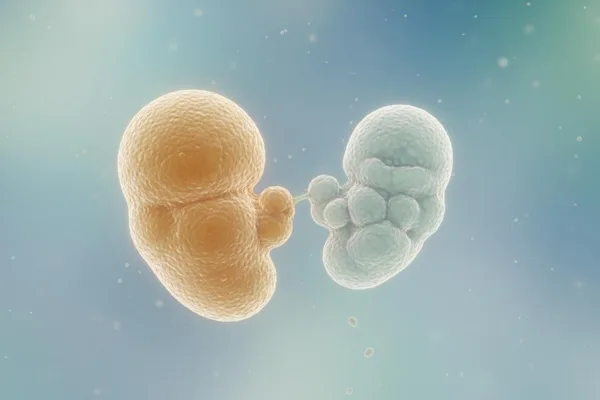
Simply put, a parasitic twin is a twin pregnancy in which one fetus stops developing and remains attached to the other healthy fetus (dominant or autositic twin). This happens very early in fetal development, when the baby is just beginning to develop in the mother's womb.
The stunted twin never fully develops. But it remains attached to the body of the healthy twin. As a result, when the healthy baby is born, it may have extra limbs, organs, or tissue from the stunted twin. The stunted twin can sometimes be unrecognizable or look like a shapeless lump of flesh.
The important thing is that this healthy baby (let's call him the dominant twin ) can have various health problems because of this. Therefore, he needs medical treatment after birth.
Doctors use several other names for this condition:
- Asymmetrical or unequal conjoined twins (`(Asymmetrical or unequal conjoined twins)`)
- Vestigial twins (`(Vestigial twins)`)
- A fetus within a fetus (`(Fetus in fetu)`)
- Heteropagus twins (`(Heteropagus twins)`)
Are there types of parasitic twins?
Yes, these parasitic twins are classified according to where they are attached to the dominant twin's body. Think of it like a branch of a tree being attached to another tree. The name is derived from the point of attachment. Here are a few examples:
- Cephalopagus: Joined to the back of the head.
- Craniopagus: Conjoined at the skull.
- Epigastric: Relating to the upper part of the abdomen (right above the stomach).
- Ischiopagus: Joining the pelvis (hip system).
- Omphalopagus: Attached to the abdomen (belly).
- Parapagus: Attached to the torso.
- Pygomelia: Involvement of the buttocks (this can result in an extra arm or leg).
- Pyopagus: Connection to the lower back or spine.
- Rachipagus: A joint in the middle of the spine.
- Thoracopagus: Connecting to the chest.
All of these types are very rare. The complexity of the surgery depends on the location involved.
Are parasitic twins and conjoined twins the same thing?
This is a good question. A parasitic twin is actually a type of conjoined twin. About 10% of all conjoined twins are parasitic twins.
But there is a key difference:
- Conjoined twins are twins born fully (or mostly) developed and joined at some point in the body. They may share one or more organs.
- In a parasitic twin , one embryo develops fully, while the other does not. The immature embryo is not functional and dies during pregnancy. However, the parts remain connected to the healthy baby.
Simply put, conjoined twins are two children who are joined together and have developed almost identically. A parasitic twin is a non-developed, non-functional twin that is attached to a fully grown child.
How common is this condition?
You may be surprised to hear this, but conjoined twins are extremely rare. Worldwide, this condition occurs in less than one in a million babies . So don't worry about it unnecessarily.
What are the symptoms of having a parasitic twin?
In fact, the mother may not experience any specific symptoms during pregnancy. The baby may not even know that the condition exists until after birth.
Why is this happening? What is the reason?
Researchers have not yet discovered the exact cause of this, but two main theories are most widely discussed:
1. Fission theory : According to this theory, the reason is that a fertilized egg does not completely divide into two. Normally, if a fertilized egg completely divides into two, it produces identical twins. However, if this division does not occur exactly, or if it splits in half, conjoined twins can be formed. A parasitic twin is formed when one of the two embryos that are connected in this way stops developing.
2. Fusion theory : According to this theory, this condition can occur when two separate fertilized eggs fuse together early in embryonic development. One of the two embryos stops developing and remains attached to the other.
There is another theory that this may be due to some problems with the blood supply (vascular system) as the fetus develops in the womb.
However, it is important to understand that this is not due to a genetic defect or any fault on the part of the parents.
How do doctors diagnose this condition?
Often, doctors may suspect this condition during a prenatal ultrasound scan during pregnancy. If such suspicion arises, further tests will be needed to find out exactly how the parasitic twin is connected to the leading twin and what organs are involved.
Such tests are:
- Magnetic Resonance Imaging (MRI)
- Computerized Tomography scan (CT scan)
When a parasitic twin is suspected, an echocardiogram may be performed to see if this is putting any pressure on the dominant twin's heart.
Sometimes, the parasitic twin is not visible until after the birth of the dominant twin. This may be because the twin is very small, or because it just looks like a lump of flesh.
How is this treated?
If left untreated, the dominant twin can develop various illnesses and complications due to this parasitic part attached to its own body. This is because the inactive part is also nourished to some extent by the healthy baby's body.
So, after the dominant twin is born, doctors carefully examine the baby to make sure that its heart, lungs, and other organs are working properly. Every case is different. Treatment depends on how and to what extent the parasitic twin is involved.
The main treatment is surgery to remove the parasitic twin from the dominant twin. A surgeon carefully removes these bones, organs, and tissues from the healthy baby.
There are some risks with this surgery, such as infection, hernia, or other complications inherent to surgery. But in most cases, a skilled medical team can perform this surgery successfully.
Can something like this be prevented?
Unfortunately, there is no way to prevent the birth of a parasitic twin. This happens early in the development of the embryo, and we cannot control it.
What is the future of conjoined twins? (Outlook)
- Parasitic twin: This part is not alive. It dies in the womb, but remains attached to the dominant twin.
- Dominant (healthy) twin: This baby will most likely survive. However, it will require extensive medical treatment to remove the parasite. Sometimes, it may develop breathing problems or heart problems, so it will need to be monitored closely.
Although cases of parasitic twins are very rare, most of the time the dominant twin survives.
Are a parasitic twin and a vanishing twin the same thing?
Yes, these are two completely different situations.
- Vanishing Twin: This is when a scan shows that there are twins early in the pregnancy, but later on, there is only one baby. The other baby is absorbed by the placenta, the other twin, or the mother's uterus. In this case, the two babies are not connected to each other.
- Parasitic Twin: In this, the part of the twin that has stopped growing is not absorbed. It remains attached to the dominant twin. Also, parasitic twins are a type of conjoined twins. Vanishing twins are not connected in this way.
Is the parasitic twin alive?
No. The parasitic twin dies during pregnancy. The fully developed dominant twin usually survives.
Parasitic twins are a very rare type of conjoined twin. This occurs when, very early in embryonic development, one half of the embryo fuses with another (its twin brother/sister). One embryo develops normally, while the other half stops developing, but remains connected to the other. The healthy baby may be born with extra limbs or a lump of flesh where the twin used to be.
Because this condition is so rare, there is little research on it. Medical experts are still learning more about it.
Things we need to remember (Take-Home Message)
It's normal to feel a little shocked and scared when hearing about such a rare condition. But there are a few important things we need to understand:
>
- Parasitic twins are an extremely rare condition. This occurs in about one in a million births.
- This is not due to any fault of the parents, and it cannot be prevented.
- The developing dominant twin often has the potential to survive, but surgery to remove the parasitic part is essential.
- If you are pregnant and have any concerns or fears about this, it is best to talk to your doctor. They can provide you with the information and support you need.
I hope this information is helpful to you. When discussing such complex medical matters, it is normal for one thing to come to mind. But being armed with knowledge gives us the strength to face anything.
` Parasitic Twin, Conjoined Twins, Embryonic Development, Surgery, Pregnancy, Rare Diseases




💬 Comments (0)
No comments yet. Be the first to share your thoughts here.
Add Your Comment