
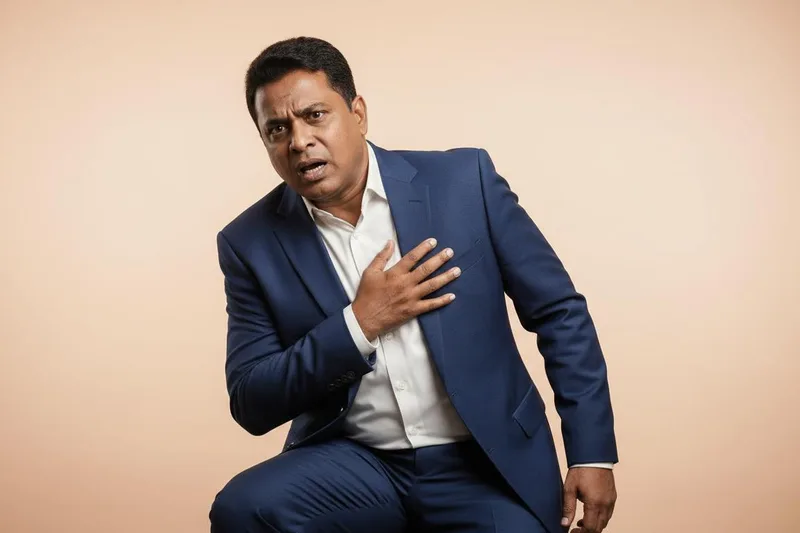
Have you ever seen someone suddenly collapse to the ground for no apparent reason? Maybe clutching their chest. At that moment, we might think, 'Oh my God, is this a heart attack?' But sometimes it can be something more serious than a heart attack, which is when the heart suddenly stops beating. But don't worry, because today we're going to talk about a small, but very powerful machine that can help save lives in times like these. It's called an AED.
What is an AED (Automated External Defibrillator)?
Simply put, AED is an abbreviation for the English words 'Automated External Defibrillator' . In Sinhala, it means 'automatic external cardiac defibrillator'. But when we talk, it's easier to say AED, right? This is a really small, portable medical device . It is used to help a person if their heart suddenly stops beating (Sudden Cardiac Arrest) , that is, if the heart stops working.
Now you might be thinking, 'What do you mean the heart stops? How does that happen?' Our heart is like a small power plant. Special cells in it send out small electrical signals. These electrical signals are what make the heart beat like a rhythm, that is, it beats. This beat is what makes blood flow throughout the body. However, sometimes there is a problem or glitch in the electrical activity of the heart. Then the heartbeat becomes erratic and can suddenly stop. That's what we call `(Sudden Cardiac Arrest)`. This is a little different from a heart attack . In a heart attack, the main thing that happens is that a blood vessel that supplies blood to the heart is blocked, but the heart does not stop at first. However, `(Sudden Cardiac Arrest)` is when the heart stops beating completely due to a problem in the heart's electrical system. Do you understand?
What exactly does an AED do?
Okay, so now we know that an AED is used to treat someone who has had a cardiac arrest. But how does this machine do it? Imagine, someone suddenly collapses, loses consciousness, and is almost not breathing. Then we take an AED and attach the two pads on the person's chest. This machine is very intelligent. That's why it's called ' automated' . After you attach the pads, the AED automatically checks the person's heart's electrical activity .
After examining the person, the AED decides whether to give them an electric shock , a small electrical current. Not every person who has stopped breathing needs to be given a shock. Some heart rhythms can be corrected with a shock, and some cannot. The AED recognizes it precisely. If a shock is needed, the machine tells you, usually by turning on a light and giving a voice prompt, something like "Shock ready, move away from the patient." Then you press a button and deliver the shock. What this electric shock does is to 'reset' the heart's erratic electrical activity and try to get it back to a normal rhythm . It's like restarting a computer that's been messed up. After this, the heart can start beating properly again. Isn't it amazing how this little machine works?
Where is this AED machine? Can we use it?
Now you might be thinking, 'Is such a valuable machine available everywhere? Can we find it if we need it?' Yes, the good news is that today, like many countries in the world, Sri Lanka also has these AED machines in some public places . For example:
- At major airports
- At major railway stations
- In sports stadiums/facilities
- In some large schools
- In large shopping malls
- In some large office complexes
- These can also be seen in some hotels .
These are usually placed in a green box, placed in a clearly visible place, and marked 'AED' in large letters.
The most important thing is that these AEDs are designed to be easy for even a layperson without medical training to use in an emergency. That means you don't have to be a doctor to use them. When you turn on the machine, it will give you step-by-step instructions , with voice prompts and sometimes on-screen diagrams, such as 'do this now' and 'do that next'. So there's nothing to be afraid of. The sooner someone in cardiac arrest gets help, the better their chances of saving their life. That's why they're placed in public places, so you can act quickly without waiting for medical help to arrive.
Imagine this. You are playing cricket with your friends. Suddenly, one of your team members falls to the ground without saying anything. When you look at him, he is unconscious and not breathing. You know that there is an AED in the sports club office. So you can quickly get it and help that friend. The decision you make at that moment could save a life.
What else do we need to know about this AED? Is training required?
You don't need a lot of medical knowledge to use an AED, and even though the machine itself gives instructions, it's still worth getting training on how to use it. Because it's normal for us to panic in an emergency. If we've received training beforehand, we can use it with confidence and without any fear.
Such training programs are now available in Sri Lanka. These are organized by some hospitals, ambulance services, or some non-governmental organizations. Anyone over the age of 12-13, that is, young school-going children, university students, working people, anyone can receive this training. Imagine, if something like this happened to someone at your school or at your workplace, how great it would be to be able to help?
Another thing is that most of the time, these AED training classes also teach CPR (Cardiopulmonary Resuscitation) , which is the method of helping to save the life of someone who has stopped breathing by artificially pressing the chest (chest compressions) and giving mouth-to-mouth resuscitation. Because, CPR can maintain the oxygen supply to the brain and other vital organs to some extent until a shock is given to someone who has had a `(Sudden Cardiac Arrest)` with an AED, or even when a shock is not needed. Therefore, AED and CPR are two life-saving methods that go together.
Remember, in an emergency, with a little effort from you, with a little training from you, you can save someone else's life. So be interested in this. If possible, get AED and CPR training. That knowledge can help not only you, but also your loved ones, someday, somewhere.
So, what are the things we should remember from this story? (Take-Home Message)
Okay, we've talked a lot about AEDs today, haven't we? Let's recap these important points:
- An AED (Automated External Defibrillator) is a portable medical device that helps save the life of someone who has suffered a sudden cardiac arrest.
- This involves testing the heart's electrical activity and, if necessary, administering an electric shock to try to get the heart to work normally again.
- AED machines are available in many public places, and they are designed to be easy to use even for an average person without medical training. The machine itself gives you instructions.
- It is very important to be trained in the use of an AED. This training also teaches CPR. Both are very important in saving lives.
- Never be afraid to use an AED. Your quick action could save someone's life.
So, I hope you now have a good understanding of AEDs. Share this knowledge with others. Because, none of us know when something like this will happen to anyone. The best thing to do is to be prepared!
` AED, Automated External Defibrillator, Sudden Cardiac Arrest, Electric Shock, CPR, First Aid, Lifesaving Equipment, Emergency Treatment


💬 Comments (0)
No comments yet. Be the first to share your thoughts here.
Add Your Comment