
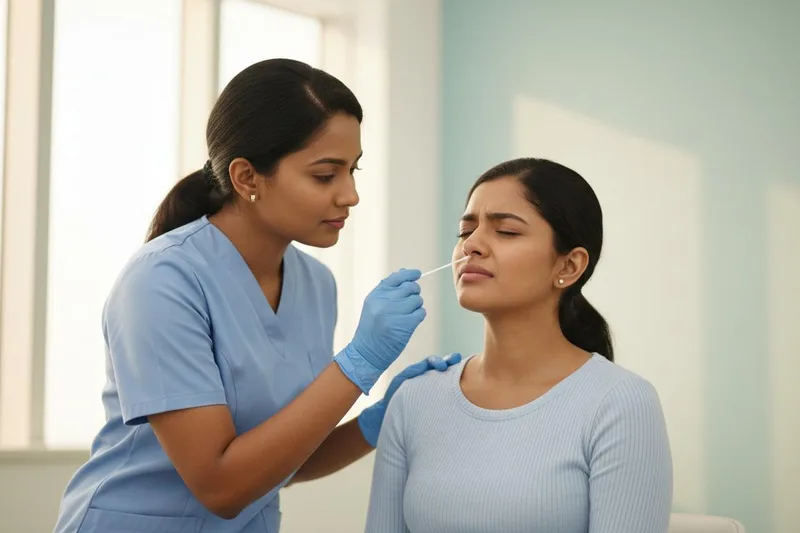
These days, it's impossible not to talk about COVID-19. Sometimes you might think, 'I don't know if I've got this,' or maybe you're a little confused after hearing about all these types of tests. Don't worry, let's talk about all this simply. Whether you have symptoms like these, or if you've been around someone who has the disease, it's very important to get a COVID-19 test. These test results can give you relief that you don't have the disease, or if you do, you can know that you need to stay away from others until it goes away.
What are the viral tests available to detect COVID-19?
Simply put, these virus tests look for virus particles in someone's nose or mouth. That is, they can tell whether you are infected with the virus on the day of the test. That is why they are also called 'diagnostic tests'. There are mainly two types of virus tests. Let's talk about each one in detail.
First type: Molecular Tests – like PCR
This is the type that most people know and often talk about, the PCR test. It is also called ``Nucleic Acid Amplification Test'' or ``(NAAT)''.
What exactly is this looking at?
These tests look for the genetic material of the virus, that is, the part called `(RNA)` that contains the genetic information of the virus. Imagine that if the virus is like a small animal, this `(RNA)` is like the animal's ID card. It is by identifying these `(RNA)` parts that it is possible to tell exactly whether the virus is present in the body or not.
How is this test done?
Most often, a swab is taken from the nose. Sometimes a swab is taken from the inside of the nose (nasopharyngeal swab), or from the front of the nostrils (nasal swab). But sometimes it can also be done from the mouth, throat (throat swab), or saliva. This sample is sent for testing.
How long does it take for the results to come?
Typically, this sample is sent to a lab. Depending on the amount of tests the lab has and the workload at that time, it can take a day or three, sometimes longer, for the results to come back. However, there are some molecular tests, especially those like ``Point-of-Care NAAT'', that can give results as quickly as one or two hours, sometimes even less. But most of the time it takes a little longer.
What are the pros and cons of this testing method?
Now let's look at the pros and cons of this.
- Pros: These molecular tests are very sensitive . This means that even if a person has a very small amount of the virus in their nose or throat, this test can detect it. Think about it, a person who is very sick, or very close to recovery, may have a small amount of the virus in their body. Even at such times, this molecular test can detect the virus. Therefore, it works very well to detect the virus throughout the entire course of the illness. This is also considered by some to be the gold standard for confirming COVID-19.
- Disadvantages: However, this high sensitivity can sometimes be a problem. How do you know? Even after someone has recovered from the disease and is no longer contagious to others, inactive pieces of virus can remain in the nose or throat for weeks. This means that the virus is dead, but pieces of it are still in the body. Those inactive, non-infectious pieces of virus can also be caught by this test. Then, it can show up as positive even after the disease has recovered. This can cause some people to worry unnecessarily and isolate themselves for a longer period of time. Also, for someone who wants to know the results on the same day of the test, the fact that it takes several days for the results to come back is also a problem, especially if they have to go on an urgent trip or report to work quickly.
Second type: Antigen Tests – Rapid tests that give quick results!
This is what we often call a 'rapid test'. It's called that because it gives results quickly. These are usually available as kits that can be done at home.
What are you looking for in this?
These tests look at the protein fragments on the surface of the virus (virus surface proteins). Imagine that if a virus is like a tumor, this is like looking at the special marks on the skin of that tumor. If these protein fragments are present, it means that the virus is present in the body.
How do you do this?
For antigen tests, a swab is usually taken from the nose or throat. For a rapid antigen test at home, the sample is usually taken from the front of the nose. It is not as difficult as putting it inside the nose for the molecular test.
How long will it take for the results to come?
The special thing about this is that you can get the results right there at the test site, in as little as 15 to 30 minutes. That's why these are so useful in emergencies.
Are there good and bad sides to this?
Yes, let's look into that too.
- Pros: The biggest advantage of antigen tests is that they provide results quickly . Imagine you have to go to school, the office, or attend an event tomorrow. Then you can take this test today and quickly find out whether you have been infected with the virus or not. Accordingly, it is easy to decide whether you can safely attend that event.
The important thing is that antigen tests work very well to determine whether someone is contagious. This is because people who are contagious usually have a lot of virus in their noses and throats. So, while not as sensitive as molecular tests, antigen tests can detect this amount of virus.
- Disadvantages: These antigen tests are not as sensitive as the molecular tests mentioned earlier. This means that in order to detect infection, the body needs to have some level of the virus. If you have a very small amount of the virus, it may not be detected by this test. This means that even if the test is negative, if you have symptoms, it cannot be 100% certain that you do not have COVID-19, especially in the early days of the illness.
Therefore, sometimes even if the first antigen test does not detect the virus (false negative), if you have symptoms or are suspicious, it is better to get tested again in a day or two. Or you can also consider going for a molecular test like a PCR. Because, if you are really infected with the virus, the amount of virus in the first few days may not be detected by the antigen test because the amount of virus is low. But after a day or two, the level of virus in the nose and throat increases. It is like a small fire getting bigger. Then the antigen test is more likely to detect it. Repeat testing can reduce the risk of reaching wrong conclusions.
So, the final take-home message:
Okay, so we've talked in great detail about two types of COVID-19 virus tests. One is molecular tests like PCR , and the other is antigen tests that give quick results .
Now you might be wondering, 'So which one should I do?' Actually, it depends on your needs, the nature of your symptoms, how quickly you want results, and the risk to those you're around.
The most important thing is to seek medical advice if you have symptoms of COVID-19 (such as fever, cough, shortness of breath, body aches, loss of taste or smell), or if you think you may have been exposed to someone who is infected.
Your doctor can understand your situation and explain everything you need to know about the test, how to get it, and what to do after the results come back. Sometimes, your doctor may recommend one test and then another based on the results. For example, if you have symptoms but your antigen test is negative, your doctor may recommend a PCR test.
Therefore, it is very important for all of us to be careful with this pandemic situation. It is important to think about not only yourself, but also your family, friends, and colleagues and act responsibly. Feel free to talk to your doctor about whether it would be beneficial for you or someone in your family to get tested for COVID-19. Then you will get the right guidance. Remember, knowing the right information is the greatest strength in times like these.
` COVID-19, virus tests, PCR, antigen, corona, symptoms, isolation, molecular tests, rapid tests


💬 Comments (0)
No comments yet. Be the first to share your thoughts here.
Add Your Comment