
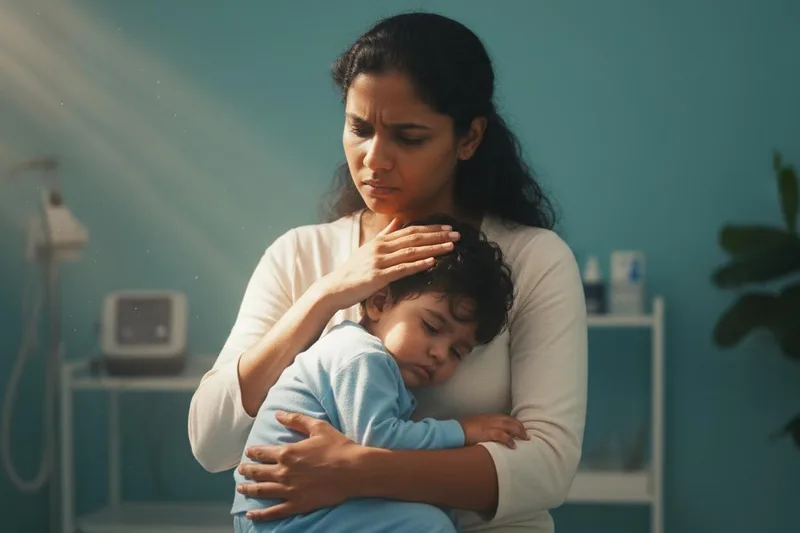
As a mother or father, one of the biggest worries for you is what to do when your little one suddenly gets sick, has a fever, a cold, or has a minor injury, and when to take him to the doctor. Isn't it? Sometimes you can't even imagine whether this is something you can take care of at home or if it's a situation that requires immediate hospitalization. Which doctor should you go to? Should you go to a big hospital? Or is there a doctor in your village? A million questions like these come to mind. Don't be afraid, don't panic. Today, let's talk about some of the most important things you need to be aware of at a time like this. Then you will be able to make the right decision without panicking.
When should you call an emergency ambulance service (like 1990)?
First, let's see what to do in a truly emergency, life-threatening situation. In such a situation, the best thing to do without delaying a single second is to call an emergency ambulance service like 1990 (in Sri Lanka). Do you know why? Because then, the ambulance with trained medical staff will come to the house or the child's place and provide the child with the basic treatment he needs until he is taken to the hospital. This not only saves valuable time, but also helps save the child's life. Think about how much safer it is to go to the hospital with medical facilities in an ambulance than to put the child in the car and run to the hospital.
In serious cases like these, you should definitely call an ambulance:
- If your child is not breathing or is having difficulty breathing and their face and lips appear blue .
- If you have fallen from a height, hit your head and become unconscious , or if you are not responding to calls.
- If you are having a seizure , that means you are suddenly showing symptoms such as body twitching and loss of consciousness.
- If you have a severe allergic reaction . For example, if you eat something, take a medicine, or get bitten by an insect, you suddenly develop hives all over your body and have difficulty breathing.
- If a bone, such as an arm or leg, is broken and the broken bone is protruding from the skin .
- If the child has taken too much of a certain type of medicine or pill, either knowingly or unknowingly, and is so sleepy that it is impossible to wake the child up, they appear to be in a state of unconsciousness .
- If something is stuck in your throat and you are struggling to breathe .
- If you can't stop bleeding from a large wound or cut.
At a time like this, it's wiser to call an ambulance rather than panicking and trying to do things alone.
When should you go to the Emergency Department (ER)?
An emergency department, or ``Emergency Department - ED'' in a large hospital, or ``ER'' as we all know it, ``Emergency Room'', is a place that is ready to treat very serious illnesses and accidents. You can get service there 24 hours a day, day or night. Even if it is not urgent enough to call an ambulance, as mentioned earlier, in more serious situations that require immediate medical attention, it is best to take your child to an ``ER''.
Take your child to the ER in these situations:
- If there is difficulty breathing (for example, if they are wheezing, if they say their chest feels tight, or if a small baby's chest seems to be making hollow sounds when they breathe).
- If the child is unusually sleepy or confused . That is, if the child seems to be lifeless and does not understand what is being said.
- If you have a fever along with a stiff neck (this can be a symptom of some dangerous diseases).
- If the heart beats rapidly without stopping, or if the child says that the chest is pounding too much.
- If the child has ingested (drank, eaten, or inhaled) a poison, unknown drug, chemical, or other unknown substance .
- If you have a severe head injury and continue to vomit or have altered consciousness.
- If the eye has suffered a serious injury (e.g., something hit the eye, stung, or a chemical splashed into the eye).
- If you have a serious burn (especially if it covers a large area or is deep).
When to Call Your Family Doctor?
Okay, now let's talk about common illnesses that children get every day. If your child has a common illness, or a non-urgent health problem, the best thing to do is to talk to your family doctor first, the doctor who sees your child regularly and is familiar with your child's health history and allergies. The doctor can then tell you what to do next, whether there is anything you can do at home, or if you need to come see him.
Talk to your doctor about these things:
- Fever : A mild fever can sometimes be reduced at home by giving a little paracetamol and wiping the body with a damp cloth. However, if the fever does not go down after two or three days, or if the child is very uncomfortable with the fever, or is not eating or drinking, you should definitely see a doctor.
- Earache : If a child complains of an earache, or if a small baby cries while rubbing their ear.
- Sore throat : If you have difficulty swallowing food, you have a sore throat.
- Stomach ache : Check to see if it's a normal stomach ache or a more severe one. If it persists, or if it's accompanied by vomiting, tell your doctor .
- Vomiting or diarrhea : If it continues, or if the child refuses to eat or drink, it is best to tell a doctor.
- A headache that won't stop .
- If there are signs of ``Possible Dehydration``, that is, the mouth is dry, the eyes appear sunken, the child seems lifeless, the amount of urine is reduced, and the urine is dark yellow.
- A skin rash .
- If you make a whistling sound when breathing (Wheezing) .
- A persistent cough , especially one that gets worse at night.
You know, when you get treatment from the same doctor who sees your child regularly and knows your child's health information well, we call it 'continuity of care' . That means that because the doctor knows everything about your child's previous illnesses, medications, and allergies, he or she can give the best treatment that suits your child. This relationship doesn't develop when you go to new doctors. Therefore, try to see your child's family doctor whenever possible.
In what situations can you go to an Urgent Care Center?
Imagine you can't get to your family doctor, their office is closed, or it's late at night or on the weekend. In such a case, if your child needs urgent care, but it's not serious enough to go to the ER, you can go to an Urgent Care Center. These are places we sometimes see in addition to 'channel centers' or attached to some pharmacies.
At these centers, you can get many of the same services as you would get from your family doctor. But remember, these are not places with the same facilities as an `ER`.
For example, things like taking X-rays, stitching up minor wounds, and splinting broken or sprained limbs are commonly done in these places.
Other things like this can also be taken care of at an ``Urgent Care Center``:
- Uncomplicated, simple fractures .
- Minor burns .
- Common cuts .
- Removing objects such as needles and glass splinters when they are stuck.
- Sprains and other minor sports-related injuries.
- Minor scratches and minor bites from animals (but if a dog bites you and causes a major injury, it's best to go to the ER).
- Fever .
- Stomach ache .
- Vomiting or diarrhea (unless dehydrated).
What is telehealth? Is it beneficial for us?
With the advancement of technology, another easy and convenient way to treat minor injuries and illnesses in children is 'Telehealth' or 'Telemedicine' . Simply put, it is a way for you to talk to a doctor from home, on your phone or computer, like a 'video call', and get advice by showing your child. Through a special app on your phone, you can talk to a doctor face to face, and the doctor can also see you and your child and ask questions.
In many cases, your family doctor or the hospital system where you are receiving treatment may provide these ``Telemedicine`` services. Check them out. This has many advantages. You don't have to go out with your child, you don't have to sit in traffic, and you don't have to go to crowded places and spread more diseases.
You can consider `(Telehealth)` for minor, non-emergency situations like these:
- Skin rashes ( you can show a photo to the doctor for advice).
- Minor cuts or burns .
- Eye disease , which means red eyes, like itching (Pinkeye / Conjunctivitis).
- Colds, flu-like illnesses, like a sore throat .
- Fever (but only after talking to your doctor and taking his advice, unless there are other serious symptoms).
- Mild allergic reactions .
- Vomiting (unless severe).
- Diarrhea (unless severe).
But remember, ``Telehealth`` is not a good option for every illness. If the doctor needs to check your child closely, or if the condition seems a bit serious, the doctor will ask you to bring your child to see him.
The most important thing to keep in mind!
Now you know when and where to seek medical advice for your child. But there is something more important than all of this.
That is, whether your child is treated in an emergency room (ETU) , an urgent care center, or through telemedicine, you should definitely see your family doctor, the doctor who sees your child regularly, within a few days, to explain what happened, and to show your child again .
This is called 'follow-up care' .
Why is that so important?
- This means that your family doctor will receive the latest information about your child's health status and details about the treatments received.
- Then he can continue further treatment if necessary, or see if the child's recovery is going well.
- Sometimes there are other things that need to be done after emergency treatment. Those things can only be done through your family doctor.
- This also confirms the previously mentioned 'continuity of care' .
So, I hope that by keeping these points in mind, you will have a clear understanding of exactly what to do when your child gets sick without panicking. Always remember, if you have the slightest doubt or fear about your child's illness, never hesitate to call a doctor and seek advice. Your child's health is the most valuable thing!
` Medical care for children, emergencies, pediatrics, family doctor, telehealth, emergency department, Urgent Care, children's health


💬 Comments (0)
No comments yet. Be the first to share your thoughts here.
Add Your Comment