

When you go for a walk in the woods, or play in the garden, sometimes you suddenly get itchy bumps and blisters on your body, right? Maybe you or your little one has had this experience. The cause of this could be a plant like `(Poison Ivy)`. Don't worry, this is not that big of a deal, but it is a little uncomfortable. Let's find out about this simply and precisely.
What is `(Poison Ivy)`?
Simply put, `(Poison Ivy)` is a type of plant. Not only this, there are other types called `(Poison Oak)` and `(Poison Sumac)`. All of these contain an oily, sticky substance called `(Urushiol)` (ອີ-ອົ-ກາ-ສົນ-ອາຍ). This is a colorless, odorless oil.
Now don't think that this `(Urushiol)` is a poison. No, it is not a poison. However, it acts as an `( allergen )`. That is, when many people get this oil on their body, their body reacts to it, just like some people get an `(allergy)` when they eat a spider or when they get dust. So, an `(allergic reaction`` occurs that causes itching and irritation in the body.
What symptoms occur when this is applied to the body?
The main symptoms of an allergy caused by ``Poison Ivy'' are:
- Itching: This is the most uncomfortable symptom.
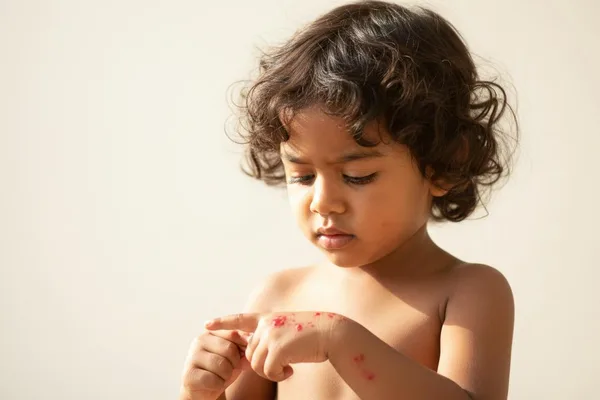
- Rash and blistering: It can appear as red, small blisters. Sometimes these blisters are filled with a watery fluid.
- Swelling: Sometimes the affected area may swell a little.
Imagine that your child, while running through a forest, gets a thorny leaf on their arm or leg. Then, that scar can continue to grow. It looks like someone has drawn a line .
These symptoms can start within a few hours of touching the plant, and sometimes as late as 5 days. Over a few days, the water-filled blisters will dry out, form a crust, and then fall off. However, it can take two to three weeks for all of this to fully heal.
What can be done at home for quick treatment? `(Home Treatment)`
If you think your child has been bitten by a plant like ``Poison Ivy,'' don't panic and do these things:
Things to do first:
1. Remove and wash your clothes: Carefully remove all the clothes you were wearing at the time and wash them thoroughly with soap. This is because the `(Urushiol)` oil may have been on your clothes as well.
2. Wash the skin and nails: Wash the baby's skin, especially the nail beds, thoroughly with soap and cool water. Do not use hot water , as this can push the oils deeper into the pores of the skin. The sooner you do this, the better.
3. Trim your nails: When your child gets itchy, they may scratch their skin without realizing it. This can cause damage to the skin from the nails, which can lead to bacteria entering and causing an infection. Therefore, keep your nails trimmed short.
4. Apply cool compresses: Applying cool compresses to the itchy areas can provide relief. Soak a clean cloth in cold water and apply it to the area for about 15-20 minutes. You can do this several times a day.
Bring relief from itching:
- Oatmeal bath: Putting a little colloidal oatmeal (or some ground oats) available from pharmacies into the bathwater and letting the child sit in the water for 15-20 minutes will greatly reduce the itching.
- Calamine lotion: You can buy this at pharmacies. Apply it to the itchy areas. But, do not apply it to the face or around the genital area.
Help to sleep well at night:
Sometimes the itching is worse at night and your child may not be able to sleep. In such cases, only if a doctor recommends it , you can give an over-the-counter antihistamine (such as Benadryl or a similar brand). This will reduce the itching for a while, make your child sleepy, and help him sleep soundly at night. However, you should definitely give the exact dose prescribed by the doctor . Ask your doctor or pharmacist for the appropriate dose for your child's age.
When do you need to see a doctor?
Most of the time, you can treat poison ivy with home remedies. However, you should definitely see a doctor in these cases:
- If the child has a fever along with the rash.
- If the skin looks ``infected``, it means:
- If the redness increases.
- If it feels warm to the touch.
- If the pain increases.
- If the swelling increases.
- If there is a pus-like fluid coming out.
- If the rash has spread over a large area of the body .
- If there are lesions on the face or genital areas .
- Even after home treatment, it seems to get worse after a few days .
Remember, if a young child is injured in any way, especially if accompanied by a fever, it is best to seek medical advice.
How do doctors treat this?
In cases where the allergy is more severe, such as when it is widespread or severe, doctors may prescribe a steroid cream or oral medication. Aren't these the same steroids that bodybuilders use? These steroids quickly reduce the itching, redness, and swelling.
If the doctor thinks the skin is infected, he or she may prescribe antibiotics to kill the bacteria.
Is this `(Poison Ivy)` contagious?
Here's a misconception that many people have. Poison Ivy is not directly transmitted from the blisters or sores that come with it. That is, the fluid in the blisters doesn't spread to someone else if it comes into contact with their skin.
But, the problem is the oil called ``Urushiol'' that I mentioned earlier.
- That oil can pass from one person to another through their skin or clothing.
- When children play, anything that has been touched by this oil (e.g. a toy, a ball) can rub off on their skin again.
- If your pet (dog, cat) comes home from a walk in the woods, this oil can be on its fur and come into the house. When you touch it, it can also come to you.
- Another dangerous thing is that if someone burns these `(Poison Ivy)` plants, that `(Urushiol)` oil gets into the air along with the smoke. Then, even if that smoke is inhaled or touched, an `(allergy)` can occur. Therefore, when clearing the forest, one should be very careful about burning such plants.
How do we protect our children from this?
Poison Ivy plants are not only found in the wild, but they can also grow in our gardens, on our property, and along roadsides. They can be difficult to identify because they are mixed in with other plants. There are different types, and their appearance changes depending on the time of year. So be aware of these things:
- Teach your children: If possible, teach your children to recognize the ``Poison Ivy'' plant (it often has leaves in groups of three). If not, at least teach them not to touch, pick, or put unfamiliar plants in their mouths .
- Protective clothing: If you are going to the forest or places with lots of bushes with your children, dress them in long pants, long-sleeved shirts, shoes, and socks .
- Keep it clean: After playing outside, especially in wooded areas, give your child a good bath. Wash any clothes that have been in the bed immediately.
- Also consider your pets: If your pet goes outside, they can also bring Urushiol oil into the house. So, if they come from a walk in the woods, it's a good idea to bathe them too.
- Be careful when cleaning up your garden: If you have these types of plants in your garden, use gloves when removing them. Never burn these plants.
Let's remember `(Take-Home Message)`
Well, I hope you now have a better understanding of `(Poison Ivy)`.
In short: Poison Ivy is an allergic reaction caused by an oil called Urushiol. It causes the skin to itch, itch, and blister.
- Quick action: If you suspect you have been exposed to the plant, immediately wash your skin with soap and water and change your clothes.
- Home treatments: You can use calamine lotion and oatmeal baths to relieve itching.
- Medical advice: If you have a fever, signs of infection, sores on the face/genital area, widespread sores, or severe itching, you should definitely see a doctor.
- Transmission: Not transmitted by bites, but can be transmitted by urushiol oil.
- Safety: Teach children not to touch unfamiliar plants and wear protective clothing.
Poison Ivy is nothing to be afraid of, but it's important to be aware. Acting quickly and seeing a doctor if necessary can help reduce the discomfort. Stay safe everyone!
` poison ivy, itchy skin, children's skin diseases, urushiol, allergies, skin diseases, home remedies




💬 Comments (0)
No comments yet. Be the first to share your thoughts here.
Add Your Comment