

Have you ever wondered how our upper and lower bodies are connected when we sit, walk, or run? Today we are going to talk about the most important part of our body, which bears the entire weight of our body, gives us stability, and acts like the foundation of a house. That is our pelvis, or as many people have heard in English, the Pelvis . When you know exactly about this, you will be even more amazed by your body.
Simply put, what is this pelvis?
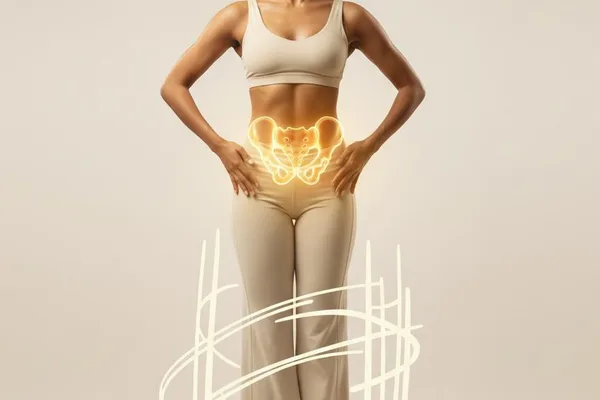
Imagine, at the bottom of your spine, a strong, basin-shaped frame of bones. That's what the pelvis is. It supports our torso and acts as a bridge connecting our legs. The pelvis is formed when all the bones in your hips, buttocks, and thighs come together.
Sometimes doctors use the word "pelvis" not just to refer to this bone frame. They also use the word to refer to the entire area around it, which means the entire area below your belly button and above your thighs. For example, if you have "pelvic pain," which is pain in your pelvic area, it could be a problem with the organs inside this bone frame. Many important organs, such as the urinary system, reproductive organs (such as the uterus and ovaries), and rectum, are protected inside this pelvic cavity. When a doctor does a "pelvic exam," he usually examines these organs.
What service does the pelvis provide to our body?
The pelvis is not just a bunch of bones. It performs many important functions for our body.
1. Weight-bearing and stability: The pelvis supports the entire weight of our upper body and distributes that weight evenly between our legs. This strong structure helps us stay stable while we stand, walk, and run.
2. Protection for organs: As I mentioned earlier, the pelvic cavity provides a safe home for many of the most sensitive and important organs, such as the uterus, bladder, and parts of the intestines. Just like the skull protects the head, the pelvis protects these organs.
3. Aiding movement: Our hip joints are located in the pelvis. Therefore, the function of the pelvis is essential for us to move our legs, bend forward, walk, and run.
4. Importance during childbirth: The pelvis, especially in women, is specially designed for childbirth. The birth canal is created through the pelvis. During pregnancy, the joints and ligaments of the pelvis relax and adjust to accommodate childbirth.
What bones make up the pelvis?
The pelvis is not a single bone. It is mainly made up of several types of bones that come together to form this complex structure. Although these bones are separate when we are young, they fuse together as we grow, especially as we get older.
| Name of the bone | A simple explanation |
|---|---|
| Sacrum | This is the lowest, triangular-shaped, slightly flattened bone in your spine. It is formed by the fusion of the last 5 vertebrae of your spine. If you place your hand between your buttocks, at the top, you will feel this bone. |
| Coccyx | This is what we call the tailbone. The small bone at the end of the spine, just below the sacrum. This is where it hurts when you hit your butt when you fall. |
| Hip Bone | This is actually a combination of three bones. There are two of these bones on each side. Those three bones are:
|
Is there a difference between the female and male pelvis?
Yes, there is clearly a big difference. These changes have come about to accommodate changes in the reproductive process. Simply put, the female pelvis has evolved to be easier to give birth to, and the male pelvis has evolved to be stronger to walk and run.
| Characteristics of the female pelvis (suitable for childbirth) | Characteristics of the male pelvis (suitable for walking and running) |
|---|---|
| Wider and shallower . The inlet is large and round to allow the baby to move easily. | Taller, narrower, and stronger . It gets narrower as you go from top to bottom. |
| The angle where the two pubic bones meet in front (pubic arch) is wide, like the letter 'U'. | The angle where the two pubic bones meet is narrow , like the letter 'V'. |
| The gap between the two ischial bones (sit bones) is too wide , which makes the outlet for the baby larger. | The gap between the two sit bones is small . |
| The sacrum is short and wide . It bends backward during childbirth to make room. | The sacrum is long, narrow, and straight . |
| The coccyx can be moved . It bends back to make room for the baby as it comes out. | The coccyx is bent inward and remains stable . |
Are there different types of pelvic shapes? Do these affect childbirth?
Yes, we usually talk about the shape of the pelvis by dividing it into four types. But it is impossible to put it into four exact boxes, most people's pelvises are a mixture of these types. This classification is mainly used when talking about childbirth.
- Gynecoid: This is the most common, classic "female" pelvic shape. It is round, wide, and shallow. It is considered the most suitable and easiest shape for childbirth.
- Android: This is typically similar to the "male" pelvic shape. It's heart-shaped, wide at the top and narrows toward the bottom. People with this type of pelvis may have a harder time delivering their baby during labor, but doctors can manage the condition.
- Anthropoid: This is an oval shape, longer from front to back and narrower from side to side. This shape also does not pose a problem for childbirth.
- Platypelloid: This is the least common shape. It is flat, wide on both sides, and shallow from front to back. It resembles a bean.
The most important thing: If you are a pregnant mother, don't worry about the shape of your pelvis. There are millions of mothers who have successfully given birth to healthy babies regardless of their shape. Childbirth is not just about the shape of your pelvis. It is also affected by many factors, such as the size of the baby, the position of the baby, and the strength of the uterine contractions. Your doctor will take all of this into account and provide you with the best advice and treatment.
What are the possible health problems associated with the pelvis?
Like other bones and joints in our body, the pelvis can be subject to various disorders and diseases.
- Pelvic fractures: This can be caused by a major impact, such as a fall from a height or a serious car accident. This is a serious condition.
- Arthritis: Arthritis can occur in the joints in the pelvis, especially the sacroiliac joints. This can cause pain in the lower back and buttocks.
- Coccydynia: This refers to pain in the coccyx, or tailbone. This pain can occur in people who sit on a hard surface for a long time, or after a fall.
- Pain during pregnancy: During pregnancy, hormones cause the pelvic joints to relax. This can cause pain while walking or changing positions. This is also called `(Symphysis Pubis Dysfunction)`.
- Cephalopelvic disproportion: This is a condition related to childbirth. The size of the baby's head is larger than the mother's pelvic opening, making normal childbirth difficult.
- Muscle and nerve problems: Conditions like ``Piriformis syndrome'' and ``Pudendal neuralgia'' can cause pain and numbness in the pelvic area and buttocks.
If you have persistent pain in your pelvic area, hips, buttocks, or lower back, be sure to see your doctor and talk about it. Don't ignore it.
Take-Home Message
- The pelvis is a strong skeletal frame that connects the upper and lower parts of our body and supports our weight. It is like the foundation of our body.
- This pelvic cavity protects many important organs, such as the uterus and bladder.
- The female pelvis is designed to be wide and shallow to facilitate childbirth, while the male pelvis is narrow and tall to facilitate vigorous movement.
- Although there are several types of pelvic shapes, a pregnant mother should not worry about it. Doctors will provide the necessary guidance for a successful delivery.
- It is very important to seek medical advice without delay for any unusual, prolonged pain in the pelvic area.




💬 Comments (0)
No comments yet. Be the first to share your thoughts here.
Add Your Comment