

Have you ever heard of a condition where a blood clot forms inside a vein in your leg or arm, causing it to turn blue, swell, and become painful? This is a serious condition, but it's not that common. Today we're going to talk about this condition called `Phlegmasia Cerulea Dolens` . Don't worry, it's important to be aware of it.
What is this `Phlegmasia Cerulea Dolens`?
Simply put, `Phlegmasia Cerulea Dolens` is a condition in which a large blood clot or multiple blood clots in the deep veins of our body, especially in the legs (and sometimes in the arms) (also known as `Deep Vein Thrombosis` or `DVT`), causes a complete blockage of the veins. Imagine a water pipe getting clogged with a large piece of dirt, causing the water to pool instead of flowing.
When a vein is blocked like this, blood doesn't flow properly through it. The blood can't flow down and back up. What happens then? Blood collects in that area, causing the leg to swell up. This swelling increases the pressure inside the vein, putting pressure on the arteries that carry oxygen. It's like a sponge that's too wet to absorb water. You can't put more water in it until you squeeze it out. That's what happens here. This also reduces the amount of oxygen that reaches the tissues.
The most important thing is that this is a medical emergency . If not diagnosed and treated quickly, the leg can be damaged and even life-threatening. Therefore, it is very important to be aware of these symptoms.
How common is this condition?
Actually, `Phlegmasia Cerulea Dolens` is a very rare condition . That is, it is something that is seen very rarely. Some doctors only see a patient like this once or twice in their entire career. Therefore, there are no big statistics about it.
What are the symptoms of `Phlegmasia Cerulea Dolens`?
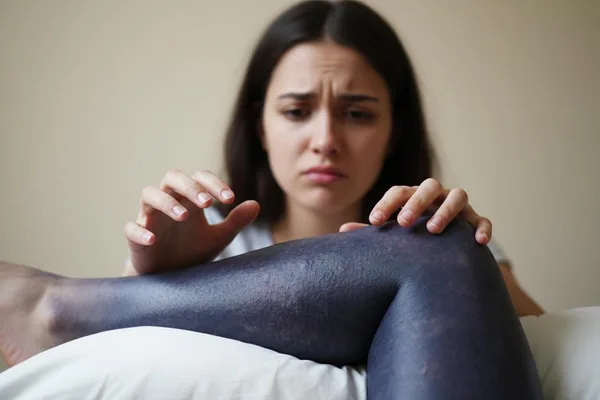
The name means "a painful blue swelling." That describes the symptoms. Look for any of these on your leg or arm:
- Skin discoloration: A red, bluish-purple color may appear. This color may spread to the entire leg.
- Severe pain: Not just ordinary pain, but severe pain that is difficult to bear.
- Swelling: A very swollen condition that feels hard to the touch.
- Skin blisters: Sometimes fluid-filled blisters (`blisters`) may appear.
- Numbness or tingling: It may feel like pricking or tingling.
It is also said that due to the structure of our body's circulatory system, this condition is more likely to occur in the left leg .
What are the causes of `Phlegmasia Cerulea Dolens`?
The main cause of this is a large blood clot (Venous Thromboembolism).This usually occurs as a complication of a `DVT` in the leg. That is, a blood clot forms in a vein, grows large, and blocks the entire venous system.
Who is most at risk for this?
The risk factors for developing `Phlegmasia Cerulea Dolens` are similar to the risk factors for blood clots in general. They are:
- Cancer: This is the main and most common risk factor.
- Surgery: After major surgery.
- Injury: Severe injuries, especially to the legs.
- Pregnancy: During pregnancy and after childbirth.
- Oral birth control pills or hormone therapy:
- Inflammatory Bowel Disease (IBD):
- Body Mass Index (BMI) greater than 30: This means obesity.
- Blood clotting disorders: Some people may be born with a tendency for their blood to clot easily.
- Venous insufficiency: The valves in the veins do not function properly.
- May-Thurner syndrome: A vein in the left leg is compressed by an artery.
- Heart failure:
- Being in one place for a long time/being confined to bed (`Inability to move around`): For example, if you have to stay in bed for several days after a major operation .
This condition is reported to occur most commonly in people between the ages of 40 and 50 .
What are the possible complications of `Phlegmasia Cerulea Dolens`?
This is a serious condition and complications can be severe.
About 50% of people with `Phlegmasia Cerulea Dolens` may develop a condition called `Gangrene`, which is the death of tissue . If gangrene develops, it can sometimes lead to amputation of the leg or arm.
Also, these people can develop a condition called `Pulmonary Embolism`, which is a blood clot that travels to the lungs . This is also very life-threatening.
How to recognize `Phlegmasia Cerulea Dolens`?
If you have these symptoms, a doctor will review your medical history and perform a physical exam. They may ask you questions like:
- "When did these symptoms start?"
- "What can't you do because of this?"
- "Have you been treated for blood vessel problems before?"
- "Does anyone in your family have problems with blood clotting?"
What kind of tests will be done?
To determine exactly whether you have `Phlegmasia Cerulea Dolens`, your doctor may perform the following tests:
- Ultrasound scan:Check for blood clots in the veins and how the blood is flowing.
- Blood tests: Check for signs of blood clotting, infection status, etc.
- `Computed Tomography Angiogram (CT Angiogram):` This can take detailed images of the veins.
- Magnetic Resonance Angiogram (MR Angiogram): This is another method of obtaining images of the veins.
How to treat `Phlegmasia Cerulea Dolens`?
This is an emergency, so treatment needs to begin immediately.
The doctor will first elevate your leg about 60 degrees above your heart . This helps blood drain from the veins in your leg, improves circulation, and reduces swelling. They may also give you fluids, wrap your entire leg in a compression bandage, and ask you to walk around a bit.
Often , along with medication, a medical procedure is also needed. If your leg is blistered or showing signs of gangrene, it means your leg is in serious danger. Doctors will try to remove the blood clot as quickly as possible and treat Phlegmasia Cerulea Dolens before gangrene sets in.
The main goals of treatment are:
- Removing blood clots.
- Opening the veins and restoring blood flow.
- Stop the situation from getting worse.
Specific medications and treatments
The following treatments can be used for `Phlegmasia Cerulea Dolens`:
- Anticoagulant medicines: For example, medicines like Heparin. These are medicines that are injected into veins.
- `Thrombolysis`: In this, a thin tube called a `catheter` is passed through a vein to the site of the blood clot, and a medication is administered through it to dissolve the blood clot.
- `Thrombectomy`: This involves removing the blood clot either through a small incision or through a larger surgery (`open procedure`).
- Angioplasty and/or stent placement: These are done to keep the artery open in people with May-Thurner syndrome.
Complications/side effects of treatment
Major surgery (`open surgery`) to remove a blood clot can cause complications such as:
- Increased chance of a blood clot forming again.
- Damage to a blood vessel.
Anticoagulants and thrombolysis treatments carry a risk of bleeding . Because thrombolysis can cause pulmonary embolism, doctors may sometimes recommend an inferior vena cava (IVC) filter to prevent it.
How soon will I feel better after treatment?
Some people may start to feel better within as little as an hour after starting anticoagulants. However, most people do not feel better until several hours after starting the medication. If the condition does not improve within 6-12 hours, the doctor may recommend a procedure in addition to medication.
With an operation to remove the blood clot, you may notice that things like swelling and discoloration in the leg will disappear quickly. You may feel the difference immediately after the operation .
Can `Phlegmasia Cerulea Dolens` be prevented?
Yes, to some extent it is possible. This condition can be prevented by either preventing DVT (deep vein thrombosis) or by treating DVT before it develops into Phlegmasia Cerulea Dolens.
What can I expect if I have `Phlegmasia Cerulea Dolens`?
`Phlegmasia Cerulea Dolens` is a condition that can cause you to lose a leg or even be life-threatening. That's why doctors act very quickly and start treatment to prevent your condition from getting worse. You may feel like they are rushing you to give you medicine or prepare you for an operation . The reason is, quick treatment is the best way to get the best results .
You will need to stay in the hospital for a few days. You may also have further scans (imaging tests) to make sure all the blood clots have gone.
Outlook for `Phlegmasia Cerulea Dolens`
The success rate of thrombolysis treatment is 85% to 95%.
However, if left untreated, Phlegmasia Cerulea Dolens can lead to gangrene. If gangrene develops, the risk of amputation is between 20% and 50% . With or without gangrene, the risk of this condition being fatal is between 20% and 40%.
If not treated properly, `Phlegmasia Cerulea Dolens` may recur.
Even with prompt treatment, many people who develop `Phlegmasia Cerulea Dolens` may develop problems with the valves in their veins and a condition called `Post-thrombotic syndrome` in the future.
How do I take care of myself?
After initial treatment, you will need to continue taking blood-thinning medications (anticoagulants) to prevent the condition from recurring. Depending on your condition, you may need to take these medications for several months or even longer.
When should I see the doctor?
Your doctor will need to check your blood regularly to make sure your blood clotting is at the right level. You will also need to have regular visits to see if any complications develop later.
When should I go to the Emergency Department (ETU) ?
If you have symptoms of `Phlegmasia Cerulea Dolens`, or if you have previously had symptoms and are now experiencing them again, seek medical advice immediately . Also, if you develop symptoms of another blood clot or symptoms of `Pulmonary Embolism`, you should go to the hospital immediately.
What questions should I ask my doctor?
You can ask your doctor questions like:
- "How long will I have to take these anticoagulants?"
- " How often do I need to come for follow-up?"
- "What could have caused my `DVT`?"
What is the difference between `Phlegmasia Alba Dolens` and `Cerulea Dolens`?
`Phlegmasia Alba Dolens` is also a complication caused by a blood clot. However, it does not stop the blood supply to your tissues. The word `alba` in the name means `white`. This means that the leg becomes pale. `Alba Dolens` can occur before `Phlegmasia Cerulea Dolens` develops.
`Phlegmasia Cerulea Dolens` is a more severe condition. It affects blood circulation. The blood supply to the tissues where the clot is located is cut off.
The most important thing we need to remember from this story!
Time is of the essence in the case of `Phlegmasia Cerulea Dolens`. If you or a loved one has these symptoms, do not hesitate to seek medical attention immediately. Prompt treatment is essential to save a leg, and possibly a life.
Sometimes you may feel nervous when doctors make hasty decisions and act quickly. But they are all doing it for your own good. If there is something you don't understand, don't be afraid to ask questions. Being informed is the best step to safety.
👩🏽⚕️ Additional questions (FAQs)
💬 What type of leg disease is Phlegmasia Cerulea Dolens?
This is a rare, life-threatening vascular emergency that can affect the leg. In this case, all the major blood vessels in the leg (Deep Veins) suddenly become severely blocked by blood clots (Massive DVT). Then, the blood flow to the leg stops and the leg begins to rot (Gangrene).
💬 What happens to the legs when this condition occurs? How do you recognize it?
The leg suddenly swells up (Acute) as if it has been hit by an electric shock. Since the blood does not circulate, the leg becomes cold as ice, and a 'dark blue/purple color' (Cyanosis / Cerulea) remains throughout the leg, like a corpse. At the same time, the patient experiences an unbearable pain (Dolens) as if the leg is exploding.
💬 If this disease occurs, what treatment should be done immediately?
You can't stay at home for even a minute, you have to go to the emergency room immediately! If you're even a few hours late, your leg will definitely need to be amputated. Once you get to the hospital, doctors will either insert a tube into the vein (catheter-directed thrombolysis) and inject medication directly into the blood clot, or they will try to save the leg by removing the clot through emergency surgery.
` Phlegmasia Cerulea Dolens, DVT, Blood Clot, Leg Swelling, Vein Blockage, Gangrene, Pulmonary Embolism




💬 Comments (0)
No comments yet. Be the first to share your thoughts here.
Add Your Comment