
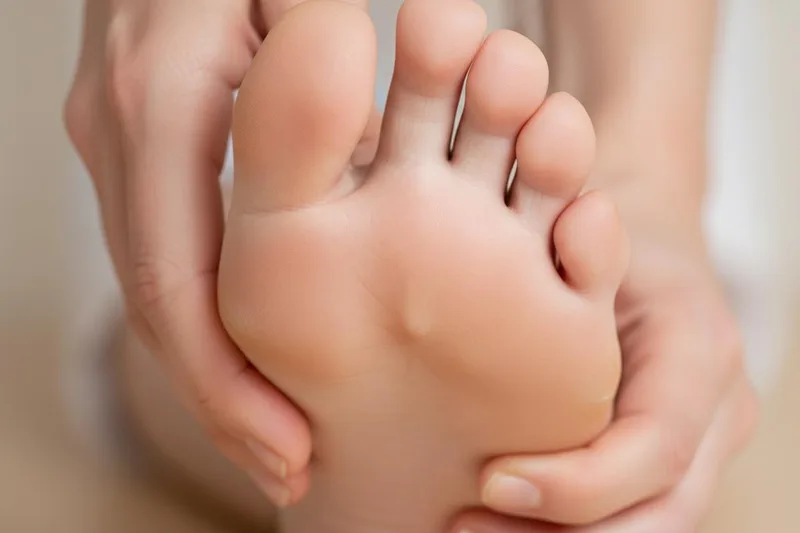
Have you ever felt something like a small lump on the bottom of your foot? Does it feel like a small pebble is stuck in your shoe? Or does your foot hurt when you walk? These are not symptoms to just ignore. Today we are going to talk about a condition that can be just as uncomfortable, but is not very well known.
What is this (Plantar Fibromatosis) or Lederhose disease?
Simply put, Plantar Fibromatosis , also known as Ledderhose disease by some, is a rare condition that affects the thick connective tissue layer on the bottom of our feet. This connective tissue layer is called the plantar fascia . To be precise, this is what protects and supports our soles. So, when this plantar fibromatosis occurs, small, hard nodules, about the size of a pea, form on the bottom of the foot, especially in the arch of the foot. These nodules can sometimes grow very quickly, up to 1 or 2 centimeters in size. Imagine how uncomfortable it is when you feel like you have a small pebble stuck in your shoe!
These lumps are not cancerous, meaning they are ``benign'', meaning they are not harmful. However, they can cause severe pain . This pain can increase when standing or walking. Sometimes, the quality of life can be reduced to the point where you cannot even do your daily activities. Therefore, if you have these symptoms, it is best to see a doctor as soon as possible. He or she can then examine your foot and tell you what treatment options are right for you.
What are the stages of this disease?
There are three main stages of plantar fibromatosis. Let's see what they are.
- The first phase (Proliferative phase): During this period, the number of cells called fibroblasts, which are a type of cell that makes connective tissue, increases. However, during this period, the protein called collagen is very low.
- The second phase `(Active phase)`: Here, the fibroblast cells continue to grow, and the amount of collagen also increases. Those lumps we mentioned begin to form during this phase.
- The third stage `(Residual phase)`: When we reach this stage, the activity of fibroblast cells decreases. But the growth of collagen is very rapid. Due to this, scar tissue is formed, which begins to tighten and `(contract)`.
What are the symptoms of plantar fibromatosis?
We've been told that Lederhosen disease causes a collection of bumps on the soles of your feet. This can be very uncomfortable, and sometimes makes it impossible to do daily activities. What other symptoms can this cause?
- Pain and swelling in the soles of the feet.
- Difficulty standing and walking.
- Sometimes the toes bend towards the sole of the foot , as if they are being hooked.
- Inability to straighten fingers.
Imagine how much trouble it would be if even walking was painful!
What are the reasons for this?
Researchers still don't know exactly what causes this disease, but they think several factors may contribute to it.
- Genetics: Sometimes it can be hereditary.
- Other health conditions: For example, it may be associated with conditions such as Dupuytren contracture (a condition in which the palms of the hands become stiff and the fingers become difficult to bend), Peyronie's disease (a condition of the male genitalia), and knuckle pads.
- Injuries or accidents to the soles of the feet: Sometimes this condition can also be caused by an injury to the soles of the feet.
Who is at higher risk of developing this disease?
This disease can develop at any age. However, it is more common in people between the ages of 30 and 50. It is also:
- For those of Northwestern European descent.
- Men develop it a little more than women.
- Smokers are also at higher risk.
In addition, people with certain chronic diseases are also more likely to develop plantar fibromatosis. For example:
- Alcohol use disorder.
- Diabetes.
- That Dupuytren contracture I mentioned earlier.
- Epilepsy.
- Frozen shoulder.
- Knuckle pads.
- Peyronie's disease.
How do doctors diagnose Ledarthrosis?
When you go to see a doctor, he or she will ask you some questions before examining your leg. What questions?
- Has anyone in your family had plantar fibromatosis before?
- Have you been previously diagnosed with a similar condition, such as Dupuytren's contracture?
- Do you have diabetes?
- Do you have epilepsy?
Then the doctor will examine your foot. He or she will look for the following:
- Check for swelling, bruising, lumps, wounds, or changes in the shape of the sole.
- Take note of any areas on the soles of the feet and heels that are painful or hurt when pressed.
- Your Achilles tendon and the muscles around it will also be examined.
- The range of motion of the foot is checked.
- You will be asked to walk a short distance and your feet and ankles will be monitored for movement.
Tests to diagnose the disease
The doctor may also perform some tests to accurately diagnose plantar fibromatosis.
- Ultrasound: This helps confirm what the doctor thinks after examining your symptoms and medical history.
- MRI (Magnetic Resonance Imaging): Sometimes, when the disease is more advanced, the lumps can go deep into the lining of the stomach. But that's very rare. An MRI can help determine how serious your condition is.
- Biopsy: This involves taking a small piece of tissue, cells, or fluid from the sole of your foot for testing. A biopsy can confirm that the lump is not cancerous.
How is plantar fibromatosis treated?
If this disease is detected early, there are several ways to treat it. Let's see what they are.
- Ice: Place an ice pack covered with a light towel on the sole of the foot for about 20 minutes, three to four times a day.
- Medications: You can buy over-the-counter pain relievers (NSAIDs - Nonsteroidal anti-inflammatory drugs) like aspirin, ibuprofen, and naproxen to reduce pain and swelling. However, it is best to consult a doctor.
- Orthotics: Shoe inserts or custom-made orthotics can help. You can cut small holes in the soles of these shoes to relieve pressure on the bumps.
- Massage: Gently massage the soles of your feet. But don't touch the bumps, as doing so may increase the pain.
- Physical therapy: Work with a physical therapist to do exercises that stretch and strengthen the connective tissues in the lower back.
Remember, if the pain does not subside after a few months with these simple treatments, you should definitely see a doctor again.
If that doesn't relieve the pain, a doctor may suggest other treatments, such as:
- Intralesional steroids .
- A medicine called Verapamil (this is sometimes given as an ointment).
- Radiation therapy .
- Extracorporeal shock wave therapy (ESWT) .
- The drug is called Tamoxifen .
- The drug is called Sorafenib .
- Collagenase injection .
- Finally, surgery is performed to remove the lumps.
When should I see a doctor?
If you experience any of these symptoms, definitely make an appointment to see a doctor:
- If you see lumps or bumps in the middle of the sole.
- If it is difficult to stand or walk.
- If there is persistent pain in the soles of the feet.
- If it is difficult to straighten your toes.
Here are some questions you can ask your doctor:
- What activities should I avoid and for how long?
- What can I do to control my pain?
- What treatments do you recommend?
What can I expect if I have plantar fibromatosis?
Lederhosen can cause painful bumps on the soles of the feet, and if left untreated, the condition can get worse. The good news is that this condition does not spread to other parts of the body, and it is not a life-threatening condition. However, you should definitely see a doctor to make sure it is not something more serious and to get the right treatment.
Although plantar fibromatosis is a rare disease, living with it can be very painful and distressing. As the disease progresses, you may find it difficult to not only walk without pain, but also to stand. Fortunately, the growths that develop in this disease are not cancerous. However, they can have a negative impact on your life. If you have these symptoms, don't hesitate to talk to a doctor. If you recognize them early, they can be controlled with simple treatments. If the disease is severe, your doctor may refer you to a foot and ankle specialist.
Finally, things to remember
Okay, so now you have a good understanding of the plantar fibromatosis, or Lederhoz disease, that we talked about today. The most important thing is that if you feel an unusual lump on the sole of your foot, pain, or difficulty walking, do not just ignore it and seek medical advice. If you recognize it early, it is easier to treat. There is nothing to worry about, this is not cancer. But you don't want to live with pain, right? So take care of your body, and if you notice any changes, take action immediately.
` Plantar fibromatosis, Ledderhose disease, foot pain, foot lumps, foot diseases, connective tissue, soles, plantar fibromatosis, Ledderhose disease


💬 Comments (0)
No comments yet. Be the first to share your thoughts here.
Add Your Comment