
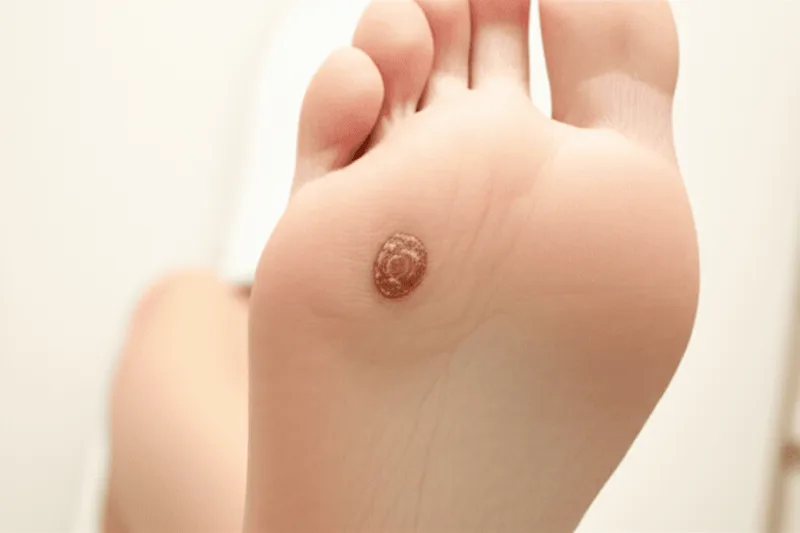
Do you have them on the soles of your feet? Let's learn about Plantar Warts A to Z!

Do you have them on the soles of your feet? Let's learn about Plantar Warts A to Z!

Have you ever noticed that you have a small, rough bump on the bottom of your foot, maybe between your toes or on your heel? Does it hurt a little when you walk? That's what we call plantar warts . Some people also call them 'plantar warts '. Don't worry, these are not dangerous like cancer. But they can be a little annoying. Let's talk about this in detail today, okay?

What are these plantar warts?

Simply put, plantar warts are harmless (i.e., not cancerous) rough bumps that develop on the surface of the skin on the soles of your feet. They are caused by a virus called the Human Papillomavirus ( HPV ) that enters your skin through a small cut or scratch, causing an infection. It's like the virus entering through a small wound.

Who is more likely to develop plantar warts?

Actually, anyone can develop these. But some people are more likely to develop them. See if you fall into this category:

  • If you are a child or a young person .
  • If you have a weakened immune system . That means your body's defense system that fights disease is a little weak.
  • If you have an autoimmune disease ( a condition in which the body's immune system attacks its own cells).
  • If you are over 65 years old .
  • Some studies have shown that white people are more likely to develop these (but it is also common in our country).

How common are plantar warts?

These are actually very common. Just think, roughly one in every 10 people has these plantar warts. This is even more common among children and young adults. Between 10% and 20% of them can develop these warts.

What effect can these warts have on your body?

Plantar warts can be painful at times. This pain can make you change the way you stand, walk, or even run. Think of it like limping when you feel something pinching the bottom of your foot. When you change your natural posture over time, it can cause pain, discomfort, or strain in the muscles, tissues, or joints of your feet and ankles .

Not only that, these warts can also affect your mental health . Some people with these warts may be reluctant to walk barefoot or wear certain types of shoes, fearing that others will notice them. This can lead to stress , anxiety, or even depression .

What are the symptoms of plantar warts?

There are several symptoms of plantar warts. Check to see if you have any of these:

  • They look like other warts, but they can be deep in the skin . Like an iceberg floating in the sea, there's more underneath than meets the eye.
  • It may have a rough, thickened surface . Sometimes it can look like the surface of a cabbage flower .
  • The color can vary . It can be dark pink, yellow, brown, purple, or gray.
  • There may be small brown or black dots (called wart seeds) on the surface. These are actually dried blood clots.
  • You may feel pain or aching when you press on it .
  • You may feel discomfort , especially when walking.
  • Sometimes there may be bleeding .

Plantar warts usually develop on:

  • On, around, or between your toes .
  • On the front of your soles (forefeet).
  • On your heels .

Sometimes, many plantar warts can grow together into a large cluster . This is called a mosaic wart .

Are these plantar warts contagious?

Yes, plantar warts are contagious . They are spread through direct contact with the HPV virus . This means that they can be spread from the skin of someone with warts to the skin of someone else, or by sharing items such as shoes, socks, or towels. If you have a plantar wart, if you touch it, you can spread it to other parts of your body.

HPV can also spread through infected surfaces , especially if those surfaces are warm or moist . That's why it's a good idea to wear flip-flops or shoes in public places like the gym, public swimming pools, saunas, and steam rooms .

How are these plantar warts identified?

A doctor can usually tell if a bump on the bottom of your foot is a plantar wart by examining it. Most of the time, they can tell right away.

However, in some cases, the doctor may need to take a small piece of skin and do a biopsy . In that case, a small piece of the lump is taken and sent to a lab. There, other doctors test it to see if it is HPV. You will get the results of that test in a few days.

How do you remove a plantar wart?

Most of the time, plantar warts will go away on their own within a year or two . This is because your body's immune system fights off the virus and defeats it. However, because these warts can spread, cause pain, and make you uncomfortable , your doctor may recommend treatment. Let's take a look at the available treatments:

1. Cryotherapy

In this, the doctor uses extreme cold to freeze the tissue. A substance such as liquid nitrogen or argon gas is used to create this extreme cold. Although it feels a bit like a burn, this is an effective method.

2. Immunotherapy

Immunotherapy is a treatment that helps your immune system fight the HPV virus. In this treatment, a topical chemical called Diphencyprone (DCP) is applied to the wart. This DCP causes a mild allergic reaction that causes the wart to go away on its own.

3. Laser treatment

In this, the doctor uses laser light to heat and destroy the tiny blood vessels inside the tumor. The tumor then loses its blood supply and dies.

4. Electrocautery

In a method called electrocautery , the doctor uses an electric current to burn and remove your warts.

5. Topical medicine

In this, the doctor applies a liquid medicine containing a chemical called cantharidin to the wart. This causes a blister to form under the wart. This blister cuts off the blood supply to the wart. After about a week, the doctor removes the dead wart.

6. Surgical removal (Surgery)

In this procedure, the doctor numbs the area with a local anesthetic . Then, using a sharp scalpel , he cuts around the wart and removes it with a small spoon-like instrument (curette) , or pulls it out with forceps.

Are there any home remedies?

Yes, there are some home remedies for plantar warts. However, it is wise to seek medical advice before doing these, as sometimes, if not done properly, they can cause injury or increase the risk of infection.

  • Duct tape: Duct tape is a common method of removing warts. After a few weeks, you can use an exfoliating tool or tweezers to remove the wart. This may seem like a strange method, but it works for some people.
  • Salicylic acid: Salicylic acid is a substance that dissolves and removes thick layers of skin. A solution with a high concentration of salicylic acid (20% to 40%) is most effective. These are available at pharmacies. After a few weeks of use, you should be able to remove the wart by scraping or pulling it off.
  • Apple cider vinegar: Apple cider vinegar contains acetic acid, which is antibacterial. It also contains malic acid , which is an alpha hydroxyl acid . It naturally exfoliates the skin. Apply a cotton ball soaked in apple cider vinegar to the wart twice a day. After a few weeks, you should be able to scrape or pull it off. However, it can sting a little, so be careful.

How to manage the symptoms of warts?

Plantar warts can be uncomfortable and painful. They can affect the way you stand and walk. You may find relief by using shoe inserts or plantar wart patches . To prevent direct pressure on the wart, you can cut a hole in your shoe inserts where the wart is. Or you can apply donut-shaped pads over the wart .

It's also a good idea to wear comfortable socks and shoes . Avoid shoes that put too much pressure on your plantar warts, such as high heels, pointed-toe shoes, or flip-flops.

With your doctor's approval, you can take nonsteroidal anti-inflammatory medications (NSAIDs) such as aspirin, ibuprofen (Advil®), and naproxen (Aleve®) . These can help reduce pain and swelling. However, not everyone can take NSAIDs, so it's best to ask your doctor before using them.

What can you expect if you have plantar warts?

The outlook for people with plantar warts is good. Some over-the-counter treatments can clear up plantar warts in as little as two weeks . Even without treatment, your immune system will usually fight off the HPV infection and clear it up within a year or two .

However, once you have been infected with HPV, there is no surefire way to prevent plantar warts from coming back . Even after treatment, plantar warts can return in the same place they were, or they can grow back in a different place on the sole of the foot. Some people never get plantar warts again after they are cured.

How to reduce the risk of developing plantar warts?

There are several ways to reduce the risk of developing plantar warts. If you keep these in mind, you can largely avoid this problem:

  • Avoid touching your own or someone else's plantar warts.
  • If you touch a plantar wart, wash your hands thoroughly with hot water and antibacterial soap.
  • Clean your feet, toes, and between your toes thoroughly when bathing.
  • Dry your feet, toes, and between your toes thoroughly after swimming or bathing.
  • Do not share personal items such as towels, washcloths, shoes, socks, and nail clippers with others.
  • Wear clean socks made of cotton or wool to absorb moisture , or socks made of synthetic materials that quickly wick away moisture.
  • Clean your shoes with disinfecting sprays or wipes.
  • Wear sandals or flip-flops in public locker rooms, swimming pools, saunas, steam rooms, or public bathrooms.
  • Either throw away or thoroughly clean any emery boards, pumice stones, or exfoliating tools you use to scrape away dead skin from your plantar warts.
  • Get the HPV vaccine (this protects against some types of HPV, you can ask your doctor about it).

When should I see a doctor?

See a doctor if your plantar wart looks like this:

  • If there is frequent bleeding or cracking, then the risk of developing an infection or spreading the virus is higher.
  • If you scratch.
  • If it looks infected (changed color, has pus , hurts when pressed).
  • If standing or walking is difficult or painful.
  • If the color changes.
  • If it gets bigger or spreads.
  • If it makes you feel embarrassed or stressed.
  • If you have a disease like diabetes mellitus or are taking medications that suppress your immune system , it's a good idea to show your doctor even if it's just a small thing.

What questions should you ask the doctor?

When you see the doctor, you can ask questions like these:

  • "Doctor, how exactly can you tell if this is a plantar wart?"
  • "If this isn't a plantar wart, what other skin condition could I have?"
  • "How can I prevent these plantar warts from spreading to other parts of my body?"
  • "How can I prevent this from spreading to others?"
  • “What steps can I take to prevent further plantar warts from forming?”
  • "What is the best treatment for my condition?"
  • “Are there any medications or treatments I should avoid?”
  • "Do I need to have this tumor surgically removed?"
  • "Should I see a podiatrist ?"

What is the difference between a plantar wart and a corn?

Some people get confused because both of these can occur on the soles of the feet. Let's see what the difference is.

Plantar warts are rough bumps that develop on the soles of your feet. They are caused by the HPV virus. They are contagious.

A corn is a small, round, hard, thickened area of ​​the skin. Corns can appear on the feet, hands, and fingers. Corns are caused by repeated rubbing, rubbing, and pressure on the same area of ​​the skin. They are not contagious. A corn usually has a hard core in the middle, which is what often hurts. Corns do not have the black dots that warts do.

What is the difference between a common wart and a plantar wart?

Common warts , sometimes called palmar warts , are most common on your hands and fingers. These are the most common type of warts.

Plantar warts form on the soles of your feet.

Both are caused by the HPV virus, but the type of virus can be slightly different. Because plantar warts form on the bottom of the foot, they can sometimes appear inward and flat due to the pressure of walking. Other warts are usually slightly raised.

Are Plantar Warts a Sexually Transmitted Disease (STD)?

No, plantar warts are not a sexually transmitted infection (STI or STD). The HPV virus causes warts, but there are over 100 types of HPV.

Plantar warts are caused by HPV types 1, 2, 3, 4, 27, and 57. These HPV types are not sexually transmitted through skin-to-skin contact. Therefore, they are not classified as sexually transmitted diseases.

HPV types 6 and 11 cause most genital warts . These HPV types are spread through skin-to-skin contact, so they are considered sexually transmitted diseases (STDs). So, there are two types of viruses that cause genital warts and anal warts. Got it?

Final Take-Home Message

Although plantar warts are common, they can sometimes be embarrassing and uncomfortable. They can also be painful depending on where they are on the sole of the foot. Over time, your body's immune system can fight off the virus that causes these warts and heal them. However, plantar warts respond well to treatment.

If you have plantar warts, be careful when touching them. This will help prevent them from spreading to other parts of your body or to others.

If your plantar warts are spreading, painful, or causing you distress, see a doctor. Your doctor can recommend the best home remedies or in-clinic treatments. Don't worry, these are treatable conditions!


⚠️ Important: The medical articles and information on Nirogi Lanka are for general awareness only, and are by no means a substitute for professional medical advice, diagnosis, or treatment. For any medical problem you have, consult a qualified physician immediately.

💬 Comments (0)

No comments yet. Be the first to share your thoughts here.

Add Your Comment

Please calculate: 8 + 4 =
Do you have them on the soles of your feet? Let's learn about Plantar Warts A to Z!

Do you have them on the soles of your feet? Let's learn about Plantar Warts A to Z!

Have you ever noticed that you have a small, rough bump on the bottom of your foot, maybe between your toes or on your heel? Does it hurt a little when you walk? That's what we call plantar warts . Some people also call them 'plantar warts '. Don't worry, these are not dangerous like cancer. But they can be a little annoying. Let's talk about this in detail today, okay?

What are these plantar warts?

Simply put, plantar warts are harmless (i.e., not cancerous) rough bumps that develop on the surface of the skin on the soles of your feet. They are caused by a virus called the Human Papillomavirus ( HPV ) that enters your skin through a small cut or scratch, causing an infection. It's like the virus entering through a small wound.

Who is more likely to develop plantar warts?

Actually, anyone can develop these. But some people are more likely to develop them. See if you fall into this category:

  • If you are a child or a young person .
  • If you have a weakened immune system . That means your body's defense system that fights disease is a little weak.
  • If you have an autoimmune disease ( a condition in which the body's immune system attacks its own cells).
  • If you are over 65 years old .
  • Some studies have shown that white people are more likely to develop these (but it is also common in our country).

How common are plantar warts?

These are actually very common. Just think, roughly one in every 10 people has these plantar warts. This is even more common among children and young adults. Between 10% and 20% of them can develop these warts.

What effect can these warts have on your body?

Plantar warts can be painful at times. This pain can make you change the way you stand, walk, or even run. Think of it like limping when you feel something pinching the bottom of your foot. When you change your natural posture over time, it can cause pain, discomfort, or strain in the muscles, tissues, or joints of your feet and ankles .

Not only that, these warts can also affect your mental health . Some people with these warts may be reluctant to walk barefoot or wear certain types of shoes, fearing that others will notice them. This can lead to stress , anxiety, or even depression .

What are the symptoms of plantar warts?

There are several symptoms of plantar warts. Check to see if you have any of these:

  • They look like other warts, but they can be deep in the skin . Like an iceberg floating in the sea, there's more underneath than meets the eye.
  • It may have a rough, thickened surface . Sometimes it can look like the surface of a cabbage flower .
  • The color can vary . It can be dark pink, yellow, brown, purple, or gray.
  • There may be small brown or black dots (called wart seeds) on the surface. These are actually dried blood clots.
  • You may feel pain or aching when you press on it .
  • You may feel discomfort , especially when walking.
  • Sometimes there may be bleeding .

Plantar warts usually develop on:

  • On, around, or between your toes .
  • On the front of your soles (forefeet).
  • On your heels .

Sometimes, many plantar warts can grow together into a large cluster . This is called a mosaic wart .

Are these plantar warts contagious?

Yes, plantar warts are contagious . They are spread through direct contact with the HPV virus . This means that they can be spread from the skin of someone with warts to the skin of someone else, or by sharing items such as shoes, socks, or towels. If you have a plantar wart, if you touch it, you can spread it to other parts of your body.

HPV can also spread through infected surfaces , especially if those surfaces are warm or moist . That's why it's a good idea to wear flip-flops or shoes in public places like the gym, public swimming pools, saunas, and steam rooms .

How are these plantar warts identified?

A doctor can usually tell if a bump on the bottom of your foot is a plantar wart by examining it. Most of the time, they can tell right away.

However, in some cases, the doctor may need to take a small piece of skin and do a biopsy . In that case, a small piece of the lump is taken and sent to a lab. There, other doctors test it to see if it is HPV. You will get the results of that test in a few days.

How do you remove a plantar wart?

Most of the time, plantar warts will go away on their own within a year or two . This is because your body's immune system fights off the virus and defeats it. However, because these warts can spread, cause pain, and make you uncomfortable , your doctor may recommend treatment. Let's take a look at the available treatments:

1. Cryotherapy

In this, the doctor uses extreme cold to freeze the tissue. A substance such as liquid nitrogen or argon gas is used to create this extreme cold. Although it feels a bit like a burn, this is an effective method.

2. Immunotherapy

Immunotherapy is a treatment that helps your immune system fight the HPV virus. In this treatment, a topical chemical called Diphencyprone (DCP) is applied to the wart. This DCP causes a mild allergic reaction that causes the wart to go away on its own.

3. Laser treatment

In this, the doctor uses laser light to heat and destroy the tiny blood vessels inside the tumor. The tumor then loses its blood supply and dies.

4. Electrocautery

In a method called electrocautery , the doctor uses an electric current to burn and remove your warts.

5. Topical medicine

In this, the doctor applies a liquid medicine containing a chemical called cantharidin to the wart. This causes a blister to form under the wart. This blister cuts off the blood supply to the wart. After about a week, the doctor removes the dead wart.

6. Surgical removal (Surgery)

In this procedure, the doctor numbs the area with a local anesthetic . Then, using a sharp scalpel , he cuts around the wart and removes it with a small spoon-like instrument (curette) , or pulls it out with forceps.

Are there any home remedies?

Yes, there are some home remedies for plantar warts. However, it is wise to seek medical advice before doing these, as sometimes, if not done properly, they can cause injury or increase the risk of infection.

  • Duct tape: Duct tape is a common method of removing warts. After a few weeks, you can use an exfoliating tool or tweezers to remove the wart. This may seem like a strange method, but it works for some people.
  • Salicylic acid: Salicylic acid is a substance that dissolves and removes thick layers of skin. A solution with a high concentration of salicylic acid (20% to 40%) is most effective. These are available at pharmacies. After a few weeks of use, you should be able to remove the wart by scraping or pulling it off.
  • Apple cider vinegar: Apple cider vinegar contains acetic acid, which is antibacterial. It also contains malic acid , which is an alpha hydroxyl acid . It naturally exfoliates the skin. Apply a cotton ball soaked in apple cider vinegar to the wart twice a day. After a few weeks, you should be able to scrape or pull it off. However, it can sting a little, so be careful.

How to manage the symptoms of warts?

Plantar warts can be uncomfortable and painful. They can affect the way you stand and walk. You may find relief by using shoe inserts or plantar wart patches . To prevent direct pressure on the wart, you can cut a hole in your shoe inserts where the wart is. Or you can apply donut-shaped pads over the wart .

It's also a good idea to wear comfortable socks and shoes . Avoid shoes that put too much pressure on your plantar warts, such as high heels, pointed-toe shoes, or flip-flops.

With your doctor's approval, you can take nonsteroidal anti-inflammatory medications (NSAIDs) such as aspirin, ibuprofen (Advil®), and naproxen (Aleve®) . These can help reduce pain and swelling. However, not everyone can take NSAIDs, so it's best to ask your doctor before using them.

What can you expect if you have plantar warts?

The outlook for people with plantar warts is good. Some over-the-counter treatments can clear up plantar warts in as little as two weeks . Even without treatment, your immune system will usually fight off the HPV infection and clear it up within a year or two .

However, once you have been infected with HPV, there is no surefire way to prevent plantar warts from coming back . Even after treatment, plantar warts can return in the same place they were, or they can grow back in a different place on the sole of the foot. Some people never get plantar warts again after they are cured.

How to reduce the risk of developing plantar warts?

There are several ways to reduce the risk of developing plantar warts. If you keep these in mind, you can largely avoid this problem:

  • Avoid touching your own or someone else's plantar warts.
  • If you touch a plantar wart, wash your hands thoroughly with hot water and antibacterial soap.
  • Clean your feet, toes, and between your toes thoroughly when bathing.
  • Dry your feet, toes, and between your toes thoroughly after swimming or bathing.
  • Do not share personal items such as towels, washcloths, shoes, socks, and nail clippers with others.
  • Wear clean socks made of cotton or wool to absorb moisture , or socks made of synthetic materials that quickly wick away moisture.
  • Clean your shoes with disinfecting sprays or wipes.
  • Wear sandals or flip-flops in public locker rooms, swimming pools, saunas, steam rooms, or public bathrooms.
  • Either throw away or thoroughly clean any emery boards, pumice stones, or exfoliating tools you use to scrape away dead skin from your plantar warts.
  • Get the HPV vaccine (this protects against some types of HPV, you can ask your doctor about it).

When should I see a doctor?

See a doctor if your plantar wart looks like this:

  • If there is frequent bleeding or cracking, then the risk of developing an infection or spreading the virus is higher.
  • If you scratch.
  • If it looks infected (changed color, has pus , hurts when pressed).
  • If standing or walking is difficult or painful.
  • If the color changes.
  • If it gets bigger or spreads.
  • If it makes you feel embarrassed or stressed.
  • If you have a disease like diabetes mellitus or are taking medications that suppress your immune system , it's a good idea to show your doctor even if it's just a small thing.

What questions should you ask the doctor?

When you see the doctor, you can ask questions like these:

  • "Doctor, how exactly can you tell if this is a plantar wart?"
  • "If this isn't a plantar wart, what other skin condition could I have?"
  • "How can I prevent these plantar warts from spreading to other parts of my body?"
  • "How can I prevent this from spreading to others?"
  • “What steps can I take to prevent further plantar warts from forming?”
  • "What is the best treatment for my condition?"
  • “Are there any medications or treatments I should avoid?”
  • "Do I need to have this tumor surgically removed?"
  • "Should I see a podiatrist ?"

What is the difference between a plantar wart and a corn?

Some people get confused because both of these can occur on the soles of the feet. Let's see what the difference is.

Plantar warts are rough bumps that develop on the soles of your feet. They are caused by the HPV virus. They are contagious.

A corn is a small, round, hard, thickened area of ​​the skin. Corns can appear on the feet, hands, and fingers. Corns are caused by repeated rubbing, rubbing, and pressure on the same area of ​​the skin. They are not contagious. A corn usually has a hard core in the middle, which is what often hurts. Corns do not have the black dots that warts do.

What is the difference between a common wart and a plantar wart?

Common warts , sometimes called palmar warts , are most common on your hands and fingers. These are the most common type of warts.

Plantar warts form on the soles of your feet.

Both are caused by the HPV virus, but the type of virus can be slightly different. Because plantar warts form on the bottom of the foot, they can sometimes appear inward and flat due to the pressure of walking. Other warts are usually slightly raised.

Are Plantar Warts a Sexually Transmitted Disease (STD)?

No, plantar warts are not a sexually transmitted infection (STI or STD). The HPV virus causes warts, but there are over 100 types of HPV.

Plantar warts are caused by HPV types 1, 2, 3, 4, 27, and 57. These HPV types are not sexually transmitted through skin-to-skin contact. Therefore, they are not classified as sexually transmitted diseases.

HPV types 6 and 11 cause most genital warts . These HPV types are spread through skin-to-skin contact, so they are considered sexually transmitted diseases (STDs). So, there are two types of viruses that cause genital warts and anal warts. Got it?

Final Take-Home Message

Although plantar warts are common, they can sometimes be embarrassing and uncomfortable. They can also be painful depending on where they are on the sole of the foot. Over time, your body's immune system can fight off the virus that causes these warts and heal them. However, plantar warts respond well to treatment.

If you have plantar warts, be careful when touching them. This will help prevent them from spreading to other parts of your body or to others.

If your plantar warts are spreading, painful, or causing you distress, see a doctor. Your doctor can recommend the best home remedies or in-clinic treatments. Don't worry, these are treatable conditions!

⚠️ Important: The medical articles and information on Nirogi Lanka are for general awareness only, and are by no means a substitute for professional medical advice, diagnosis, or treatment. For any medical problem you have, consult a qualified physician immediately.

💬 Comments (0)

No comments yet. Be the first to share your thoughts here.

Add Your Comment

Please calculate: 8 + 4 =