

Have you ever heard the words 'Polyclonal Antibodies'? Maybe you heard a doctor say it, or you read it in a book or newspaper somewhere. Although this may seem like a bit of a scientific and difficult word to understand, it is actually something very, very important for our body's health and to protect us from diseases. So today we will talk about what these polyclonal antibodies are, how they work inside our body, how they are useful for us, and what are their advantages and disadvantages, simply, as if we were telling a good friend or family member. Ready?
Simply put, what are these polyclonal antibodies?
Okay, first let's clearly understand what these Polyclonal Antibodies are. Do you remember, when our body gets sick, that is, when something like a germ enters, we have special parts in our body that fight against it. That's what we call antibodies. These are like little guards, or soldiers, in our body. These proteins called antibodies are made by our body specifically to fight diseases and germs and protect us.
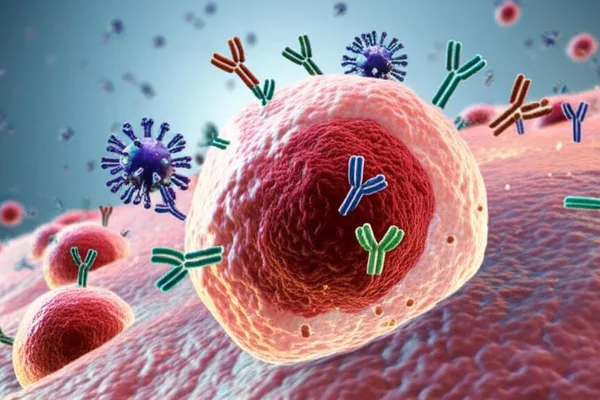
Now these antibodies come from a specific type of cell called `(Plasma B cells)`. The word ``polyclonal'' means ``from many different types'' (poly = many, clonal = lineages/types). That is, these polyclonal antibodies are not the same type, they are not from the same mold. They are a collection of antibodies that come from different plasma B cell lineages (`lineages`), and that are slightly different from each other. Think of it like a group of soldiers from different regiments of the same army.
Then each of these antibodies, or different soldiers, recognizes different parts of the same antigen. Now you ask, "What is an antigen?" Think of it as a little 'label' or 'flag' on a germ, pollen, or other unfamiliar protein that enters our body. By looking at this label, our immune system, our body's defense system, recognizes whether it is our own (`self`) or a foreign enemy (`non-self`). It's like the uniform of an enemy, or the flag of an enemy army.
So, these polyclonal antibodies are different soldiers (antibodies) that can recognize different emblems, different shapes (we scientifically call these `epitopes` ) on the uniform or flag of the same enemy (antigen). Do you understand? It's like a team of skilled soldiers who can attack the same enemy from different directions.
When humans and other animals get sick, that is, when they get an infection, these polyclonal antibodies are naturally produced in their bodies. However, polyclonal antibodies used in medical research and some treatments are often obtained from mammals such as rabbits, sheep, and goats. Sometimes, they are also obtained from the blood of people who have recovered from certain diseases.
How do these polyclonal antibodies actually work?
Now let's see how these polyclonal antibodies work in our body, how they fight. When you get a virus, bacteria, or other germ (pathogen) into your body, your immune system makes antibodies to fight them.
These germs have the antigens we talked about earlier on their surface. Antibodies (our soldiers) recognize these antigens and bind to them. Each antibody binds to only one specific antigen. In other words, each key fits only one specific lock. When an antibody binds to an antigen, it sends a signal to the rest of the immune system, saying, "Here's an enemy, now destroy it."
But, even for a single antigen, there can be several places where the antibody can bind, like the keyhole of a tortoise. We call these specific binding sites ``epitopes''. So the polyclonal antibodies in your blood, or in the concentrated solutions (serums) given for medical treatment, are a collection of different antibodies. Each of these antibodies can recognize and bind to different ``epitopes'' (different binding sites) on that antigen. In other words, it's like several different teams of soldiers working together to capture the same enemy.
Imagine, there is a big enemy. If you can grab that enemy not only in one place, but in several places at once, such as his hand, leg, head, and collar, the chances of controlling and incapacitating the enemy are much greater. That is how polyclonal antibodies work. Different types of antibodies (`lineages`) give the immune system many opportunities to recognize, attack, and capture germs. This makes our body's defenses even stronger.
What do we use polyclonal antibodies for?
These polyclonal antibodies, which we naturally produce in our bodies, are also used in medicine for many important purposes. Let's take a look at what they are:
- Diagnosing disease: There are some laboratory tests that you may have heard of, such as the ELISA test and the Immunohistochemistry test. These tests use polyclonal antibodies to detect various infectious diseases (e.g. HIV, hepatitis) and cancer. That is, they can detect whether a blood sample contains an antigen that is specific to the disease.
- Scientific research: Researchers use these polyclonal antibodies to understand how our bodies work, how different cells work, how diseases affect us, and to find new drugs. They are like tools that help scientists "see" things that are invisible.
- Treating or preventing infectious diseases and some health conditions: Some drug overdoses, venomous snake bites, and some blood-borne diseases can be treated and, in some cases, prevented with polyclonal antibodies.
What are the treatments used with polyclonal antibodies?
Let's take a closer look at some of the treatments using polyclonal antibodies:
- Some antivenoms contain polyclonal antibodies. These are made by injecting small amounts of snake venom into animals, such as horses, and then purifying the antibodies produced by those animals. When a snake bites you, the antibodies in the antivenom go and neutralize the venom.
- Convalescent plasma: You may have heard of this during the COVID-19 pandemic. During outbreaks of some serious infectious diseases, plasma (the liquid part of the blood) taken from the blood of people who have recovered from that disease is given to patients. Because that plasma contains polyclonal antibodies that their bodies have produced against that disease. When these antibodies enter the patient's body, they help fight the disease.
- Digoxin immune fab: This is a vaccine given in case someone overdoses on the heart drug digoxin. This also contains polyclonal antibodies made against the digoxin molecule.
- Rho(D) immune globulin: This is also called `RhIG`, and you may also see it written as `Rh 0 (D)`. This is given to pregnant mothers with `Rh-negative` blood type. The reason for this is that if the mother's blood is `Rh-negative` and the baby's blood is `Rh-positive`, the mother's body may develop antibodies against the baby's blood. Although this may not affect the first baby, when a second `Rh-positive` baby is born, those antibodies can harm the baby. This is called `(Rhesus isoimmunization)` (Rhesus incompatibility). This is what the `Rho(D)` vaccine is given to prevent. It is also given as a treatment for `(Chronic immune thrombocytopenia)` or `(ITP)`, a condition in which the platelets in the blood are reduced.
What is the difference between polyclonal and monoclonal antibodies?
Okay, now you may have a little question. There is also a type called 'Monoclonal Antibodies', what is the difference between these and these polyclonal antibodies? Both are antibodies, and both target antigens. But there are some important differences.
Simply put:
- Polyclonal Antibodies: These come from different B cell lineages. So they can recognize and bind to many different `(epitopes)` (binding sites) on the same antigen. It's like a team of soldiers with different specialties and different weapons. They attack the same enemy from different angles.
- Monoclonal Antibodies: These are ``exact copies`` of a single antibody. That is, they are made by a single B cell lineage. Therefore, they recognize and bind to only one ``epitope``. Like cloned soldiers who use the same type of weapon, attack only one target.
For medical purposes, polyclonal antibodies are often obtained from the blood of animals such as rabbits, goats, and sheep. Sometimes they are also obtained from humans (e.g., the plasma of recovered patients). Monoclonal antibodies are first obtained from the blood of animals and then reproduced in a lab. Currently, monoclonal antibodies are used more often than polyclonal antibodies in medical treatments, especially for diseases such as cancer, because they are more specific in their targeting.
What are the advantages of polyclonal antibodies?
So what are the advantages of these polyclonal antibodies? Why do we still use them?
- The cost of production is relatively low. It is cheaper to make these than to make monoclonal antibodies.
- This can detect antigens in a sample at very low levels, even if they are present at very low levels. Because different antibodies work together, even if one is missed, there is a high chance that another will be caught.
- The overall ability to recognize an antigen is high. Because there are many antibodies that can bind to different ``epitopes'', the probability of recognizing an antigen is high, even if its shape is slightly different.
Are there any disadvantages then?
There are advantages and disadvantages to these polyclonal antibodies. It's good to know what they are.
- Because these come from a natural source (either human or animal blood), they are less consistent in quality and composition from one batch to the next, unlike drugs made in a laboratory. This means that there may be slight differences between the antibody mixture produced one time and the mixture produced another time. Therefore, the effectiveness may also vary slightly.
- With monoclonal antibodies, there is a higher risk of cross-reactivity. That is, there is a higher chance that the target antigen will bind to another antigen (one we don't want). This can cause problems in tests or research. For example, false positives can occur. That is, a person who does not have the disease can get a result that looks like they have the disease. Therefore, if a positive result comes back, as in severe infectious diseases, doctors may have to do more tests to confirm it.
- When polyclonal antibodies from animals are used for medical treatment, there is a higher risk of allergic reactions or other side effects, as these animal proteins are foreign to our bodies.
Finally, the most important things you need to remember
So, you probably now understand that polyclonal antibodies are a very important part of our body's immune system, and are indispensable in medical science for research, diagnosis, and some specific treatments.
These are usually used for research and diagnostic tests. However, if you are pregnant and have Rh-negative blood type (your doctor will tell you about this), if you have a serious infectious disease (such as diphtheria), if you have been bitten by a snake, or if you have a condition such as chronic immune thrombocytopenia (ITP), you may be given a treatment containing polyclonal antibodies.
If you have any further questions or concerns about this, don't hesitate to ask your doctor or nurse. They will explain these things to you in more detail. Because being informed about your health and the treatments you receive is one of the best steps to staying healthy and happy!
` Polyclonal Antibodies, Antibodies, Immune System, Antigen, Epitope, Diagnosis, Medical Treatment




💬 Comments (0)
No comments yet. Be the first to share your thoughts here.
Add Your Comment