

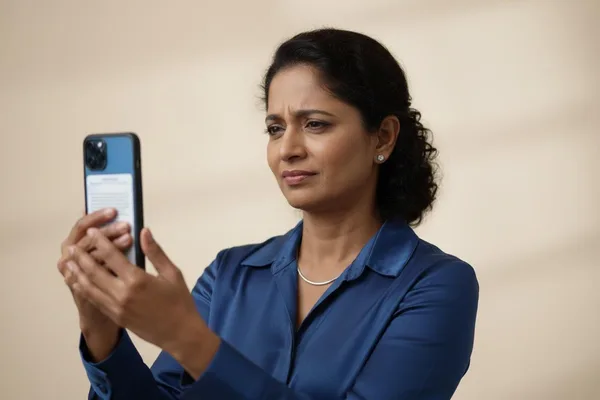
Do you also find it a little difficult to look at the newspaper, read a book, or see the small print on your phone? Maybe you have to hold a book a little further away to read it? Or do your eyes hurt and feel tired when doing close work? In most cases, this is due to the condition we are talking about today (Presbyopia). It is not something to be afraid of, it is not a disease, it is something that happens to many people as they get older.
What is Presbyopia? Let's understand it simply!
Simply put, presbyopia is the gradual loss of your ability to focus clearly on objects that are close to you as you age. This happens because the natural lens inside our eyes loses its flexibility as we age.
Presbyopia usually starts around the age of 40. It can then gradually worsen until around the age of 60-65. You may find that doing close tasks like reading a book or newspaper or threading a needle becomes more difficult than before. For some people, this can cause headaches, eye strain, and eye fatigue.
The important thing is, Presbyopia is not a disease. It is a natural part of aging. Just like our hair turns gray. It is a refractive error in the eyes, which is a slight change in the way light is focused inside the eye. The best part is that it can be easily corrected with glasses, contact lenses, or surgery.
How common is this condition (Presbyopia)?
Presbyopia is a very common condition. It's not just you, it's millions of people around the world. As of 2015, about 1.8 billion people worldwide had presbyopia. Researchers predict that by 2030, this number will reach 2.1 billion. So you can see how common this is.
What are the symptoms of presbyopia? See if you have these too!
Take a look and see if you have these characteristics:
- Needing more light to read: Do you feel like you now need more light to read things you used to read with normal light?
- Blurred vision when reading at a normal distance: Is the text not clear when you hold a newspaper or book in a normal position?
- Having to hold things you read at a distance: This is something that many people don't understand. Do you have to hold your phone or book at such a distance?
- Headaches when doing close work: Do you get headaches after reading a book or doing something sewing?
- Eye strain: Do your eyes hurt, feel like they are being pulled from the inside, or feel tired?
If you have one or more of these symptoms, it may be due to presbyopia.
Why do we get presbyopia? What is the cause?
The main reason for the development of presbyopia is the changes that occur in our eyes as we age. When we are young, that is, in the first few decades of life, the lens inside our eyes is very soft and flexible. When you look at something far away and then suddenly look at something close, this lens can change its shape very quickly. We also call this ability ``accommodation``. This is because of this, light rays fall exactly on the ``retina`` and we see clearly.
Think of your eye as a camera. The lens of a camera can autofocus on objects that are close up and objects that are far away. The lens of our eye, together with the transparent part of the front of the eye called the cornea, provides this clear vision. To understand presbyopia, it is helpful to know a little about this process:
1. The cornea bends naturally as light enters the eye.
2. Then, a small ring-shaped muscle around the lens either contracts or relaxes. This action changes the shape of the lens and allows objects that are near or far to be focused. If the object is far away, the muscle relaxes. If it is near, the muscle contracts.
3. Light falls on the retina. This is a membrane at the back of the eye . This is what converts light into electrical signals.
4. The optic nerve carries these signals to the brain. That's when we see the image.
As we age, the lens of our eyes continues to grow. Like an onion, new layers of cells are added. This causes the lens to thicken and lose its flexibility. As a result, light is not focused properly on the retina. This is when things that are close to us start to appear blurry. This is the main cause of presbyopia.
Who is at higher risk of developing presbyopia?
The main risk factor is being over 40 years of age . However, some medications and diseases can cause presbyopia in people under 40. We call this "premature presbyopia" or ``premature presbyopia''.
Risk factors for developing presbyopia include:
- Having farsightedness (Hyperopia).
- The use of certain medications. For example, antihistamines for allergies and antidepressants for depression.
- Having certain diseases. Examples: Diabetes Mellitus, Multiple Sclerosis (MS), Cardiovascular disease.
How do you know if you have presbyopia?
An ophthalmologist, that is, a doctor who specializes in eyes, can accurately diagnose presbyopia through an eye exam.
An important part of this test is called a ``refraction assessment.`` This test measures how well you can see at different distances. This test can tell your doctor if you have presbyopia, other vision problems such as astigmatism, nearsightedness (Myopia) or farsightedness (Hyperopia).
What are the remedies for presbyopia?
Depending on your health condition, lifestyle, and your preferences, your ophthalmologist may suggest one or more of the following methods:
- Eyeglasses
- Contact lenses
- Surgeries
- Eye drops
Let's talk about each of these in a little more detail.
Eyeglasses
Whether you've used glasses for another vision problem before, now may be the time to switch to a more comfortable type of glasses that suits your changing eyes. Here are some options:
- Reading glasses / Readers: These are best for people who are nearsighted (Myopia), farsighted (Hyperopia), or have astigmatism. You can buy Readers over the counter at a pharmacy. However, it is best to ask your doctor what magnification power is right for you. Alternatively, you can get prescription reading glasses that are made to fit both eyes.
- Bifocals: These glasses, often prescribed for presbyopia, have two prescriptions in the same lens. The top part of the lens helps with distance vision, and the smaller part below helps with near vision.
- Trifocals: These have three lenses: one for near vision, one for intermediate vision (about three feet away), and one for distance vision.
- Progressives: These are multifocal lenses, like bifocals. However, the transition from one prescription to another is gradual. Many people choose progressives because they don't like the lines in their glasses.
- Office progressives: These glasses are designed for close work in the office. That means working on the computer, writing, etc. When you get up from your desk, you have to take them off to see far away.
Contact Lenses
There are several types of contact lenses that can help you see better if you have presbyopia. Choose the type of lens that helps you see most comfortably:
- Bifocal contact lenses: A true ``bifocal`` lens helps with two focal points, usually near and far. They come in ``soft`` or ``gas-permeable`` types.
- Multifocal contact lenses: ``Multifocal`` lenses are similar to ``Bifocal`` lenses, and the two names are often used interchangeably. However, ``Multifocal`` lenses can include more than two focal points, which means an intermediate zone about three feet away. These also come in soft and hard types.
- Monovision contact lenses: In a ``Monovision'' lens set, the lens in one eye helps you see far away, while the lens in the other eye helps you see near. Your brain will gradually adjust to this system, but it may take about two weeks for you to become comfortable with it.
- Modified monovision contact lenses: In this method, you wear a lens for near or far vision in one eye, and a ``multifocal'' lens for all distances in the other eye.
Surgeries
Before deciding whether to have surgery, talk to your doctor about your eye health, family medical history, and your lifestyle. For those who only use `(Readers)`, the risks of surgery may outweigh the benefits.
These three laser procedures correct presbyopia using the monovision method (one eye is far away, the other eye is near):
- LASIK surgery: ``Laser in-situ keratomileusis / LASIK'' is a popular surgical procedure used to correct vision in people with nearsightedness (Myopia), farsightedness (Hyperopia), or astigmatism.
- PRK Surgery: If you have moderate or high levels of nearsightedness (Myopia), farsightedness (Hyperopia) and/or astigmatism, Photorefractive keratectomy (PRK) surgery may be a good option.
- SMILE surgery: In `(Small-incision lenticule extraction / SMILE)` surgery, the surgeon uses a very fine laser beam to create a disk-like piece of tissue inside your cornea and remove it through a small incision.
Eye drops for presbyopia
Eye drops are a good option for some people with presbyopia. Eye drops containing pilocarpine (such as Vuity®) shrink your pupil , increasing your depth of focus and improving your near vision. These are the first eye drops approved by the U.S. Food and Drug Administration (FDA) for presbyopia. The most common side effects are redness and headaches. You may also experience some difficulty seeing at night.
Some studies have found a link between the use of these eye drops and retinal detachment. If you have had this condition before, or if you have risk factors for it, talk to your doctor about whether this treatment is right for you and what the risks are.
What to expect if you have presbyopia?
Talk to your eye doctor about your symptoms and how they affect your daily life. He or she can help you find the best treatment options for you. You may need to try several different methods until you find one that works best for your needs and lifestyle.
Can we prevent Presbyopia?
Unfortunately, presbyopia is a natural part of aging, so it can't be completely prevented. Just as we can't stop aging, there are things you can do to protect the health of your eyes. Here are some tips:
- Wear sunglasses to protect your eyes from harmful UV rays.
- Eat foods that contain nutrients that are good for eye health, especially foods that contain vitamin A, vitamin C, vitamin E, and lutein.
- Be aware of computer vision syndrome and make changes to your daily routine to reduce eye strain.
When should I seek medical advice?
If you have symptoms of presbyopia, or if you have any other problems with your vision, be sure to see an eye doctor. Blurred vision can be a symptom of many other conditions. Therefore, it is very important to have your eyes examined by a specialist to find out exactly what the cause is.
Even if you don't have any symptoms, it's a good idea to get your eyes and vision checked regularly. How often you should have your eyes checked usually depends on your age, eye health, and any underlying medical conditions you may have. Most adults need an eye exam every year or two. Ask your eye doctor what interval is right for you.
What is the difference between (Presbyopia) and (Hyperopia) (farsightedness)?
Both presbyopia and hyperopia are refractive errors that cause near objects to appear blurry. That is, errors in the focusing of light. However, the underlying causes of these two are different.
- Presbyopia occurs because the lens of your eye loses its flexibility.
- Hyperopia occurs because your eyeball is too small, or your cornea is too flat.
Simply put, it's hard to see both, for two reasons.
Can Presbyopia and Myopia occur together?
Yes, it definitely is possible. And it's very common. Myopia is a condition where your eyes are naturally over-focused. So, while things that are close up appear clear, things that are far away appear blurry.
However, if you have Myopia and are over 40 years old, you may start to feel the effects of Presbyopia even when you wear glasses or contact lenses. Don't worry, your eye doctor can adjust your lens prescription to accommodate both Presbyopia and Myopia.
Presbyopia is a normal part of aging. But that doesn't mean you have to wait until it affects your daily activities. If you experience blurred vision or other eye discomfort, see an eye doctor right away. Presbyopia is not a disease, but its symptoms can be similar to those of serious conditions that require immediate treatment. Your doctor will be able to diagnose the problem and give you the treatment you need.
The most important things to remember (Take-Home Message)
Okay, so let's recap the most important things you need to remember from what we've talked about:
- Presbyopia is the loss of near vision after the age of 40. This is not a disease, but rather a result of the lens of the eye becoming less flexible as we age.
- Symptoms may include having to hold a newspaper or book from a distance, needing more light, and headaches.
- This is very common. It's not just you, many people in the world have this.
- The best thing is that there are simple solutions to this. The condition can be controlled with glasses, contact lenses, and possibly surgery or eye drops.
- If you have these symptoms, definitely see an ophthalmologist. They will choose the right solution for you.
- Take care of your eyes. Eat well, wear sunglasses, and get your eyes checked regularly.
So, I hope you now have a better understanding of (Presbyopia). You can accept this as a part of your life, take the necessary precautions, and continue your work comfortably!
` Presbyopia, nearsightedness, presbyopia, eyeglasses, contact lenses, eye health, vision impairment




💬 Comments (0)
No comments yet. Be the first to share your thoughts here.
Add Your Comment