
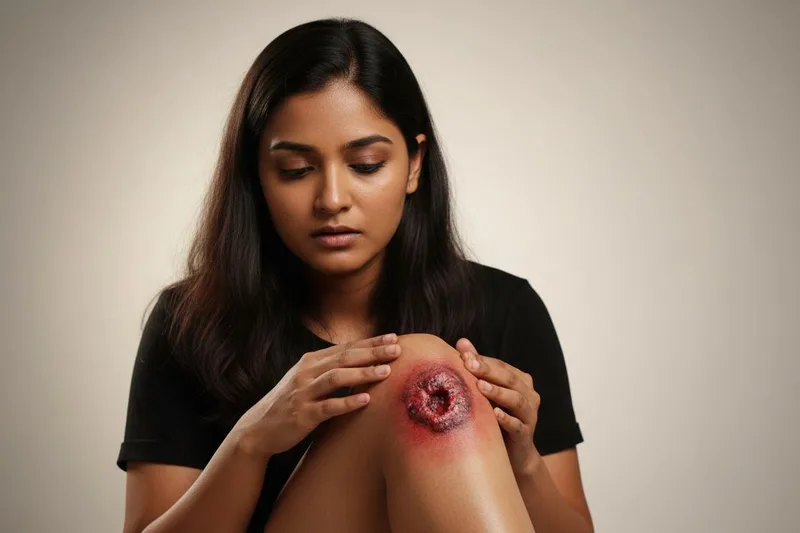
Have you suddenly developed a small red blister on your body, especially on your legs, which quickly turned into a large, deep, and very painful wound? You may think that this is a normal wound, or that you have been bitten by some insect. But sometimes it can be a bit more complicated than that, and it requires special attention. Today we are talking about a condition that is not very common in Sri Lanka, but it is important to know about. That is Pyoderma Gangrenosum .
Simply put, what is Pyoderma Gangrenosum?
Pyoderma Gangrenosum (pronounced: pyo-der-ma gane-gra-no-sum) is a long-term, recurring skin condition. It starts as a small, discolored (red, purple, blue) bump or fluid-filled blister (blister or bullae) on your skin. This then grows incredibly quickly, spreads, and becomes an open, deep wound (ulcer) that breaks through the skin.
One or more of these lesions can develop on the body. If the condition is not very severe, there may be only one lesion. However, in severe cases, multiple lesions may develop. These lesions are very painful .
The important thing is that Pyoderma Gangrenosum often occurs in conjunction with other medical conditions in the body. This means that it can occur as a symptom of another condition rather than a disease on its own.
Who is most likely to develop this condition?
Although this disease can occur at any age, it is very rare among young children. It is most common in women between the ages of 20 and 50. Also, if you have the following medical conditions, your risk of developing Pyoderma Gangrenosum is slightly higher.
- Rheumatoid Arthritis: This is an autoimmune disease that causes swelling and pain in the joints.
- Ulcerative Colitis : A condition in which the lining of the large intestine becomes inflamed.
- Crohn's Disease: Another disease that can cause inflammation anywhere in the digestive tract.
- Certain types of cancer: especially blood-related cancers such as leukemia or lymphoma.
This condition is not very common in Sri Lanka. Roughly speaking, in a country like America, this disease is reported in about one in every hundred thousand people. But it is not good to be unaware of this because it is not common.
What are the main symptoms of Pyoderma Gangrenosum?
Although this condition can occur anywhere on the body, it is most commonly seen on the legs, ankles, and feet. It can also occur on the hands, neck, and genitals. Now let's see what symptoms you may experience with this condition.
| Symptom | Description |
|---|---|
| Skin changes | It first appears as a small, red, purple, blue, or black bump or pus-filled blister on the skin. These can grow very quickly. |
| Open wounds (Ulcers) | That small blister quickly spreads, turning into a deep, open wound that tears through the skin. The edges of these wounds are raised and clearly visible. |
| Pain and swelling | The wound and the surrounding area are swollen and painful, much more than a normal wound. |
| Other features | Some people may also experience general symptoms such as fever and joint pain. |
Why does something like this happen? What is the reason?
In fact, doctors still haven't been able to pinpoint the exact cause of Pyoderma Gangrenosum, but it is widely believed to be caused by a malfunction in our immune system.
Simply put, our body's defense system, the immune system, mistakenly starts attacking our own healthy skin tissue. We call these types of diseases autoimmune diseases.
Another very important thing is that sometimes a small wound, scratch, or surgery on the skin can start or worsen this condition. In medicine, we call this 'pathergy' . This is a special feature of this disease. For example, these wounds can also occur around a stoma site after surgery.
Is this a contagious disease?
Absolutely not. This is something that needs to be remembered very clearly.
Pyoderma Gangrenosum is not a contagious disease. It is not spread from person to person by touch or in any other way.
How does a doctor accurately diagnose Pyoderma Gangrenosum?
This is one of the biggest challenges with this disease. Because there is no single test that can confirm, 'Yes, this is it.' That's why doctors first make sure that other medical conditions are not causing it. That is, they rule out other possible causes of these lesions one by one.
Your doctor will try to rule out things like:
- Bacterial or fungal infections
- Skin cancer
- Inflammatory conditions in blood vessels
- Other autoimmune diseases, such as lupus
To confirm these things, you may need to do some tests like these:
- Blood tests: Check for inflammation and other diseases in the body.
- Biopsy: A very small piece of skin is taken from the lesion and examined under a microscope.
- Bone marrow sampling: If conditions such as blood cancer are suspected.
- Special camera tests: Tests such as ``Colonoscopy`` to examine the colon if a condition such as Crohn's disease is suspected.
What are the treatments for this?
There are several treatments for Pyoderma Gangrenosum. Your doctor will decide on the treatment based on the severity of your condition.
For minor situations
In the early stages or if the condition is not too severe, the doctor may prescribe creams or ointments to apply to the wound.
- Corticosteroid creams: These are powerful medications that control inflammation and swelling. They are applied directly to the wound.
If the situation is serious
If the lesions are large, there are many of them, or the pain is severe, oral medications or other special treatments may be needed.
- Corticosteroids: Drugs like prednisone control inflammation throughout the body.
- Immunosuppressant medications: These medications work by reducing the activity of our immune system, stopping it from damaging our own bodies. Cyclosporine is one such medication.
- Biologic agents: These are new, advanced drugs that target specific proteins in the body that cause inflammation.
- Debridement: Surgically removing dead tissue from a wound can sometimes help. But this is risky. Because of the condition called 'pathergy' that we discussed earlier, this type of skin damage can make the condition worse. So this should only be done with great care and under the supervision of a specialist.
What do I need to know while living with this condition?
Living with Pyoderma Gangrenosum can be challenging, but with proper management, it can be controlled.
Wound care
- Avoid skin damage: Be as careful as possible with cuts, scrapes, and bruises. Even a small scratch can be the cause of a new wound.
- Keep the wound clean: Wash the wound with clean water and soap as directed by your doctor. This is very important to prevent infection.
- Bandage correctly: Use special bandages that do not stick to the wound. For some severe wounds, your doctor may recommend special dressings, such as hydrocolloid. Your doctor's advice is the most important thing.
Time to heal
This condition can take weeks, even months, to heal. So it's important to be patient and not expect immediate results.
Mental health
It's normal to feel depressed and stressed when dealing with a long-term, painful condition like this. Talk to your family and doctor about your feelings. Seek the help of a mental health counselor if necessary.
Informing other doctors
If you have Pyoderma Gangrenosum, be sure to tell your doctor if you see him or her for any other reason (such as a tooth extraction or minor surgery), as anything you do to your skin can cause the condition to come back.
When do you need to see the doctor?
There are several situations in which you should see your doctor immediately.
- If you have a risk condition such as arthritis or Crohn's disease and develop blisters or sores on your skin that grow rapidly.
- If your wound looks infected (e.g., redness, purple discoloration around the wound, increased swelling, or a foul odor).
- If you develop new symptoms.
- If the medications used for treatment cause severe side effects.
Take-Home Message
- Pyoderma Gangrenosum is not just a common wound. It is a rare but serious skin condition that causes painful sores.
- This is not contagious. So there is no need to isolate or fear a patient.
- This is often related to a problem with your immune system and other diseases, such as arthritis.
- Even a minor injury to the skin can cause the disease to worsen (Pathergy). Therefore, it is very important to protect yourself from injuries.
- Diagnosing the disease is complex and treatment can take a long time. It is essential to be patient and follow medical advice.
- If you have Pyoderma Gangrenosum, it is imperative that you tell your doctor before any surgery or skin-related treatment.


💬 Comments (0)
No comments yet. Be the first to share your thoughts here.
Add Your Comment