
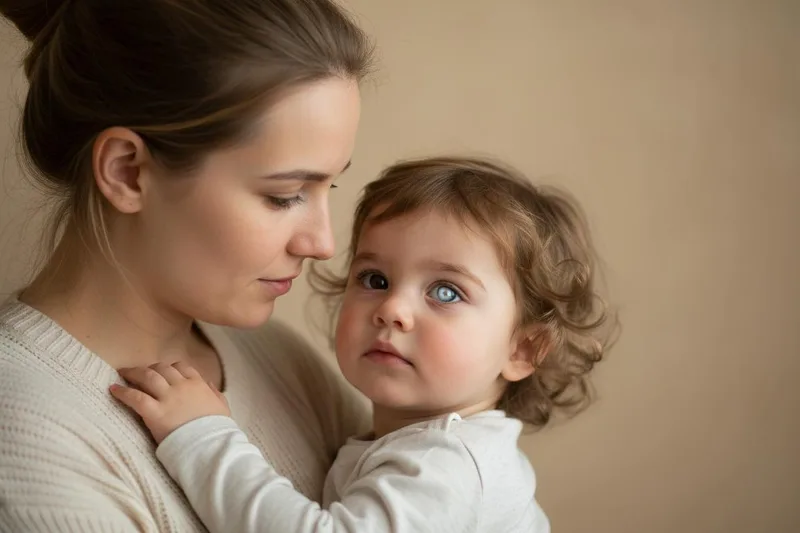
Have you ever noticed that your little one's eyes have a white spot inside the black ring, like a cat's eyes twinkling in a photo? Or does it sometimes look like one eye is slightly tilted to the other? These can sometimes be more than just minor things. Today we are going to talk about something like that, especially a type of eye cancer that occurs in young children. This is what doctors call `(Retinoblastoma)`. Don't worry, we will talk about everything in simple terms.
What exactly is `(Retinoblastoma)`?
Simply put, `(Retinoblastoma)` is a type of cancer that starts in the layer of light-sensitive cells at the back of our eye. We also call this layer the retina. It works like the film in a camera, the image of what we see is first recorded here. So, `(Retinoblastoma)` is the most common type of eye cancer in young children.
It can affect only one eye, but some children can have both eyes. Statistically, about one in four people with retinoblastoma will have both eyes affected. Doctors believe that it is caused by a malfunction in the young, developing cells in the retina. Most of the time, about four out of five children are diagnosed with the disease before they are three years old. However, very rarely, adults can develop retinoblastoma. How do you know? It happens when a small tumor that started in childhood lies dormant and then suddenly starts growing again after many years.
Are there main types of `(Retinoblastoma)`?
Yes, `(Retinoblastoma)` can occur in three main ways:
- Unilateral Retinoblastoma: As the name suggests (Uni means one, and lateral means side), this type affects only one eye.
- Bilateral Retinoblastoma: In this case (the 'Bi' means two), the cancer affects both eyes of the child.
- Trilateral Retinoblastoma: This one is a bit more complicated. Tri means three. Here, there is cancer in both eyes, and in addition, there is cancer in a third location, a small gland inside the brain, called the pineal gland. This is also called pineoblastoma.
Most of the time, about 60% of retinoblastoma patients have the unilateral type, which affects only one eye. The other 40% are the bilateral and trilateral types, which affect both eyes.
How common is this disease called ``Retinoblastoma''?
In fact, ``(Retinoblastoma)`` is a very rare type of cancer.If you take a million children under the age of 20, about 3.3 of them develop this. In a country like America, about 300 new cases are reported per year. If you take the whole world, about 9,000 new cases are reported per year. So this is not a very common thing.
What are the symptoms of `(Retinoblastoma)`? How do we recognize it?
This is often recognized before the child is 3 years old, as young children do not know how to express their difficulties. Therefore, as parents, we must be very attentive to the changes that can be seen in the child's eyes and changes in the child's behavior.
Leukocoria - white discharge
This is the first and most common symptom of `(Retinoblastoma)`. `(Leukocoria)` is when the pupil of the eye sometimes appears white or light, especially when taking a photo with a flashlight in a dark place. It is like a cat's eyes glowing at night. This can happen in one eye or in both eyes.
Imagine you took a photo of your baby on his birthday, with the flash on. Later, when you look at the photo, you see that the black iris of one eye is shining white, while the other eye looks red as usual (red-eye effect). That white appearance is called `(Leukocoria)`. If you see something like that, you should definitely show it to a doctor immediately.
Other symptoms of `(Retinoblastoma)`
In addition to `(Leukocoria)`, there are some other symptoms that hint at this disease:
- Strabismus (crossed eyes): Sometimes, when one eye looks straight ahead, the other eye may turn inward or outward.
- Difficulty looking at something that moves, or not looking at it at all.
- Eye pain: Young children can't tell you this. So they may cry more often than usual, refuse to eat, have trouble sleeping, and be restless all the time.
- One eye appearing larger than the other (`Buphthalmos`).
- Protruding eye (`Proptosis`).
- A blood clot in the front of the eye (`Hyphema`).
- Swelling, redness, and infection-like appearance of the tissue around the eye (`Orbital cellulitis`).
If you notice one or more of these symptoms in your child, please don't ignore it. See a pediatrician or ophthalmologist as soon as possible.
Why does this `(Retinoblastoma)` develop? What are the causes of this?
`(Retinoblastoma)` is a type of cancer. Simply put, cancer is when some cells in our body become dysfunctional and begin to divide rapidly and uncontrollably.This division is what causes tumors to form, damaging surrounding healthy tissue. If these cancer cells continue to grow out of control, they can spread to other parts of the body from where they first started. This is called metastasis.
So, the primary cause of the development of `(Retinoblastoma)` is an error in our genes (`DNA`).
The difference in ``(DNA)`` is the beginning
Our cells use ``DNA'' like recipes in a cookbook. We get our ``DNA'' from our mother and father. That means we take parts of their recipe books and create our own recipe book.
But sometimes, there can be a mistake in this `(DNA)`, like a letter in that recipe being written incorrectly. Our cells only know how to make the recipe exactly as it is in the book. So if there is a mistake in `(DNA)`, the cells also know how to make it incorrectly. That is why some cells grow out of control and become cancerous.
Doctors recommend that children with retinoblastoma, whether it is hereditary or not, receive genetic testing and counseling. They also recommend that the child's siblings and other family members undergo these tests as well.
The mutation that causes Retinoblastoma affects the gene called RB1. This is a tumor suppressor gene. Tumor suppressor genes are like the brake system in our body. They control cell division and growth. So, if there is a mutation in the RB1 gene, it seems like the brake doesn't work. Then the cells in the retina grow uncontrollably and form a tumor. Sometimes, even if the part of the chromosome called 13p that contains the RB1 gene is completely deleted (deleted), Retinoblastoma can develop.
Rarely, some people may develop a benign tumor called `(Retinoma)` in the retina. These are like precursors to `(Retinoblastoma).` But for some reason, these stop growing. However, later, this `(Retinoma)` can start growing again and become `(Retinoblastoma).`
There are two main ways that errors occur in `(DNA)`:
- Sporadic mutations: These occur when a cell makes a random mistake while copying DNA from its parents. It's like someone making a mistake when they write a recipe by hand. The original recipe was good, but the new recipe has a mistake. This type of sporadic retinoblastoma usually affects only one eye.
- Inherited mutations:What happens here is that either the mother or the father, or both, have a defect in this `(DNA)`. Then, when the child gets a copy of that `(DNA)`, it comes with that pre-existing defect. The genetic mutation that affects `(Retinoblastoma)` is inherited in a way called `(Autosomal dominant inheritance`. That means, simply, if one of the parents has this genetic mutation, the child has about a 50% chance of getting it. If both have it, there is about a 75% chance. However, sometimes, even if the parents do not have `(Retinoblastoma)`, the child can develop `(Retinoblastoma)` through inheritance. The reason for this is that some people are `carriers` of this genetic mutation. That means that even though they have the mutation in their body, they do not develop the disease.
If ``Retinoblastoma`` develops due to an inherited genetic mutation, it is most often the ``Bilateral`` type, which affects both eyes. Rarely, it can also occur as ``Unilateral``, which affects only one eye.
Siblings of a child with retinoblastoma also have an increased risk of developing it. If both parents have retinoblastoma, the risk for siblings of the affected child is between 4% and 7%.
What other complications can occur due to `(Retinoblastoma)`?
Retinoblastoma can damage the tissues around the eye, and can lead to partial or complete loss of vision in the affected eye .
Because this is a cancer, there is a risk of `(Retinoblastoma)` cells spreading (`metastasizing`) to other parts of the body. If it spreads, the situation becomes even more dangerous. Therefore, one of the main goals of treatment is to prevent this spread. The most dangerous way is for this cancer to spread from the eye along the `optic nerve` to the brain. Then it starts anew as a brain cancer.
The genetic mutations that cause retinoblastoma also increase the risk of developing other types of cancer later in life. There is about a 1% risk of developing a new cancer each year (for example, a 20% risk over 20 years).
Other types of cancer that can occur most often are:
- Sarcomas: These are cancers that affect bone and connective tissue.
- Melanomas: These are cancers that affect areas such as the skin, eyes, and mucous membranes inside the mouth and nose.
- Lung cancers: Due to the complex blood vessel system in the lungs, cancers that develop here can easily spread to other parts of the body.
How do doctors diagnose `(Retinoblastoma)`? (Diagnosis)
Most of the time, parents (or caregivers) are the first to notice the white spots called ``Leukocoria''. As soon as they see it, they tell the child's pediatrician. Then the doctor tries to confirm it. Sometimes, doctors can also see this ``Leukocoria'' during tests that check the child's normal development.
If a pediatrician sees ``Leukocoria``, the next step is to immediately refer the child to an ophthalmologist or other eye care specialist. An ophthalmologist will try to look directly into the eye to see if there is a ``Retinoblastoma`` tumor. When examining the eyes of young children, it is sometimes necessary to put ``medicated drops to dilate the pupils`` or to give the child anesthesia to examine the eyes.
What do scan tests do?
In addition, it is likely that scans will be performed. These scans can be used to see if there are tumors that are difficult to see in the other eye , or if there are tumors in the brain like ``Pineoblastoma''.
The most commonly used types of scans are:
- Ultrasound scan: This scan shows calcium accumulations, which are commonly seen in retinoblastoma.
- CT Scan (`Computed Tomography (CT) scan`): `(Retinoblastoma)` has calcium deposits, so they can be seen clearly on CT scans.
- MRI scan (Magnetic Resonance Imaging (MRI) scan): This is the best scan for taking detailed pictures of the different tissues and structures inside the body. It takes a while and is expensive. So it is not often the first test done. However, it is very important to see exactly how far a tumor has spread and whether there are other tumors in the other eye or brain.
- PET scan (Positron Emission Tomography (PET) scan): This test can be done early in the diagnosis and treatment process or later. It is especially useful to see if the tumor has spread (metastasized) to other areas or if new tumors have formed elsewhere.
What are the treatments for `(Retinoblastoma)`?
There are several ways to treat `(Retinoblastoma)`. Most often, treatment involves a combination of several methods. They can be done at the same time or one after the other. The main treatment methods are:
- Chemotherapy: This involves using drugs that directly attack the cancer cells. This can sometimes help avoid surgery, which can lead to blindness . It can also shrink tumors, making it easier for other treatments to kill any remaining cancer cells. These chemotherapy drugs can be given locally, which means they are injected directly into the eye (targeted injections), or intraarterially, which means they are given into an artery (intravenous (IV) infusion). The way they are given depends on the child's condition and needs.
- Radiation therapy:This uses high-frequency energy to destroy cancer cells. This can be done either from outside the body, such as external beam radiation therapy (EBRT), or from inside the body, such as brachytherapy. However, this treatment method is often avoided because of the risk of long-term complications.
- Focal therapies: These are so named because they "focus" on and destroy only the cancer cells. They can use either thermotherapy, which uses high heat, or laser therapy, which uses high cold.
- Surgery: Surgery is most likely to be performed when there is a risk of retinoblastoma spreading. This often involves a complete removal of the eye (enucleation). This prevents the cancer from spreading further. By the time this surgery is performed, the affected eye may already be losing vision.
- Other treatments and therapies: These can vary widely. Often, these help to control the side effects of other treatments. For example, medications to treat nausea and vomiting caused by chemotherapy. There are many types of supportive treatments, so your doctor will be able to advise you on which ones are best for your child.
What happens if my child has this condition? What is the future?
The prognosis for a child with retinoblastoma depends largely on how quickly the disease is diagnosed and treatment is started. However, in general, the chances of recovery are very high. 95% of pediatric retinoblastoma patients make a full recovery. If the disease is diagnosed before the child is 2 years old, the chances of a good outcome without vision loss are high.
People who recover from retinoblastoma need lifelong surveillance to check for new tumors. This usually involves annual scans and other tests to check for new tumors. Your doctor will tell you what tests your child needs.
Is there a way to prevent the development of `(Retinoblastoma)`?
Retinoblastoma is caused by a genetic mutation. Therefore, there is no way to completely prevent it. However, if someone in your family has had Retinoblastoma, or you know that you have a genetic mutation that causes it, genetic counseling can help you understand the risk of passing that gene on to your child when you have a child.
When should I talk to a doctor about `(Retinoblastoma)`?
Related to ``(Retinoblastoma)`` in your child's eyesIf you notice any symptoms or changes in your vision, see a doctor immediately. Also, if you or your partner have a family history of `(Retinoblastoma)`, or if you know that you have the `(RB1)` gene mutation, it is a good idea to consider genetic counseling before having children.
Important things to know if someone in your family has had ``(Retinoblastoma)``
If someone in your family has had `(Retinoblastoma),` it is very important for your child and the rest of your family to have regular ``eye exams.`` The ``(RB1)`` gene that causes ``(Retinoblastoma)`` can also cause a benign type of eye tumor called ``(Retinocytoma).``(Retinocytoma)`` can develop in people of any age.
Receiving a cancer diagnosis is a life-changing experience. But, stay hopeful. Researchers and doctors are constantly finding new, effective treatments that increase the chances of survival for children with this type of cancer. If your child has retinoblastoma, you may want to consider taking part in a clinical trial to find new treatments. Also, ask your doctor about support groups for cancer patients and their families. Many parents and families find these groups a great source of strength, courage, and hope.
The most important thing we want to take home from this story (Take-Home Message)
Okay, so we've talked a lot about `(Retinoblastoma)` today, haven't we? Here are the most important things to remember:
- If you see a white spot in your little one's eye (especially in flash photos), or if the eyes appear sunken, don't ignore it. See a doctor right away.
- Retinoblastoma is a rare but completely curable disease if detected early.
- There are a number of treatment options, and doctors will choose the one that best suits your child.
- If someone in your family has had this disease, consider genetic counseling and regular eye exams.
- Don't worry, you're not alone. There are many places and people to turn to for help at a time like this.
I hope you find this information useful. I wish you and your baby good health!
👩🏽⚕️ Additional questions (FAQs)
💬 Is Retinoblastoma a common tumor that develops in the eye?
Cancer! This is a very dangerous cancer that develops in the retina of the eye. This occurs mostly in infants and children under the age of 5. What happens here is that the cells in the retina grow abnormally rapidly due to a genetic defect (RB1 gene) and become a large cancerous tumor inside the eye.
💬 What is the biggest clue that a child is developing this cancer (Retinoblastoma)?
The clearest and biggest clue comes when you take a photo! After all, when you take a photo, our eyes turn red (Red eye) due to the flash. But in this disease, if the camera catches a 'white reflex' (Leukocoria / White reflex) like a cat's eye (Pupil) in the child's eye, then there is a 90% chance that it is definitely Retinoblastoma.
💬 Will the child's eye have to be completely removed because of this cancer?
This was done decades ago. But today, with advanced technology, if detected early, it is possible to save the eye and burn off only the cancer with laser therapy. It can also be cured with intra-arterial chemotherapy, which is a drug injected directly into the eye. Enucleation is only performed if the cancer has grown and there are signs that it has spread to the brain/other areas.
` Retinoblastoma, childhood cancer, eye cancer, leukocoria, retina, genetic mutations, RB1 gene


💬 Comments (0)
No comments yet. Be the first to share your thoughts here.
Add Your Comment