

Have you ever wondered how your heart and lungs, which are so important organs inside your chest, are protected? It's like a bird's nest, but our chest has a much stronger cover. Today we're going to talk about this amazing structure in our body, the rib cage. It's like the protector of our chest.
What is the function of the rib cage?
So, why do we have this rib cage? Imagine, inside your chest, that is, inside the thoracic cavity, are two very sensitive and vital organs: the heart and the lungs. These are like precious gems. So this rib cage, like a safe , protects these organs. If you fall or hit something, it is the first thing that helps to save these organs from damage.
Not only that, but when you breathe, your lungs inflate, right? At that time, your rib cage also expands , meaning it gets bigger. This allows your lungs to fill with air better.
Another thing is that it also acts as part of the main skeletal system ``Axial Skeleton`` that makes up the middle part of our body, that is, the ``Trunk``. Also, our major muscles, for example, the diaphragm, come and connect to this rib cage. So you can see, this is not just a few pieces of bone, it is something that performs a very important function.
What parts are in our rib cage?
Now let's see what parts this rib cage is made up of. Part of our skeletal system, this system mainly consists of bones and the joints that connect them to each other.
What are the bones in the rib cage?
There are three main types of bones we need to talk about here.
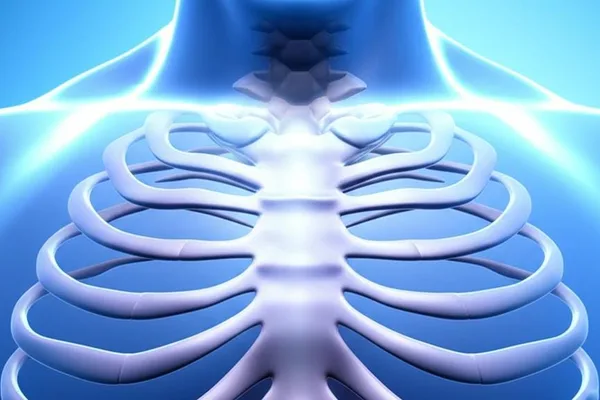
- 24 ribs (12 on each side): These are curved, horizontal bones. Like the ribs of a cage. They connect to the flat bone in the middle of the chest (which we call the sternum) in front, and to the bones of the spine in the back.
- 12 Thoracic Vertebrae (T1 – T12): Vertebrae are the bone-like structures that make up our spine. The thoracic vertebrae are the part of the spine behind our chest. They are where the ribs attach from behind.
- Sternum: This is the flat, elongated bone that runs from top to bottom in the middle of your chest. Some people also call it the 'breastbone'. It is where the ribs come in front and attach.
So, simply put, the 24 ribs, the 12 thoracic vertebrae in the back, and the sternum in front form the framework of the rib cage.
What are the joints in the rib cage?
Just having bones isn't enough, right? They need joints to connect with each other and to allow for some movement. The rib cage has several such joints.
- 20 Costal Cartilages: These are the cartilage (a tissue that is like rubber, but much stronger) ends. They start at the ends of the first 10 ribs on each side and help connect them to the sternum. This cartilage is what gives the rib cage some flexibility.
- 20 Costochondral Joints: This joint is formed where each rib connects to the tip of its corresponding costal cartilage.
- 10 Interchondral Joints: These joints connect the costal cartilage ends of the ribs (6th to 10th on each side) in the middle.
- 24 Costovertebral Joints: The 'head' of each rib connects to the corresponding vertebra at this joint.
- 24 Costotransverse Joints: This is the second point of contact between the ribs and the vertebrae. It connects the ribs to a bony protrusion on the side of the vertebra (called the transverse process).
Imagine all these joints coming together, forming a strong cage that's well-built, but still able to move a little when you breathe.
Are there different types of ribs?
Yes, our doctors sometimes use special names when talking about ribs. Let's get to know them a little bit.
- True Ribs / Vertebrosternal Ribs: These are the first seven ribs (1-7) on each side. They are called 'true' ribs because they are directly attached to the sternum by their costal cartilage.
- False Ribs / Vertebrochondral Ribs: The eighth, ninth, and tenth (8-10) ribs on each side are called 'false' ribs. The reason is that they do not connect directly to the sternum. Instead, they are connected to the rib cage in front only by interchondral joints. This means that each rib below is connected to the rib above it.
- Floating Ribs / Vertebral Ribs or Free Ribs: Your 11th and 12th ribs, the lowest of your ribs, are called 'floating' ribs. They have no interchondral joints or costochondral joints. This means they are not connected to the rib cage in front. Instead, they end inside the abdominal muscles.
- Typical Ribs: These ribs have a specific, common shape. They have a wedge-shaped head, a neck (which has a bony tubercle), and a curved shaft. The third through ninth ribs fall into the 'typical' category.
- Atypical Ribs: These ribs are shaped differently from the others and have special characteristics. The first, second, and tenth to twelfth ribs are considered 'atypical'.
- Cervical Rib: This is not actually part of your rib cage. It is an extra bone that some people are born with in their neck. It starts at the lowest bone in the cervical spine and can sometimes extend to the top rib.
These classifications sometimes help doctors diagnose diseases and plan treatment.
What are the common diseases that affect the rib cage?
Even though our rib cage is strong, sometimes it can be prone to various diseases and accidents. Let's see what such conditions are.
- Rib Fractures: A rib can be broken by something like a fall, an accident, or a hard blow.
- Rib Contusions: Even if the bone is not broken, it can be severely bruised.
- Slipping Rib Syndrome: A condition in which some of the lower ribs do not fit properly and move around, causing pain.
- Osteoporosis: This is a condition in which bones become weak and easily broken. It can also affect the ribs.
- Costochondritis: Inflammation of the cartilage that connects the ribs to the sternum. This can cause chest pain.
- Tietze Syndrome: This is similar to Costochondritis, but there is also swelling.
- Ankylosing Spondylitis: This is a type of arthritis that affects the joints of the spine. Over time, the movement of the rib cage can become restricted.
- Rheumatoid Arthritis: This is also a disease that causes inflammation of the joints and can also affect the joints of the rib cage.
- Pectus Excavatum: This is when the sternum and ribs sink into the chest, making it look as if the chest has been dug out.
- Pectus Carinatum: In this, the sternum and ribs protrude forward. Also called 'bird chest'.
- Chest Wall Tumors: Cancerous lumps can form in the ribs or surrounding tissues.
- Flail Chest: This is a very serious condition. When several ribs are broken in multiple places, part of the chest wall does not move in unison with the rest of the body, causing it to move unnaturally when you breathe.
If such situations occur, it is very important to seek medical advice immediately .
What are the symptoms of a rib cage problem?
If you have a problem with your rib cage, you may experience symptoms like these:
- Musculoskeletal Chest Pain: This pain is not like cardiac chest pain or angina. That is, it is less painful, like a squeezing, squeezing, or heaviness in the chest. Instead, the pain may be worse when your rib cage moves, such as when you cough or breathe in hard (which causes the rib cage to expand). It feels like a sharp pain when you move .
- Visible Deformity: Due to an accident or a congenital condition, the bones in the rib cage may appear out of place and out of alignment. This is a sign that you should see a doctor . The doctor will examine you and, if necessary, order imaging tests (such as X-rays).
Remember, if you experience chest pain, don't try to diagnose it yourself. It's wise to seek medical advice immediately, as it could be a sign of a heart attack.
What tests are done to examine the rib cage?
If your doctor suspects there is a problem with your rib cage, he or she may order imaging tests such as:
- Chest X-ray: This is the most common and simple test. It can look for things like broken ribs and changes in the lungs.
- Ultrasound: This allows you to see things like soft tissue and cartilage better.
- CT Scan (Computed Tomography Scan): This can produce more detailed, cross-sectional images than an X-ray. It can help detect things like small bone fractures and cancerous conditions.
- MRI (Magnetic Resonance Imaging): This allows you to see things like soft tissues, joints, cartilage, muscles, and nerves very clearly.
- DXA Scan: This is specifically done to check bone density. This can help determine if you have conditions like osteoporosis.
The doctor will consider your symptoms, age, and other factors to determine which of these tests is right for you.
How are rib cage conditions treated?
Treatment for rib cage conditions varies depending on the type and cause of the condition .
Something like a simple rib fracture will usually heal with time, good rest, and pain relievers. However, if there is a visible deformity, surgery may be necessary .
For conditions like arthritis, there are treatments such as medications, therapeutic injections, and physical therapy. In some severe cases, surgery may be necessary.
The most important thing is to seek advice and treatment from a qualified doctor, rather than self-treating.
Finally, remember this.
Okay, so we've talked a lot about the rib cage today, haven't we? You probably understand how important this is to our body.
Your rib cage is very strong on one side, and very flexible on the other.
That is, because it is made up of a mass of bones, the thoracic cavity is well-framed and protects valuable organs like the heart and lungs. At the same time, because it has many joints, this structure can be shaped as needed, and it can also move accordingly when you breathe and move your body.
However, these advantages can also be turned into disadvantages due to illness and accidents. If a rib is broken or dislocated, it can damage the soft tissues inside and endanger organs. If a joint is worn or inflamed, it can cause pain, stiffness, swelling, and make it difficult to move or even breathe.
That's when doctors treat your rib cage.
So, take care of your rib cage . Be careful of accidents. If you notice any unusual pain or change in your chest, do not ignore it and seek medical advice. Because keeping this protector well is very important for your overall health.
` Rib Cage, chest bone, thoracic cavity, heart, lungs, bones, joints




💬 Comments (0)
No comments yet. Be the first to share your thoughts here.
Add Your Comment