

Does one shoulder of your child seem a little lower than the other? Or does it feel like the hips are not balanced? Maybe you feel something different in your own back. At times like these, you may be a little suspicious about a spinal curve, a condition we medically call Scoliosis . So today we are talking about a very simple, small device that doctors use to clear up this suspicion.
What is a scoliometer?
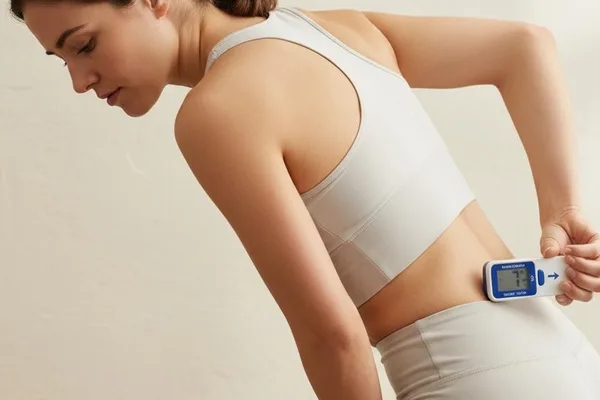
Simply put, a scoliometer is a small device that measures the curvature of your spine ( scoliosis ). It is used to check for scoliosis in children, young adults, and adults.
Think of it like a carpenter's level and a ruler combined. On the bottom of this, there's a little notch that's designed to fit right over your spine. When a doctor places this on your back, they can measure the curvature of your spine in degrees.
But remember, the reading from the scoliometer is only one part of the scoliosis diagnosis. In addition, the doctor will examine you physically and, if necessary, refer you for an X-ray .
How do you check the back of the bed with this?
This is a very simple, painless test. Your doctor can do it during a routine checkup.
- First, the doctor will remove your shirt and ask you or your child to bend forward from the waist, as if you were touching your feet. This is called the Adams forward bend test .
- When you bend over like that, your spine will be clearly visible. The doctor will look at your spine and touch it with his hand to check if there is any curvature.
- Then, take the scoliometer and position it so that the groove is exactly over the spine.
- If there is a curvature of the spine, that is, a tilt to one side, the air bubble inside the scoliometer will tilt to one side and show the amount of that tilt in degrees. Just like the 'level' used to check if a wall is straight when building a house.
- Doctor, you can try placing this in several places along the spine, not just in one spot on the back.
| Scoliometer reading (in degrees) | What it says |
|---|---|
| 0° (zero degrees) | There is no pain in the back. A normal, healthy condition. |
| If more than 10° | This could be a condition called scoliosis. The doctor will refer you for further tests. |
Are scoliometer and Cobb Angle two different things?
You may also hear the term 'Cobb angle' . This confuses many people.
Simply put, the scoliometer gives us a basic idea. But the actual degree of curvature of the spine is confirmed by an X-ray examination . The degree measured by that X-ray is what we call the Cobb angle . A person with scoliosis has a Cobb angle of more than 10 degrees.
So the scoliometer is a screening test first. The Cobb angle is a measurement taken from an X-ray to confirm the disease.
What happens after the scoliometer test?
Depending on the readings on the scoliometer, your doctor will likely order a spine X-ray . This is the only way to confirm the condition 100%.
An X-ray can also show exactly how much spinal curvature there is and whether there are other problems with the spine (e.g., fractures).
If you are diagnosed with scoliosis, you will need to see your doctor every 4 to 6 months to check it out. You should always check to see if the condition changes, especially as your child grows.
Remember, not everyone with scoliosis needs treatment. Most people have only mild symptoms. It just needs to be monitored regularly.
Can I check my scoliometer at home using an app?
Nowadays, there are scoliometer apps for phones. You can also buy these devices online. But there is something very important here.
Never use these to diagnose yourself or your child.
A back injury is something that should only be examined, measured, and confirmed by a qualified doctor. If you have any doubts, the best thing to do is to see a doctor.
When should I see a doctor?
It is important to see a doctor if you or your child notice the following changes:
- Difference in the height of the two shoulders (one is higher, the other is lower).
- The hips are not balanced on both sides.
- When bending forward, one side of the back appears to be further forward than the other.
- Feeling like clothes don't fit properly when you put them on.
- Feeling back pain or discomfort.
Don't panic when you see something like this. Most of the time, these are not serious things. However, it's wise to see a doctor to find out exactly what's going on.
Take-Home Message
- A scoliometer is a simple, painless device that checks for any underlying suspicion of scoliosis.
- If you or your child's shoulders or hips seem out of balance, see a doctor.
- The reading from the scoliometer is only a preliminary test. The exact condition is confirmed by measuring the Cobb angle from an X-ray.
- Not everyone with scoliosis needs major treatment. What is often important is to have regular checkups as advised by your doctor.
- Do not self-diagnose using phone apps. Always seek the advice of a qualified medical professional.




💬 Comments (0)
No comments yet. Be the first to share your thoughts here.
Add Your Comment