
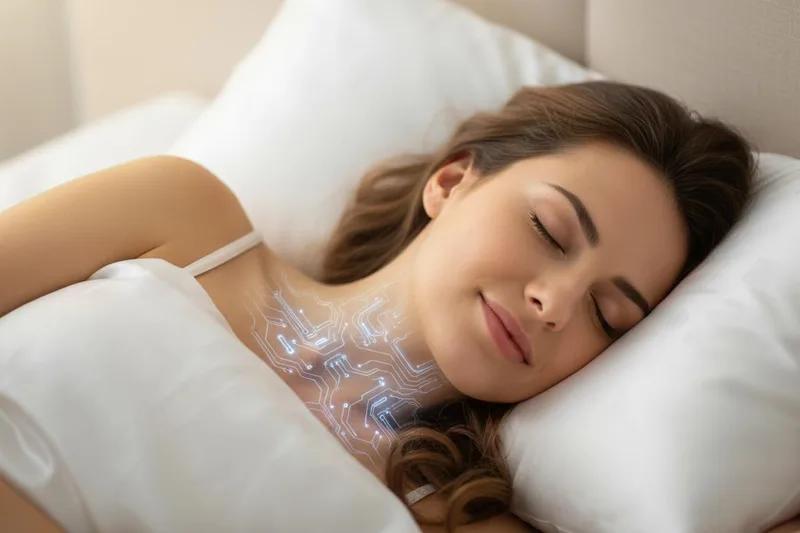
Snoring and sudden shortness of breath during sleep at night have become a common occurrence for many people. This is medically known as Obstructive Sleep Apnea (OSA). One of the most popular treatments for this is the CPAP machine. However, sleeping with this mask and machine on your face while sleeping at night is not easy for everyone. So, for those who do not like this, or for those who do not have successful results, we are talking about the most advanced solution available today. That is the Sleep Apnea Implant, which is surgically implanted inside our body.
Simply put, what is this Sleep Apnea Implant?
This is an electronic device that is implanted inside your body after a minor surgery. Its main function is to keep your airway open while you sleep. This helps control the symptoms of Obstructive Sleep Apnea (OSA).
The most widely used device in the world today is the Inspire®. It is also called the hypoglossal nerve stimulation device. Simply put, it stimulates the nerve that controls the tongue.
How does this device work?
The way it works is very simple. If you have OSA, when you sleep, your tongue can fall back and block the airway in your throat. That's when you suffocate.
This implant sends a small electrical signal to the nerve that controls the movement of your tongue, the hypoglossal nerve . When it receives this signal, your tongue moves forward a little, opening up your airway. So you can breathe without any obstructions throughout the night.
This entire system has four main parts.
| Part of the device | The work that it does |
|---|---|
| Stimulator Device | This is where the main battery and circuitry are located. This is where the electrical signals are generated. |
| Stimulation Electrode | This is the thin wire that connects to the nerve that controls the tongue. This is where the electrical signal is sent to the nerve. |
| Pressure Sensor Electrode | This detects your breathing pattern and signals the stimulator to activate only when you breathe. |
| Remote (remote control) | This is what you use to turn the device on at night when you go to sleep and off in the morning. You can also control the strength of the signal. |
Who can undergo this surgery?
This is not something everyone can do. The doctor will consider several factors before deciding if this is right for you. The following people are usually eligible for this.
But remember, don't worry if you don't have any of these qualifications. Only your doctor can make the best decision about whether this is right for you.
| Consideration | Description |
|---|---|
| Age | Must be over 18 years old. |
| Body Mass Index (BMI) | A BMI of 35-40 or less is ideal. |
| Nature of the disease | Must have moderate or severe Obstructive Sleep Apnea (OSA). |
| CPAP use | Must be someone who is unable to use a CPAP machine or who is not getting successful results from it. |
How do you prepare before surgery?
Before approving the surgery, your doctor will perform a special test on you. It's called a drug-induced sleep endoscopy (DISE) . This involves giving you medication to put you to sleep, and then inserting a small camera-equipped tube (endoscope) down your throat to examine your throat, tongue, and airway.
This is mainly to check if the walls of your throat collapse inwards all the way around. This is called complete concentric collapse (CCC) . If this happens, the device may not be successful.
A few days before surgery, your doctor will give you some instructions like this:
- Avoid eating and drinking the night before surgery.
- Tell your doctor about the medications you are taking, and take or stop them according to his or her advice.
- If you smoke, it is very important to stop or reduce it.
What happens during surgery?
On the day of your surgery, you will be given general anesthesia. This means you will be completely asleep so that you will not feel any pain. These are the steps that will take place during the surgery.
1. Two small incisions are made: one in the neck, below the jaw (to locate the lingual nerve). The other in the chest, below the collarbone (to insert the main device).
2. Attaching the stimulator to the nerve: The hypoglossal nerve is located through an incision in the neck and the stimulation electrode is attached around it.
3. Implantation of the main device: A small space is created under the skin through an incision in the chest, and the main device (stimulator device) is implanted there.
4. Attaching the breathing sensor: A pressure sensor electrode that detects breathing patterns is attached to the muscles between the ribs.
5. Connecting wires: These three parts are connected to each other with thin wires.
6. Testing: At the end of the surgery, the device is turned on and checked to make sure it is working properly.
7. Stitching the incisions: Finally, the incisions are stitched up and covered with a plaster.
This entire surgery usually takes about 90 minutes .
What happens after surgery?
This is usually an outpatient procedure . This means that you can go home from the hospital the same day. After surgery, you may experience some pain and swelling at the incision sites. Your doctor will prescribe painkillers for this. These discomforts will subside completely in a few weeks.
The most important thing is that this device is not turned on immediately after surgery. It is turned on only after the incisions have fully healed, which means about a month later.
When you go to see the doctor a month later, he will show you how to use the remote. He will turn on the device with the remote and adjust the settings so that the nerves in your tongue are stimulated. This is not painful , but you will feel your tongue move forward a little. You can adjust the intensity to a comfortable level.
It usually takes about three months to adjust it to the exact strength you need. After that, another sleep study is done to see how effective the device is.
What are the benefits and side effects of this method?
As with any medical treatment, there are both benefits and minor risks.
| Main advantages | Possible side effects/risks |
|---|---|
|
|
How long does it take to fully recover?
It is important to rest for a few days after surgery. After about two weeks, you can resume normal activities, except for heavy lifting. However, it will take some time for your body to get used to this device. Regular follow-up visits with your doctor are essential .
The battery in the device can usually be used for about 10 years . When it is necessary to replace the battery, the entire device is not removed. Only the battery is replaced through a small incision.
When do you need to talk to the doctor?
After surgery, if you experience severe pain, swelling, and fever, tell your doctor immediately. Also, if you have difficulty adjusting to the device after it is turned on or if it seems too uncomfortable, talk to your doctor about that. He or she can change the settings to make it more comfortable for you.
Take-Home Message
- The Sleep Apnea Implant is a good solution for people with moderate to severe OSA, especially those who do not want to use a CPAP machine.
- This works by stimulating the nerves that control the tongue while you sleep, keeping your airway open.
- This is a device that is surgically implanted in the body. It is activated a month after the surgery.
- It takes some time to get used to this. Therefore, it is essential to maintain regular contact with the doctor and go for follow-ups as scheduled.
- The most important thing is to talk to your doctor about whether this is right for you and what the pros and cons are, and then make a decision.


💬 Comments (0)
No comments yet. Be the first to share your thoughts here.
Add Your Comment