
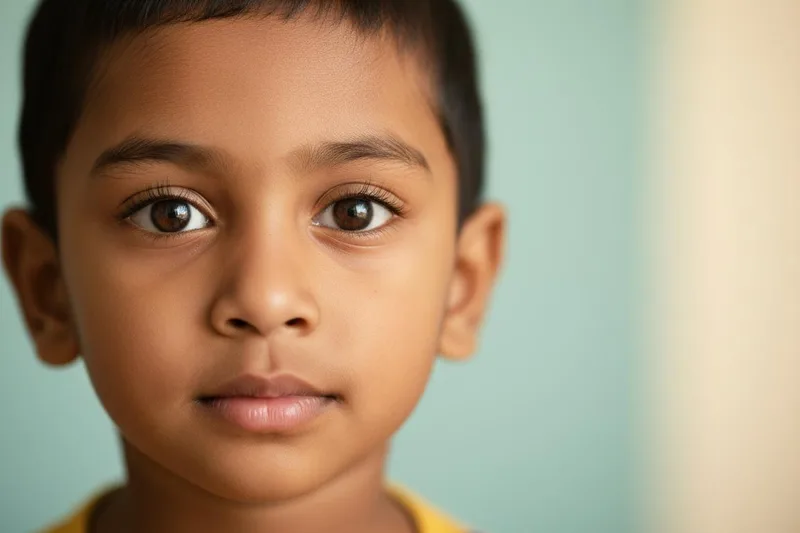
Have you ever noticed that the distance between the inner corners of your child's or someone else's eyes (the corners that are toward the nose) seems to be a little longer than normal? When you see this, you may be a little curious, or even a little scared. This is what we call telecanthus in medical science. This may sound like a serious illness, but don't be afraid. Let's talk about this simply, in a way that you can understand.
Simply put, what is Telecanthus?
Telecanthus is, quite simply, an increase in the distance between the two inner corners of our eyelids, or what doctors call the `medial canthi` . In most cases, this is congenital . That is, this condition can be present at birth. The main cause of this is said to be genetic disorders .
However, sometimes, this condition of telecanthus can occur due to injuries and traumas to our face, or even after a tumor on the face is surgically removed.
There is another name for this, which is `dystopia canthorum` . However, the name `Telecanthus` is the most commonly used.
How will this affect my child?
If you are a parent of a child with Telecanthus, it is normal to be concerned about your child's physical and mental well-being. But there is good news! Telecanthus alone is not painful and usually does not cause vision problems . However, if Telecanthus is accompanied by other eye abnormalities, vision problems may occur.
The other thing is, as your child gets older, they may feel a little embarrassed or ashamed about it. They may think, "My eyes are not like everyone else's." If this is affecting your child's self-esteem , you can talk to a doctor about ways to surgically correct the telcanthus condition. Also, talking to a mental health professional can be very helpful at times like this.
Who gets this condition?
Most often, telecanthus is a symptom of a genetic disorder that is present at birth. Here are some of the main genetic disorders that can cause telecanthus:
- Cri du chat syndrome ( This can cause problems with the child's growth and development, and can also cause a high-pitched sound like a cat crying.)
- Down syndrome
- Dubowitz syndrome
- Ehlers-Danlos syndrome
- Fetal alcohol syndrome (a condition that can occur in a child if the mother drinks alcohol during pregnancy)
- Klinefelter syndrome
- Noonan syndrome
- Short syndrome `(SHORT syndrome)`
- Turner syndrome
- Waardenburg syndrome
There are also some factors that increase the risk of a child having a genetic disease. For example:
- Mother's recreational drug use during pregnancy.
- Exposure to harmful chemicals or radiation during pregnancy.
- Someone in the family (biologically related) has had this type of genetic disease before.
Can adults develop Telecanthus?
Although this is a bit rare, yes, even someone who is not born with the condition can develop telecanthus later in life. Sometimes, traumatic injuries or tumors to the face can change the shape of the face. This can cause the corners of one or both eyes to move closer together. (Sorry, the original article said "closer together", but telecanthus means "farther apart". So I'm correcting that. An accident or tumor can cause the corners of the eyes to move apart and become more distant.)
How common is this condition?
Telecanthus is very rare to have on its own. It is often seen with other genetic syndromes.
What are the symptoms of Telecanthus?
Telecanthus itself does not usually cause eye pain or vision problems. However, when it occurs in conjunction with other syndromes that affect the way the eyes develop, the following can occur:
- Low vision
- Myopia / nearsightedness
- Hyperopia (farsightedness)
What are the causes of Telecanthus?
Some people are born with telecanthus ( congenital ). If you have congenital telecanthus, it may be because the tendons that hold your eyelids together - the medial canthal tendons - are too long or not in the right place. Instead of bringing the inner corners of your eyelids closer together, these tendons have pulled them apart.
For others, the condition may develop later in life, due to certain injuries or illnesses. For example:
- Naso-orbital ethmoid (NOE) fractures . These are very complex fractures.
- Squamous cell carcinomas
- Basal cell carcinomas
Causes of Traumatic Telecanthus
Traumatic telecanthus is caused by injuries to the face. Falls and car accidents can cause fractures called naso-orbital ethmoid (NOE) fractures . These NOE fractures can affect your nose, nasal bones, eye sockets, forehead, and the front of your skull. NOE fractures can damage your medial canthal tendons, causing telecanthus.
Traumatic telecanthus can also be caused by tumors - usually squamous cell carcinomas or basal cell carcinomas . If these tumors form in the inner corners of the eyelids, the surgery to remove them can damage the medial canthal tendons, causing traumatic telecanthus.
What is Pseudotelecanthus?
Severe facial injuries can cause swelling, scarring, and fluid buildup between the eyes, above the nose, and on the forehead. These complications can cause the inner corners of the eyes to appear very far away. An eye specialist may call this `secondary telecanthus` or `pseudotelecanthus` . This is to distinguish it from the original injury. This means that there is no actual tendon problem, but rather swelling that causes the eyes to appear far away.
How to identify Telecanthus?
A doctor can see that a baby's eyes are set too far apart right after birth. They use a special ruler to measure the distance between the inner corners of the baby's eyes (the ``inner canthal distance`').
Your child may also have tests like these:
- CT scan
- Genetic testing to identify genetic diseases
- X-ray examination `(X-ray)`
The doctor will also examine other features of the child's face and skull. Since telecanthus does not usually occur alone, your child may have other symptoms as well. Some genetic diseases that can cause telecanthus can also cause problems with the child's heart, kidneys, bones, and nervous system.
What kind of doctor treats Telecanthus?
Telecanthus is usually treated by an oculoplastic surgeon . These doctors are your:
- Eye sockets
- Tear ducts
- Facial bones
Treating problems that affect things like...
Sometimes, otolaryngologists, who specialize in head and neck surgery, also treat telecanthus.
Because telecanthus is usually caused by other health conditions, your or your child's medical team may include other types of doctors.
What are the treatments for Telecanthus?
The main treatment for telecanthus is surgery . Some people choose surgery for cosmetic reasons. These surgeries may include:
- Tendon shortening and fixation : The surgeon cuts your medial canthal tendons to the correct length. The shortened tendons are then attached to a bone between the side of your nose and your eye socket. This procedure is usually used for congenital telecanthus.
- Transnasal wiring: This procedure is usually used for traumatic telecanthus. The surgeon removes the medial canthal tendon of the affected eye and repositions it. The tendon is then attached to your skull using a very thin wire. The wire is passed through small holes in the inside of your eye socket and the nasal bones.
Important: Mild cases of telcanthus that do not affect vision or self-esteem may not require treatment.
Can this be prevented?
There is no way to prevent telecanthus. If you are concerned about passing on the genetic condition to your children, you can talk to a doctor about genetic counseling .
What is the outlook for someone with Telecanthus?
Telecanthus does not get worse with age. And it usually does not require treatment (unless it is necessary for the reasons mentioned above). Telecanthus surgery is usually successful. However, after surgery, your medial canthi (inner corners) may move closer together again (i.e., become less distant). Some people may need a second surgery.
Telecanthus, a genetic condition, can lead to more serious long-term conditions, such as:
- Developmental delays
- Learning disabilities
- Problems with your heart, lungs, gastrointestinal system, and other organs.
What questions should you ask your doctor?
If you or your child has Telecanthus, it's a good idea to ask your doctor questions like these:
- Does my child have other eye problems besides Telecanthus?
- Does Telecanthus require treatment?
- How can I help my child deal with the mental and emotional challenges caused by Telecanthus?
- How soon can my child have surgery to correct Telecanthus?
- What causes Telecanthus?
What is the difference between Telecanthus and Hypertelorism?
These two can be a bit confusing, but there is a slight difference.
- Telecanthus : In this, only the inner corners of your eyelids are too far apart. The distance between the lateral canthi and the pupils is not affected. Your eyes may not appear to be too far apart, but the inner corners of your eyelids may be significantly closer to the colored part of your eye (iris).
- Hypertelorism : People with this condition have both the inner and outer corners of their eyes, as well as the distance between their pupils . When you have hypertelorism, it can clearly appear that your eyes are very far apart.
Both of these conditions can be caused by genetic disorders. Telecanthus is sometimes called pseudohypertelorism .
What is the difference between Telecanthus and Epicanthus?
- Epicanthus is a fold of skin on the inside of your upper eyelid, above the inner corner of your eyelid. An eye specialist may also call this an epicanthal fold or monolid eyes . (This is a common condition in Asian countries.) Epicanthus and telecanthus can occur together.
What is the difference between Telecanthus and BPES (Blepharophimosis-ptosis-epicanthus inversus syndrome)?
BPES (Blepharophimosis-ptosis-epicanthus inversus syndrome) is a condition that affects the growth of the skin around the eyes. It is also characterized by telcanthus. Symptoms of BPES may include:
- Blepharophimosis : The eyelids are very narrow, not properly developed, and do not open fully.
- Epicanthus inversus : The skin on the inner side of the lower eyelid folds upward from the inner corner of the eyelid (the opposite of a normal epicanthus).
- Ptosis : This is when the upper eyelid droops downward.
Although telecanthus is a rare condition, it can be challenging for you or your child. It is usually caused by a genetic disorder, and it can also cause other complications in your child's eyes or body.
In summary, things we need to remember (Take-Home Message)
Okay, so let's recall some of the most important points from what we've talked about.
- Telecanthus is an increase in the distance between the inner corners of the eyes. This is often a congenital condition.
- When this occurs alone, it usually does not cause significant pain or vision problems.
- However, this can be linked to genetic diseases, which can lead to other health problems.
- If it affects the child's self-esteem, you can consider surgery. Mental health counseling is also very important.
- Although this cannot be prevented, things like genetic counseling can help you become aware of the risk.
- If you have any doubts or problems, definitely talk to a doctor. Don't be afraid or embarrassed. Your health and that of your baby are the most important thing.
Remember, you are not alone. The best thing to do is to be aware of these situations and seek the necessary medical advice.
` Telacanthus, eye diseases, genetic diseases, children's health, surgery, symptoms, eye health


💬 Comments (0)
No comments yet. Be the first to share your thoughts here.
Add Your Comment