

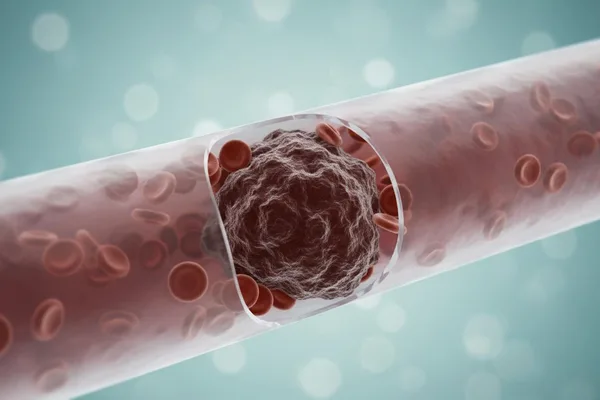
Imagine that the blood vessels throughout our body are like a network of roads in a city. It is along these roads that blood travels, carrying the oxygen and nutrients that every cell in our body needs. When everything is going well, this traffic happens without any obstacles. But what happens if suddenly a major obstacle, like a large stone, blocks this main road? Traffic stops completely, right? The same thing happens if a blood clot (thrombus) forms in one of our blood vessels. This stops the blood flow, causing great damage to the organ that is supplied by that vein, and can even be life-threatening. Today we are talking about a special surgery that is performed to save lives in such a dangerous situation.
Simply put, what is Thrombectomy?
Thrombectomy is a surgical procedure to remove a blood clot that has become lodged in your blood vessel (either an artery or a vein). It's like removing a clog in a water pipe and getting it flowing again. The main goal of this surgery is to restore normal blood flow that has been blocked by a blood clot.
These blood clots can form in various places in our bodies. The most common are:
- In the legs
- In the hands
- Intestinal
- In the brain
- In the lungs
- In the heart
Sometimes this surgery needs to be done within a few hours, because if not done right, there is a high chance of losing a limb or even life.
Who really needs this surgery?
If you have a blood clot, your doctor will first try to treat it with medications. For example, you may be given anticoagulants or thrombolytics. However, if these medications do not control the clot, or if the clot is large and in an emergency, your doctor may decide to perform a thrombectomy.
The main reasons for having this surgery are:
- Prevent life-threatening complications: If a blood clot forms in a major blood vessel leading to the brain or heart, it can be fatal.
- Permanently stop organ damage: If the blood supply to an arm or leg is cut off, the tissue in that organ will begin to die. If the blood flow is not restored quickly, the organ may become disabled or even have to be amputated.
- Prevent an embolus: This is when a blood clot that has formed in one place breaks away, travels with the blood, and gets stuck in another part of the body, for example, in the lungs. This is also a very dangerous condition.
Are there any reasons not to have thrombectomy surgery?
Yes, not everyone can have this surgery. In some cases, the harm from doing this may outweigh the benefits. If you have any of the following conditions, your doctor may decide not to have this surgery:
- If the blood clot is in a place that is very difficult to reach with surgery.
- If the blood clot is in a very small blood vessel , inserting instruments into such a place to remove the clot can damage the vein itself.
- If you can control your blood clotting well with medication .
- If you have a pre-existing blood disorder .
- If there is bleeding inside the brain (intracranial hemorrhage) .
- If you have high blood pressure that cannot be controlled even with medication.
- If the blood clot is more than 30 days old and is chronic .
The most important thing is that only a doctor who carefully examines your medical condition can decide whether you need a thrombectomy or not.
Main conditions treated with thrombectomy
This surgery is used for a variety of medical conditions. Let's take a look at what they are.
| Condition | A simple explanation |
|---|---|
| Deep Vein Thrombosis (DVT) | The formation of a blood clot in a vein deep within the body (often in the leg). |
| Acute Limb Ischemia | A sudden blockage by a blood clot of an artery supplying blood to an arm or leg. |
| Stroke | Damage to part of the brain due to a blood clot blocking a blood vessel that supplies blood to the brain. |
| Heart Attack (Myocardial Infarction) | Blockage of the coronary arteries that supply blood to the heart by a blood clot. |
| Pulmonary Embolism | A blood clot that has formed elsewhere in the body (often in the leg) breaks loose and becomes lodged in a vein in the lungs. |
| Acute Mesenteric Ischemia | Sudden blockage of a vein that supplies blood to the intestines. |
What are the types of thrombectomy surgeries?
There are two main methods of performing this surgery. Let's look at the differences between the two.
| Surgical / Open Thrombectomy | Percutaneous / Minimally Invasive Thrombectomy |
|---|---|
| In this, the surgeon cuts the skin over the vein where the blood clot is, opens the blood vessel, and removes the blood clot directly. More specifically, the blood vessel is cut, a small balloon-like device is inserted into it, and the blood clot is pulled out. The vein is then sewn back together. | This does not involve a large incision. A small hole is made in the skin, and a very thin tube called a catheter is inserted into the blood vessel. Then, using imaging techniques such as X-rays, this tube is guided to the site of the blood clot. There, special equipment is used to break the blood clot into pieces or to suck it out like a vacuum cleaner. |
| This is usually done under general anesthesia. | This is often done by giving the patient a sedative (sedation). No major anesthesia is required. |
What should you do before surgery?
Sometimes this is done as an emergency surgery, so you may not have time to prepare. However, if it is a planned surgery, your doctor will tell you the following:
- Imaging tests: They may order tests such as an ultrasound, MRI, or CT scan to see the exact size and location of the blood clot.
- Quitting smoking: If you are a smoker, you should quit as soon as possible before surgery. Smoking can cause complications after surgery.
- Stopping certain medications: You should tell your doctor about all medications you are taking, including vitamins and herbal remedies. You may be asked to stop taking blood thinners (anticoagulants) a few days before surgery.
What happens during the surgery?
This process can vary depending on the type of surgery you're having. Depending on the size and location of the blood clot, the procedure can take an hour or several hours. In general, this is what happens:
1. Anesthesia/Sedation: Anesthesia or a sedative will be injected into a vein in your arm so that you don't feel any pain.
2. Incision/puncture: In direct surgery, the skin is cut where the blood vessel is. In the mini-incision method, a small hole is made through the skin to the vein.
3. Cannulation (Percutaneous method): The cannula (catheter) and wires are inserted into the vein through the hole and guided to the site of the blood clot while looking at the scan.
4. Removing the blood clot: In direct surgery, the clot is pulled out with a balloon cannula. In other methods, the clot is crushed, dissolved, or suctioned out with special instruments.
5. Closure: In direct surgery, the cut blood vessel and skin are sewn back together. In the other method, the cannula is removed and the hole is either clamped shut or a special device (vascular closure device) is used to close the hole.
What happens after the surgery? And what are the risks?
After the surgery, you will be taken to an observation ward and your vital signs (blood pressure, heart rate, etc.) will be closely monitored. Some people can go home the same day. But some people will have to stay in the hospital for a few days. It depends on your condition.
On your way home, the doctor will tell you about these things:
- How to take care of the cutting path.
- Medications to take and not to take.
- When can normal work resume?
Like all surgeries, thrombectomy carries some risks, but these risks are usually small compared to the harm caused by having a blood clot.
Let's look at the main advantages and risks.
| Benefits | Risks |
|---|---|
| Being able to save lives. | Damage to the blood vessel or its narrowing (stenosis). |
| Preventing the loss of a limb, such as an arm or leg. | Excessive bleeding. |
| Minimizing brain damage caused by conditions such as paralysis. | Blood accumulation under the skin (Hematoma). |
| Quickly restore blood circulation and stop damage to organs. | Infectious conditions. |
| A blood clot breaks off and gets stuck in the lungs (pulmonary embolism). | |
| Another blood clot. |
Emergency situations requiring a visit to the doctor
If you experience any of the following symptoms after you go home from surgery, you should call your doctor immediately without delay . Or, go to the Emergency Department (ETU) of the nearest hospital.
- Bleeding: If there is bleeding from the surgical site.
- Chest pain: If you suddenly feel chest pain or tightness.
- Difficulty breathing (dyspnea): If you suddenly have difficulty breathing.
- Confusion: If you feel dizzy or lightheaded, or if you feel like you are losing consciousness.
- Dizziness or loss of balance: If you feel dizzy and have difficulty walking.
- Fever: If you have a fever, it could be a sign of an infection.
- Pain, swelling, or numbness in the arms or legs.
- A pus-like fluid oozes from the incision.
These symptoms could be a sign of a serious complication, so don't ignore them.
Take-Home Message
- Thrombectomy is an important, life-saving treatment that surgically removes a blood clot stuck in a blood vessel.
- Not all blood clots require this surgery. Most can be treated with medication. This surgery is done in emergency and serious cases.
- There are two main methods of performing this surgery (direct surgery and minimally invasive surgery). Your doctor will decide which method is best for you.
- It is very important to follow the doctor's instructions (medication, lifestyle changes) exactly to prevent blood clots from forming again after surgery.
- Be aware of the warning signs that may occur after surgery. If any such signs appear, seek medical advice immediately.




💬 Comments (0)
No comments yet. Be the first to share your thoughts here.
Add Your Comment