
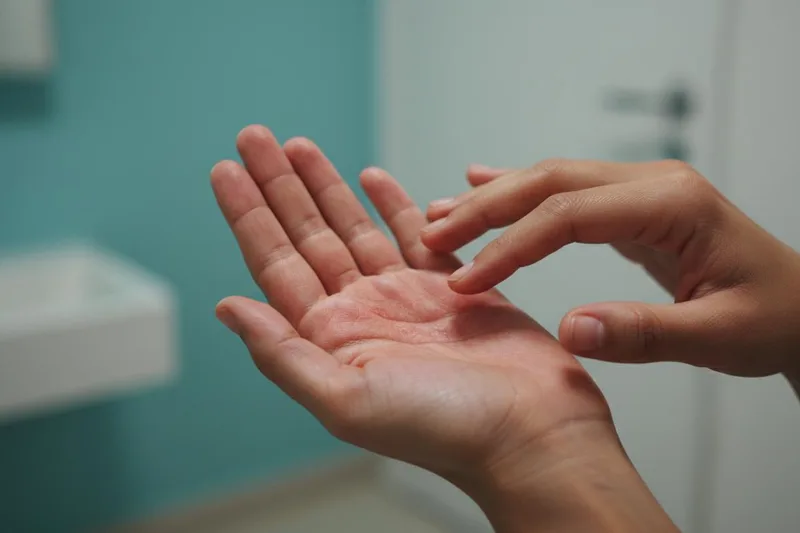
Do your hands sometimes itch unbearably? Or do they look red and flaky? For some people, the palms of their hands may be very dry, the skin may be rough, and in some places it may even crack. When we have symptoms like these, we think that it is just a minor skin problem. However, this could actually be a fungal infection. That is the condition we are going to talk about today, called `Tinea Manuum`. Don't worry, let's talk about this in detail.
What is Tinea Manuum? Let's find out exactly!
Simply put, Tinea Manuum is a fungal infection that can occur on one or both of your hands. It affects the top layer of your skin. Some people also call it ``Ringworm''. However, even though the name ``Ringworm'' says it, it doesn't have a worm attached to it. That's because when this infection occurs, it sometimes looks like a ring, like a ring. There may be a little raised area around that ring, like a scab.
This condition, called Tinea Manuum, can affect the following areas of your hands:
- Your hand.
- On the back of the hand.
- For the folds of skin between the fingers.
Tinea Manuum is often confused with Tinea Pedis (also known as Athlete's Foot), a fungal infection of the feet. However, it can also occur on the hands.
Who gets this most often? How common is it?
Tinea manuum can affect anyone of any age, regardless of gender. However, it is most commonly seen in young boys and older men.
It is estimated that about 25% of the world's population suffers from fungal infections. Among them, Tinea Manuum and Tinea Pedis are the two infections that doctors most often diagnose. In some countries, Tinea Manuum accounts for about 13% of all fungal infections.
Tinea Manuum can occur on both hands, but most often it occurs on only one hand. This is also known as "Two feet, one hand syndrome" among doctors. This means that when you have Tinea Pedis on both feet, you also have Tinea Manuum on one hand. This occurs in about 65% of cases. Fungal infections on both hands and feet occur in about 20% of cases, Tinea Manuum on only one hand occurs in about 12% of cases, and Tinea Manuum on both hands occurs in about 4%.
What are the symptoms of Tinea Manuum?
The main symptom is itchy, circular spots on the back of the hand. In someone with light skin, these spots may appear red or pink. In someone with dark skin, they may appear brown or gray. These spots may sometimes be clear in the center and may form several circles around them. The circles may sometimes be raised and have a scaly appearance.
The skin on your palms may become thick. The skin may also become very dry . You may notice deep cracks on your palms. The cracks may look like white peeling inside. The palms may itch or not. Sometimes there may be pain and swelling .
You may notice red spots on the skin around your fingers, along with blisters and pimples. In many cases, this infection can spread to your nails as well .
Why does tinea manuum occur? What are the causes?
Tinea Manuum is caused by a type of fungus. These fungi thrive in warm, moist environments. They are common in tropical environments like ours. They also thrive in damp places like public bathrooms and locker rooms in gyms.
Tinea Manuum is a very contagious disease. You can get it if you touch someone who has the infection, an infected animal, or soil that has the fungus. You can also get it if you use items that have the fungus or touch areas that have the fungus. The fungus can live on infected items and surfaces for a long time.
Many people develop Tinea Pedis (Athlete's foot) on their feet before they develop Tinea Manuum. This fungus is very contagious, so if you scratch your feet, the fungus can spread to your hands and cause Tinea Manuum.
Who is most at risk of developing this?
We've already mentioned that the fungus that causes Tinea Manuum loves warm, moist environments. So, here are some things that increase your risk of developing this condition:
- Living in a tropical environment: Just like our Sri Lanka.
- Traveling to hot, humid areas.
- Using public bathrooms, locker rooms, indoor swimming pools, and gyms.
- Many people live together in places like boarding houses.
- Playing physical sports like wrestling and football.
- Sharing things like clothes, towels, bedding, combs, and sports equipment with others.
Also, some people who work with their hands are more likely to develop it. For example:
- People who interact closely with others, such as massage therapists and hairdressers.
- People who work closely with animals, such as farm workers and veterinarians.
- Car mechanics, machine operators, people who work with chemicals.
There are several other risk factors:
- Being male.
- High blood pressure (Hypertension).
- Weakened immune system (e.g. due to conditions such as HIV/AIDS, cancer, diabetes).
- Atherosclerosis.
- Obesity.
- Excessive sweating (Hyperhidrosis).
How is this transmitted?
Tinea Manuum is a highly contagious disease. It can be transmitted in three main ways.
From people
You can also get it if you come into direct contact with someone who has the infection. That person may or may not have symptoms. But if they are a carrier, they can spread the infection.
From animals
You can also get it if you touch an infected animal. It can be transmitted from pets such as dogs and cats (especially puppies and kittens), as well as from farm animals such as cattle, horses, pigs, and goats.
From inanimate objects (Fomites)
Fomites are objects or materials that can carry an infection. These fungi can be spread by sharing items such as clothing, towels, and bedding. They can also live on hard surfaces in moist environments (e.g., locker rooms, public bathrooms).
It can spread from one part of your body to another, as well as from touching the fungus in the soil, infected objects in the environment.
How does a doctor diagnose tinea manuum?
When you go to see a doctor, they will ask you about your symptoms and examine you. They will look at your palms, the backs of your hands, and your fingers. They will often also look at your feet, because many people with Tinea Manuum also have Tinea Pedis (a fungal infection of the feet).
The doctor may want to take a small sample of the infected area and do further tests to confirm that it is Tinea Manuum.
What tests are being done?
To accurately diagnose Tinea Manuum, the following tests can be performed:
KOH test (KOH stain)
In this, the doctor gently scrapes a small amount of skin from the infected area of your hand. In the lab, the skin scrapings are placed on a microscope slide, a drop of potassium hydroxide (KOH) is added to it, and the sample is examined under a microscope. The KOH makes it easy to see if the fungus is present. The results are usually available within 24 hours.
Cultivation of fungi (Culture)
If the `KOH` test is not definitive, your doctor may order a `Culture`. A `Culture` is a medium that allows fungi to grow. The technician can then determine exactly what type of fungus is causing your infection. This is more accurate than the `KOH` test, but it can take several weeks for the results to come back.
Dermoscopy
Sometimes your doctor may use a procedure called dermoscopy to check for a fungal infection on your hands. This involves using a handheld device called a dermoscope. It has a magnifying lens and a light system. It can see details that are invisible to the naked eye. If you have tinea manuum, you will often see white, scaly patches inside the cracks on your hands.
What are the treatments for Tinea Manuum?
Your doctor will prescribe antifungal medication to treat tinea manuum. In most cases, you can treat the infection at home with an over-the-counter cream. This antifungal cream should be applied to the affected area once or twice a day for about six weeks. Examples of these creams include Miconazole (e.g. Monistat 7®) and Clotrimazole (e.g. Lotrimin®).
But in some cases, your doctor may prescribe an oral antifungal medication. If your infection has spread to your nails or to a larger area of your body, you may need oral medication. You may also need oral medication in the following cases:
- If your immune system is weak.
- If all the medicine doesn't work.
- If you get this infection frequently.
Examples of oral medications are `(Terbinafine)` (e.g. `Lamisil®`) and `(Itraconazole)` (e.g. `ONMEL®`).
How can I reduce the occurrence of this? Prevention methods
There are many things you can do to prevent Tinea Manuum. Here are some things you can do:
- Maintain good hygiene: Wash your hands frequently, rinse and dry them thoroughly. Keep your nails short and clean.
- Avoid scratching your feet: If you scratch your feet, you are more likely to get the fungus on your hands.
- Treat Athlete's Foot Quickly: If you have athlete's foot, it needs to be treated quickly and completely to prevent it from spreading to other parts of the body, including your hands.
- Do not use topical steroid creams: Corticosteroids may temporarily relieve itching, but they will not cure the fungal infection and may delay the diagnosis.
- Do not share personal items with others: Do not share items that may contain fungus, such as clothes, towels, and bed sheets.
- Be careful when around animals: Wash your hands thoroughly after handling or playing with pets or other animals. If you think your pet has a fungal infection, take it to a veterinarian.
- If you are an athlete, consider this: If you play a sport that involves contact with your body, shower promptly after practice and competition. Don't share sports equipment with others, and keep your uniform and other equipment clean.
What happens if you get tinea manuum? How long does it take to heal?
Tinea Manuum can cause the skin on your hands to become dry and itchy. You can treat it at home with an over-the-counter antifungal medication. However, tinea manuum can sometimes be difficult to treat. Just like taking an antibiotic, it is important to take the full course of antifungal medication. You may notice that the spots are getting smaller, but if you don't finish the treatment, they can come back.
Remember, you need to take the medicine for the entire duration prescribed by the doctor. Only then will you be completely cured.
If the infection persists, you should see a doctor. He or she can diagnose your condition and recommend the best treatment. If the infection does not clear up, you may need to take an antifungal medication prescribed by your doctor. It may take some time, but tinea manuum infections will eventually clear up.
Fungal infections can be difficult to treat. So it's important to use any antifungal medication exactly as directed. Even if your infection seems to be clearing up, it can come back if it's not completely treated. You may need to continue using the antifungal medication for up to six weeks , according to the instructions on the medication package. If your infection hasn't cleared up after six weeks, see a doctor.
Finally, the most important thing to remember (Take-Home Message)
Okay, so we've talked a lot about Tinea Manuum, haven't we? Finally, here are the most important things you need to remember:
- Tinea Manuum is a fungal infection, not a worm infection.
- This can be contagious, so it is very important to take care of cleanliness.
- This can be cured with the right treatment. However, the medication must be used for the entire period prescribed by the doctor.
- If home treatments don't help, definitely see a doctor.
- Taking preventative measures is the best way to reduce the risk of developing this condition. Especially if you have a fungus on your feet, make sure you don't spread it to your hands.
Tinea manuum is an itchy, uncomfortable infection. However, you can treat it at home with antifungal medications. But it takes a while. It is very important to follow the instructions on the package and complete the treatment. If you are having trouble treating it on your own, seek help from a doctor. They are there to help you. You don't have to endure this pain and itching.
` Tinea Manuum, Fungal Infection, Fungus on Hands, Skin Diseases, Ringworm, Tinea Manuum, Antifungal


💬 Comments (0)
No comments yet. Be the first to share your thoughts here.
Add Your Comment