

Have you ever looked at your toenail and thought, "Oh, this one's changed color and is getting thicker"? Or have you ever noticed that your nail is breaking into small pieces? You might think that this is just something else. But in fact, this could be a sign of a nail fungus infection, which is very common in our country and around the world, and can be a bit annoying. So let's talk about this in detail, simply.
What is Toenail Fungus?
Simply put, nail fungus is a fungal infection that affects your toenails. It can also affect your fingernails, but it is most common on your feet. This happens when a fungus, a type of fungus, gets into your nail and the skin underneath it (called the nail bed). The fungus usually enters through a small cut, nick, or crack in your nail.
The medical name for this is Onychomycosis .
Is there another medical name for this?
Yes, you may have heard of Tinea unguium . This name is used specifically when this infection is caused by a type of fungus called dermatophyte . Dermatophytes are a type of mold. They need a protein called keratin to live and grow. Did you know that your nails, hair, and the top layer of your skin are made of this protein called keratin. This keratin is what gives your nails their hardness. So this type of fungus feeds on keratin and grows inside your nails. This type of fungus, called dermatophytes, is responsible for 90% of nail fungal infections.
Who is most at risk of developing this condition?
It can actually happen to anyone, but it is more common as you get older, especially in people over the age of 60. In addition, if you have any of the following conditions, you are at a slightly higher risk of developing nail fungus.
- Athlete's foot / Tinea pedis: If you frequently get a fungal infection that affects the skin between your toes, the fungus can also spread to your nails.
- Diabetes: People with diabetes may develop fungal infections more easily because their blood circulation and immunity may be weakened.
- Excessive sweating (Hyperhidrosis): If your feet are constantly sweaty and moist, it is the perfect environment for fungus to grow.
- An accident to the nail: If the nail is hit hard, bruised, or if a blood clot forms under the nail, the fungus can enter through it.
- Poor blood circulation: Infections are more likely to develop if blood flow to the legs is reduced, especially due to conditions such as peripheral vascular disease .
- Psoriasis: People with skin diseases like psoriasis can also develop these infections along with changes in their nails.
- Weakened immune system: People with weakened immune systems due to HIV infection or another autoimmune disease have a harder time fighting fungal infections.
Imagine, if you're someone who wears closed shoes all day, your feet are sweaty and damp all day long. This is like a party for fungi. They love warm, moist, dark environments.
What are the symptoms of a nail fungus infection?
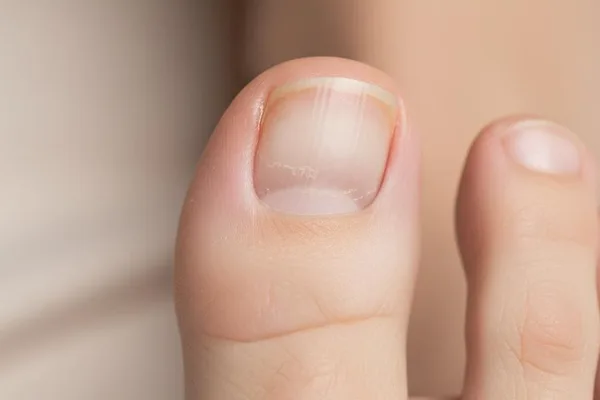
When this infection occurs, the appearance of the nail can vary. You may see one or more of these symptoms. Let's look at the table below to understand this clearly.
| Symptom | The change that occurs (Description) |
|---|---|
| Color change | The nail may turn white, yellow, or brown. It may start as a small spot at the tip of the nail and gradually spread to the entire nail. |
| Thickening of the nail | The nail may become thicker than normal and its shape may change. This makes it difficult to cut the nail. |
| Breaking into small pieces | The nail becomes very brittle. The edges and tips of the nail can easily break and crumble. |
| Nail bed removal | As the infection progresses, the nail may separate from the skin underneath (the nail bed) and lift up. |
| A bad smell | In some cases, an unpleasant odor can be caused by things like dust accumulating under the nail. |
This condition is usually not painful , but if the infection becomes severe, the nail may become very thick and painful when wearing shoes.
Is this contagious? How do we get it?
Yes, it is definitely contagious. Nail fungus is very contagious. It can be spread from person to person through direct contact, as well as by touching an infected surface.
Imagine going into a bathroom, a swimming pool, or a gym locker room without your shoes on. There may be fungal spores on the floor in such places. Even a small cut on your foot can introduce the fungus into your body.
Likewise, if one person in a household has this infection,
- Using the same nail clipper
- By using the same towel
- Using the same bathroom without slippers
There is a high chance that others will be infected as well.
Can this infection spread to other parts of the body?
Usually, nail fungus rarely spreads beyond the toenails. However, some types of dermatophyte fungi can easily spread to the skin. Because, as mentioned earlier, the skin also contains keratin.
This is how a nail fungus infection can spread to the following areas:
- To the nails of the other leg
- The skin between the toes (we call this Athlete's foot )
- In the groin area (this is called Jock itch )
- Scalp skin (this can occur as ringworm )
A little tip to reduce this spread is to put on your socks first when you get dressed. Then put on your underwear. This will prevent the fungus on your legs from spreading to your groin area by getting on your underwear.
How do you know for sure if this is a nail fungus infection?
If you notice a change in your nail, the best thing to do is to see a doctor . The doctor will first examine your nail carefully. Sometimes, it can be diagnosed as a fungal infection just by looking at it.
However, sometimes there can be other causes for nail changes, so the doctor may recommend a test to confirm the exact cause.
This involves scraping a very small sample from under the nail or from the nail itself and examining it under a microscope. This can look for fungal cells. Sometimes the sample is sent to a laboratory to see if the fungus grows (cultured). This can help determine exactly what type of fungus is causing the infection.
What are the treatments for this?
Nail fungus is a difficult and stubborn condition to treat . It can take several months, or even longer, to completely eliminate the fungus. Also, even after treatment, there is a high chance of recurrence.
If you see a dermatologist , they will choose the most appropriate treatment for you. If the infection is very mild and doesn't bother you, your doctor may recommend no treatment at all.
There are several main treatment methods.
Oral antifungal medication
This is the most commonly used and most effective method. Your doctor will prescribe an antifungal medication that you will take every day for several months. For example, you may be given medications such as Terbinafine , Itraconazole , or Fluconazole . While you are taking these medications, your doctor may do blood tests to check for any liver damage.
Topical medication
These come in the form of liquids, creams, or medicated nail polish. These are applied directly to the infected nail. However, they are more effective when used in conjunction with oral medications than alone. This is because it is more difficult for these creams to penetrate through a thick nail and kill the fungus.
Laser treatments
This is a relatively new treatment. It involves using a special laser beam to destroy the fungus. However, it is difficult to guarantee that this will completely cure the infection. The success rate is lower than other treatments. Therefore, this treatment is not usually recommended as a first step.
What can be done to prevent it from recurring?
Just as important as treatment is preventing it from happening again. There are a few things you can do to help.
| Do's | Don'ts |
|---|---|
| Keep your feet clean and dry. After bathing, dry them thoroughly, even between the toes. | Don't walk barefoot in public places. Be sure to wear a pair of slippers in places like swimming pools and public bathrooms. |
| Wear socks that absorb sweat. Cotton or wool socks are best. Change your socks if your feet sweat during the day. | Avoid wearing tight, air-tight shoes. Choose shoes that allow your feet to breathe and fit well. |
| Cut your nails straight across. Cut them straight across, not around the edges. It's easier if you soak your nails in hot water before cutting them. | Do not share your nail clippers, towels, etc. If someone in your family has an infection, use separate items. |
| Dry your used shoes thoroughly. If possible, avoid wearing the same pair of shoes for two days in a row. Wearing them alternately gives the shoes time to dry. | Avoid applying nail polish frequently. Nail polish can trap moisture under the nail and encourage fungus to grow. |
When should you definitely see a doctor?
Nail fungus is usually not a serious condition. However, in some cases, especially in people with other medical conditions, it can be serious. Very rarely, this fungal infection can lead to cellulitis, a serious bacterial infection of the skin. It is a serious health threat.
If you have the following conditions, it is imperative to seek medical advice as soon as you notice a change in your nails:
- Diabetes
- If there is poor blood circulation to the legs
- If the immune system is weak (e.g. HIV)
- If the skin around the nail is red, swollen, painful, or pus is coming out
In cases like this, it is very important to seek treatment for even a minor infection before it becomes a major problem.
Take-Home Message
- Nail fungus is a very common, but somewhat stubborn infection. It can be unsightly, but it's usually not painful.
- This is contagious. It is important to avoid walking barefoot in public places and sharing personal items.
- Treatment can take months. For the most effective treatment, be sure to see a doctor.
- The best way to prevent this is to keep your feet clean and dry at all times.
- If you have diabetes, circulatory problems, or a weakened immune system, seek medical advice even for the slightest change.




💬 Comments (0)
No comments yet. Be the first to share your thoughts here.
Add Your Comment