
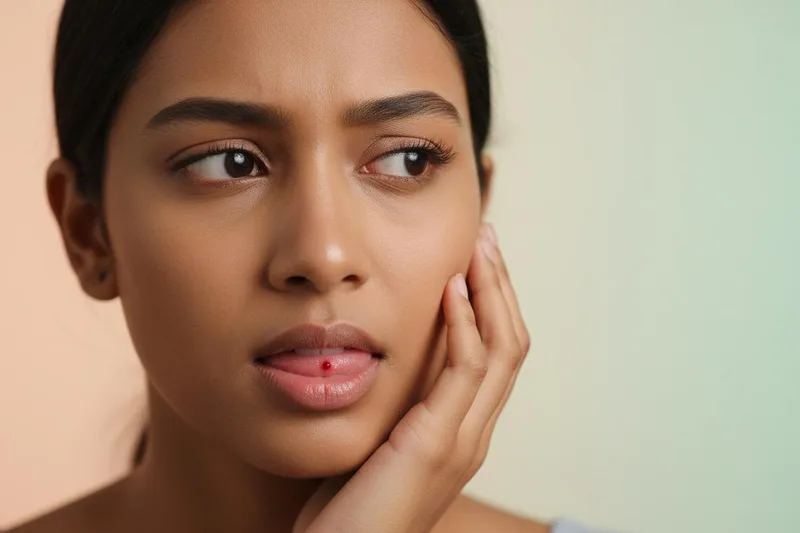
Have you ever noticed that small, red or white bumps suddenly appear on your tongue, which are very annoying when you talk or eat? Sometimes they appear on the tip or both sides of the tongue. Our ancestors sometimes called this "lying bumps". However, the medical name for this is `(Transient Lingual Papillitis)`. Some people also call it `(Lie Bumps)`. What exactly is this? Why does this happen? Let's talk about this in a little more detail today.
What exactly are these blisters on the tongue? (What is Transient Lingual Papillitis?)
Simply put, `(Transient Lingual Papillitis)` is when the small, bumpy parts of our tongue, that is, the taste buds (this is called `(Papillae)`), become irritated and swollen for some reason. Imagine, there are thousands of these little `(Papillae)` all over our tongue, and inside them are the taste buds. So when one or more of these `(Papillae)` are `irritated` by something, that is, when they get irritated, they become swollen, red, and sometimes white, and appear as a painful blister.
Is that "you get a headache when you lie" just a myth? It's just a rumor. This situation can happen to anyone, whether they lie or not.
How common is this situation?
This is actually a very common condition . However, since most people get these blisters and they heal on their own in two or three days, not everyone goes to a doctor. That's why it's difficult to say from statistics exactly how many people get this. But doctors say that this is a very common thing to see.
What are the symptoms of this?
If you have ``Transient Lingual Papillitis'', you may experience symptoms like these:
- Small blisters on the tongue: These can be red, white, or sometimes yellowish. They are most often seen on the tip, sides, or back of the tongue.
- Sharp pain: The pain may feel like a stabbing or burning sensation. This pain may increase when eating, drinking, and sometimes even talking.
- Burning sensation: There may be a burning or hot sensation in that area of the tongue.
- Some people may feel like they don't want to eat because they feel pain when eating.
Imagine, when you wake up in the morning, a small red blister suddenly appears on the tip of your tongue, and you can't eat or talk all day, and you're in a lot of pain. That's the nature of this.
Are there different types of tongue blisters?
Yes, there are several different types of this condition, ``Transient Lingual Papillitis''. The symptoms of each type may vary slightly.
Classic type
This is the most common type . It is characterized by the appearance of one or more red, painful blisters on the tip or sides of the tongue. These usually heal on their own within a few days.
Eruptive Lingual Papillitis
This type is especially common in young children . In this case, along with the red and white blisters, you may also see a fever and swollen lymph nodes around the neck . Sometimes this type is thought to be contagious . It is heartbreaking when your little one has a fever and blisters in their mouth, and cries without eating. If that happens, the best thing to do is to show them to a doctor.
U-shaped type
This type of tongue may feel slightly enlarged (also called `(Macroglossia)`) and spots may appear on the tongue. Some studies suggest that this may also be a symptom of `(COVID-19)` infection.
Papulokeratonic type
This is when the entire tongue becomes covered with white and yellow blisters. This can look quite serious.
Why do we get these "Lie Bumps"? What are the causes?
It can sometimes be difficult to pinpoint the exact cause of these little blisters. Because there can be many reasons why those ``Papillae'' on our tongue become irritated. According to research, these are the main ones:
- Trauma to the tongue: This can be caused by things like inadvertently biting the tongue, brushing the tongue with a hard toothbrush, or rubbing the tongue with braces (orthodontics).
- Stress: Don't be surprised, excessive stress can also be a cause! Stress affects many things in our body.
- Viral infections: Some viral infections can cause tongue blisters like this.
- Hormonal fluctuations: This condition can occur due to hormonal changes, especially in women, during the monthly menstrual cycle or during pregnancy.
- Food allergies: These types of blisters on the tongue can also be caused by allergies to certain foods. For example, some people may experience this after eating spicy "Nairos", or a pickle with a lot of lime, or acidic fruits like tomatoes and pineapple.
- Atopic diseases: People with atopic diseases such as atopic dermatitis (a condition like eczema) are more likely to develop this condition.
- Oral products: The tongue can become sensitive to chemicals in some toothpastes, mouthwashes, and teeth whitening products, causing these blisters. In one study, a woman who ate a hot candy containing cinnamon and chili pepper developed a condition called ``Transient Lingual Papillitis.'' It's a condition similar to ``Contact Dermatitis'' that affects the mouth.
Imagine, if you started getting blisters like this on your tongue the day you started using a new toothpaste, that toothpaste might be bad for you.
How does a doctor recognize this?
Often, a doctor will diagnose this as ``Transient Lingual Papillitis`` just by examining your tongue . In addition, the doctor will ask you questions like:
- How long have these symptoms been present?
- Has it ever happened like this before?
- Did this happen after eating or drinking something special, or after using a new toothpaste or mouthwash?
- Are there any other symptoms (such as fever, body aches)?
With the answers you give to these questions, it will be easier for the doctor to diagnose this condition accurately. Special tests are often not needed.
What are the treatments for this?
The good news is that most of the time, no special treatment is needed for `(Transient Lingual Papillitis)`. These blisters will heal on their own within a few days, or at most a week. However, there are a few things you can do to reduce the pain and discomfort:
- Painkillers: You can use an over-the-counter (OTC) painkiller (e.g. paracetamol) that you can buy from a pharmacy without a prescription.
- Gargle with salt water: Dissolve about a teaspoon of salt in a glass of lukewarm water and rinse your mouth with the water two or three times a day to reduce pain and swelling. It also helps prevent infection.
- Eliminating harmful substances: If you think that this is caused by a certain food, drink, or toothpaste, try stopping using those things for a few days. It is best to reduce spicy foods, very sour foods, and very sweet foods during these days.
What will happen if this situation occurs? How long will it last?
Usually, these symptoms of ``Transient Lingual Papillitis'' go away completely after a few days to a week . However, for some people, it can come back again and again . Especially if you can't find the exact cause of it, and you continue to use the same thing, it is likely to come back.
What should you do when you get "lie bumps"? How do you take care of yourself?
The most important thing you can do when these blisters appear is not to pick, squeeze, or pop them . Yes, they can look like pimples on your tongue. You may even want to pop them.
But control that urge! These are not like pimples on the skin. A pimple is a pore in the skin that is filled with dirt. But these tongue blisters are swellings of the papillae, which are part of your tongue. If you try to pop them, the wound will get worse, the pain will increase, and you may even get an infection.
So, be careful not to get those blisters. In addition, stay away from things that you think are causing this condition:
- Spicy foods: Foods high in chili and pepper.
- Acidic foods and drinks: Foods and drinks made with things like lemons, oranges, grapefruit, and vinegar.
- Eating and drinking too much sugar or honey.
- Any toothpaste or mouthwash that seems to irritate your `(Papillae)`.
Taking care of these things will help you recover quickly and prevent this condition from recurring.
When should I see a doctor?
Transient Lingual Papillitis is not a serious condition and usually resolves without medical treatment. However, if you notice any changes (such as a lump, spot, or sore) on your tongue, gums, or inside your mouth that do not improve after more than two weeks , it is important to see a doctor or dentist. This could be a sign of a more serious condition. Therefore, if you have any concerns, it is wise to see a doctor to get it checked out.
Important questions to ask your doctor
If you go to see a doctor, it's a good idea to ask these questions:
- What type of ``Transient Lingual Papillitis'' do I have?
- Will I need treatment for this?
- Can this happen to me again?
- What can I do to prevent this situation from happening again?
The doctor's answers to these questions will help you gain a better understanding of this condition.
So, what did we learn from this (Take-Home Message)
Simply put, these `(Transient Lingual Papillitis)` or `(Lie Bumps)` are small, painful blisters caused by irritation of the taste buds (`Papillae`) on the tongue. The story of "lying bumps" is just a myth. There are many reasons that can cause this condition – tongue biting, stress, certain foods, toothpaste, etc.
The most important thing is that this is not a serious illness, and it usually heals on its own. However, it can be a little annoying and painful. Don't try to pop those blisters, and stay away from things that you think are bad for you. Rinsing your mouth with warm salt water is also good.
But remember, if you have anything unusual in your mouth for more than two weeks, don't forget to see a doctor.
So, I hope these points are helpful to you. If you have had a similar experience, there is nothing to fear. Be careful about the things I have said.
` tongue blisters, lie bumps, transient lingual papillitis, tongue pain, tongue damage, tongue diseases, mouth diseases, taste buds, papillae


💬 Comments (0)
No comments yet. Be the first to share your thoughts here.
Add Your Comment