

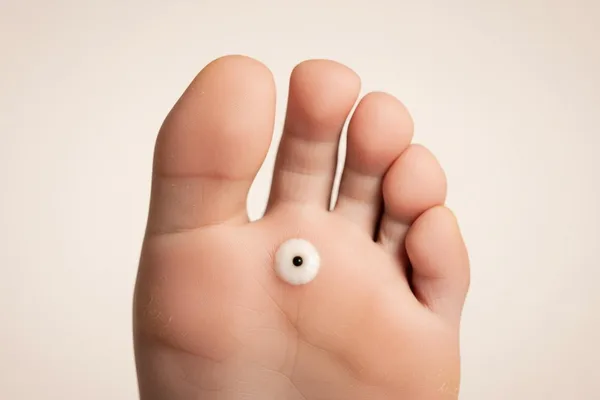
Have you ever noticed that there's a small white circle on your leg, especially on the soles of your feet or between your toes, with a black dot in the middle? It might be itchy or painful. If so, it could be a skin condition called "tungiasis." This is caused by a tiny sand flea burrowing into your skin and laying eggs. Don't worry, we'll talk about it in detail.
What is Tungiasis?
Simply put, Tungiasis is a painful, itchy skin condition caused by female sand fleas burrowing into the skin, where they lay eggs. You'll see a white, circular lesion with a small black dot in the middle. These most commonly appear on the legs, such as the soles of the feet, heels, and between the toes. However, they can appear anywhere on the body.
Just think, this disease was first reported in the 1500s! Some of Christopher Columbus' crew members also contracted Tungiasis after they were shipwrecked on the Caribbean island of Haiti.
Who is this sand flea?
The scientific names of the sand fleas that cause Tungiasis are `(Tunga penetrans)` and `(Tunga trimamillata)`. They are also called by other names, for example:
- "Bicho del pie" - that means something like "worm on the leg."
- Chigoe fleas
- Jiggers
- Nigua
- Pico
You don't need to remember all of these names, but most people know when you say "sand flea".
Where is this sand flea?
We don't see these special sand fleas everywhere in Sri Lanka. As their name suggests, these fleas prefer sandy areas, such as beaches. They can also live in warm, dry soil on farms and in animal pens. In addition, these fleas can move from one place to another by clinging to the fur of animals.
In the past, these sand fleas were only found in the West Indies and the Caribbean, but now they are also found in these tropical and subtropical regions:
- Africa
- India
- Latin America
- Pakistan
How common is Tungiasis?
More than 20 million people worldwide are at risk of developing tungiasis. It is particularly common among barefoot people, in rural areas, in remote villages, and in slums in large cities. It is most common in boys between the ages of 5 and 14, and in older people. It is estimated that 8 out of 10 underprivileged children living in areas where sand fleas are present will develop tungiasis.
Why does Tungiasis occur?
You can get tungiasis from direct contact with sand fleas on the ground, or from touching the fur of an animal that has sand fleas. These fleas are most commonly found on animals like pigs, cattle, dogs, cats, and rats. Also, these sand fleas are so small that we can't even see them with our eyes.
The important thing is that only female sand fleas that are ready to lay eggs cause Tungiasis. Male sand fleas also suck our blood, but since they don't have eggs to lay, they don't burrow into the skin, and therefore don't cause Tungiasis.
How does this really happen?
Okay, let's see how this works. The female sand flea bites and gnaws a small hole in your skin, the epidermis. Then, she goes through that hole and into the second layer of your skin, the dermis. She starts sucking blood from the blood vessels there. Your blood is what she needs to make her eggs. The flea breathes through that hole in your skin.
The black dot in the middle of the white circle you probably see is the back of the sand flea that has burrowed into the skin. That's where the eggs come out.
This way, the sand flea can live inside your skin for about six weeks. It drinks your blood and grows with the eggs. During this time, it can lay about 100 eggs. Those eggs fall out of the hole in the skin and fall to the ground. After laying the eggs, the sand flea dies and is removed when your skin sheds.
After about four days, the eggs that have fallen to the ground hatch into larvae. They feed on organic matter in the sand or soil. Then, the larvae pupate, and after about four weeks, they become full-grown sand fleas. Those fleas are the ones that come back to find people and start sucking blood.
What are the symptoms of this?
Sand fleas can't jump very far. That's why they mostly burrow into the skin on your soles, between your toes, on your heels, or on the backs of your legs. When a female sand flea first enters your skin, you may not even feel it. But after she burrows into your skin, you'll see a white circle, like a ring or a sparrow's eye, with a black dot in the middle. Over time, as the sand flea feeds on blood and grows with its eggs, that black dot also gets bigger.
This injury can look like this:
- It scratches very well.
- There is also pain.
- It may be red.
- It may be swollen and tight.
What complications can this cause?
People with tungiasis are at high risk of developing serious bacterial infections from the insect burrowing into the skin and scratching. These infections can lead to permanent leg deformities and inability to walk.
Other possible complications are:
- Bacterial infection of the blood (`(Bacteremia)`), which can lead to serious conditions such as `(Septicemia)` and `(Sepsis)`.
- Cellulitis is a skin infection caused by an insect bite.
- Gangrene (death of tissue).
- Tetanus (a bacterial infection that affects the nervous system and can be life-threatening).
How do you recognize this?
Health workers working in areas where tungiasis is common can diagnose the disease by examining the skin. In fact, many people living in such areas are aware of tungiasis and recognize it themselves when they get it.
How do doctors treat this?
Your doctor may use sterile forceps or a needle to remove the sand flea from the skin. Since the flea is swollen from the blood, a small incision (excision) may be needed to completely remove the flea.
Other ways to get rid of sand fleas are:
- Applying an antiparasitic medication, a thick wax, or a jelly to the wound will kill the sand flea.
- Cryotherapy kills sand fleas by freezing skin tissue.
Can this be treated at home?
Oh no, never do that! Only a qualified health care professional should attempt to remove a sand flea that has burrowed into the skin, using sterilized equipment.
In areas where healthcare is not readily available or expensive, people sometimes use unsterilized equipment to treat sand fleas. Sometimes, the same equipment is used to treat several people in a family or village.
These unsafe methods can lead to:
- Sand fleas can burst inside the skin, causing a bacterial infection.
- Using unsterilized equipment can spread diseases such as `(Hepatitis B)`, `(Hepatitis C)`, and `(HIV/AIDS)`.
How can you survive this?
If you are traveling to an area where tungiasis is common, you can reduce your risk by doing the following:
- Wear fully enclosed shoes.
- Wear socks that cover your ankles.
- Wear long pants.
- Avoid walking barefoot as much as possible.
- You can apply a herbal insecticide `(Zanzarin®)` (a special insect repellent like this) to your legs twice a day. This can reduce the risk of tungiasis. Your doctor can help you find this treatment.
- In some countries, a different type of insecticide is sprayed on the ground to kill sand fleas.
What happens if this happens? Will most people recover?
Most people with tungiasis recover without treatment. However, the pain and itching until the sand fleas die can be very uncomfortable. In poor areas without good health care, infections caused by tungiasis can be disabling and even life-threatening.
When should I see a doctor?
If you see any of the following after you return from an area where sand fleas may be present, see a doctor immediately:
- If you have white lesions/spots on your legs, ankles, or anywhere else on your body.
- If the skin itches, is painful, or looks like a rash .
- If you develop a fever after treatment for Tungiasis, or if you notice red streaks on your skin (these could be signs of an infection).
What should you ask the doctor?
You can ask the doctor questions like:
- What is the best treatment for Tungiasis?
- What can I do to protect myself from Tungiasis when I travel?
- What symptoms of Tungiasis should I look out for?
- Should I also look into complications?
What is the difference between Tungiasis and regular flea bites?
The most important difference is that only sand fleas (which cause tungiasis) burrow into your skin and suck blood. Other types of fleas come to the surface of your skin and temporarily suck blood. You may then see a few small red blisters. Although these common flea bites can be itchy and upsetting, they are not a major health threat like those caused by tungiasis, but rather a nuisance.
Finally, things to remember
If you are traveling to an area where sand fleas are likely to be present, it is important to take precautions to reduce your risk of developing tungiasis. Wear fully enclosed shoes, socks that cover your ankles, and apply a special insect repellent to your feet. Before you travel, ask your doctor about how to find such an insect repellent.
Many people with tungiasis seek treatment to remove or kill the sand flea. To reduce the risk of infection and other complications, it is essential to seek proper medical attention to remove the sand flea. Remember, never try to do this at home alone. Your safety is paramount!
` Tungiasis, sand flea, skin disease, itchy, pain, infection, jiggers




💬 Comments (0)
No comments yet. Be the first to share your thoughts here.
Add Your Comment