
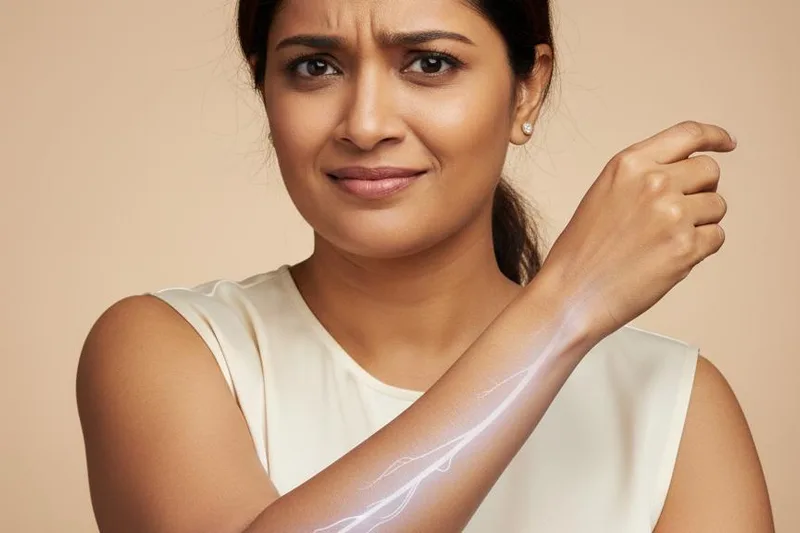
We've all experienced this feeling when we bump our elbow somewhere, like we've been hit by a "funny..." and then feel a strange tingling sensation running down our entire arm. We jokingly call this the "funny bone." But did you know that this "funny bone" isn't actually a bone, it's a very important nerve in our hand? Today we're going to talk about the part of the arm that causes this experience, medically known as the Ulnar Nerve.
What exactly is this 'Funny Bone'?
Simply put, it's a nerve. The ulnar nerve, which runs deep under the skin on the inside of our elbow, sits on top of a bone. So, when our elbow hits a hard surface, this nerve is temporarily compressed. It's like a wire being pinched. That's when we get this electric, tingling, "funny" feeling. So the name "funny bone" comes from this strange, laughing sensation, not because it's a bone.
A small pinched nerve can cause pain, numbness, and weakness in your hand. This can affect your ability to grip things, perform daily tasks, and even feel sensations. If you have these symptoms, it's best to see a doctor. He or she can talk to you about your symptoms and offer you the solutions you need to get relief.
What is the function of the ulnar nerve? How is it important to the body?
The Ulnar nerve is a very important nerve in our hand. It controls many of the small muscles in our hand. Although this nerve starts in our armpit area, its main functions begin in the forearm. Its main functions can be divided into two parts.
| Function | Description of what is happening |
|---|---|
| Controlling movements (Motor Function) | These nerves carry messages from our brain to our muscles, causing movement. For example:
|
| Providing sensations (Sensory Function) | This nerve also carries sensations such as touch, temperature, and pain from certain parts of our hands to the brain. That is:
|
Where is the Ulnar nerve located in our body?
This is like a long cable inside our body. It starts in the brachial plexus , a bundle of nerves that starts in our cervical spine. From there, this nerve travels a long way.
Think about it this way...
1. This nerve starts in our armpit.
2. Moves down from the inside of the upper arm.
3. Next comes the most important part - the elbow. This nerve runs through a tunnel of tissue (called the Cubital Tunnel ) under a bony bump on the inside of the elbow. That's where we call the "Funny Bone."
4. Then, move under the muscles on the inside of the forearm.
5. Finally, at the wrist, another small tunnel ( Guyon's Canal ) enters from the palm side and divides throughout the hand.
During this journey, the ulnar nerve divides into smaller branches, each of which provides movement and sensation to different parts of the hand.
What problems can occur with the ulnar nerve?
This nerve can become damaged or compressed for various reasons. Here are some of the main conditions that can occur when this happens.
| Condition | Simply put... |
|---|---|
| Ulnar Nerve Entrapment | This means that the nerve is compressed somewhere along its path. Just as a water pipe stops flowing when it is squeezed, when a nerve is compressed, messages do not travel properly. This can happen in the elbow or wrist. |
| Cubital Tunnel Syndrome | This is the most common condition. It occurs when the ulnar nerve is compressed over a long period of time at the elbow, where the 'Funny Bone' is located. This condition can occur in people who keep their elbows pressed against a table or who constantly bend their elbows. |
| Ulnar Tunnel Syndrome (Guyon's Canal Syndrome) | This condition occurs when the nerve enters the hand through the Guyon's Canal, a passageway at the wrist where it is compressed. It can occur in cyclists and people who work with their hands. |
| Ulnar Nerve Dislocation | This is when the nerve is pinched. This usually happens after an accident or fall. If you hear or feel a "click" sound when you bend or straighten your elbow, this could be the case. |
What symptoms should you be concerned about?
When the ulnar nerve is compressed, various symptoms can occur. These may not be noticeable at first, but they can increase over time. Therefore, it is very important to be aware of these symptoms.
- Numbness and Tingling: This is the most common symptom. It is a tingling sensation, especially in the little finger and ring finger (fourth finger) . It can feel as if the fingers are "sleeping."
- Hand Weakness: Difficulty gripping things tightly. For example, it may be difficult to open a water bottle cap, turn a wrench, or lift a heavy object. This weakness may also be felt when writing or typing.
- Claw Hand: This is a more severe condition. As the nerve damage increases, the little finger and ring finger become bent toward the palm and become clawed.
- Muscle Wasting: If a nerve is compressed for a long time, the muscles controlled by that nerve can gradually shrink and atrophy. This is a rare but serious symptom.
- Pain in the elbow or wrist: Pain may occur at the site of nerve compression.
When should you see a doctor?
Don't ignore these symptoms. They may start as minor discomfort, but over time they can progress to permanent nerve damage. That's why it's important to seek treatment early.
If you have one or more of the following symptoms, see your doctor without delay.
- If you have frequent tingling or numbness in your little finger or ring finger (fourth finger).
- If you feel that your grip has decreased .
- If you have difficulty doing delicate tasks like buttoning a shirt or writing with a pen.
- If your little finger or ring finger seems to be curling inward .
- If you have pain or numbness in your elbow, wrist, or hand.
Your doctor will examine you and, if necessary, refer you to a neurologist. The tests they perform can determine if there is any nerve damage and where it is located.
Take-Home Message
- We don't call a bone "Funny Bone," but an important nerve called the Ulnar Nerve.
- The "electric shock" feeling you get when you get hit in the elbow occurs because this nerve is temporarily compressed.
- Numbness, pain, or weakness in your little finger and ring finger could be a sign of a problem with the ulnar nerve.
- Don't ignore these symptoms. If they interfere with your daily activities, be sure to see a doctor.
- Early diagnosis and proper treatment can prevent permanent nerve damage and promote a speedy recovery.


💬 Comments (0)
No comments yet. Be the first to share your thoughts here.
Add Your Comment