
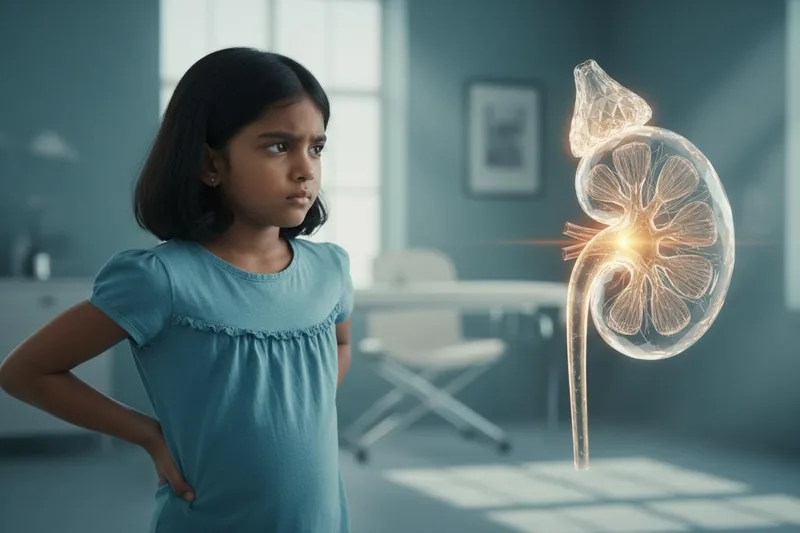
Sometimes our little one feels like a small lump in his stomach, or he gets frequent urinary tract infections, right? Maybe with a fever. One reason for these things can be a blockage in the area where the urine starts from the kidney. Today, we will talk in detail, very simply, about this condition called `(Ureteropelvic Junction Obstruction)` or `(UPJ Obstruction)`.
What is this 'ureteropelvic junction obstruction'?
Simply put, there is a funnel-like area at the top of both of your kidneys, which we call the `(Renal Pelvis)` . The urine that flows from the kidneys collects in this `(Renal Pelvis)`. Then this urine goes down a tube called `(Ureter)` and collects in the bladder. The junction where the `(Renal Pelvis)` and `(Ureter)` meet is called `(Ureteropelvic Junction - UPJ)`. If there is a blockage, that is, a blockage, at this junction for some reason, the urine does not go down properly. This is what we call `(UPJ Obstruction)`.
Normally, each kidney has only one `(Ureter)`. Our kidneys filter waste products and excess fluid from the blood and produce urine. The urine that is produced in this way collects in the `(Renal Pelvis)`, passes through the `(UPJ)`, and travels along the `(Ureter)` to the bladder. When there is a `(UPJ Obstruction)`, this urine flow is very slow, and sometimes it can stop completely. This increases the risk of kidney damage.
Most of the time, this condition called `(UPJ Obstruction)` is something that is present at birth (that is, `(Congenital urinary abnormality)`). And it usually affects only one kidney. Other names for this are `(UP junction obstruction)`, `(Obstruction of the ureteropelvic junction)`, or `(UPJO)` for short.
Is this `(UPJ Obstruction)` a serious condition?
Yes, UPJ Obstruction is a serious condition. If not treated properly, it can even lead to kidney failure . That's why it's important to be aware of it and take the necessary steps. There's nothing to worry about, but you should be careful.
How common is this situation?
Statistically, about one in every 1,500 babies born has this condition (UPJ Obstruction). This means that, although it is not very common, it can happen to anyone.
What are the symptoms of a `(Ureteropelvic Junction Obstruction)`?
There are several common symptoms that can be seen in this condition. However, sometimes, especially in young babies, there may be no outward signs.
- A lump-like feeling in the abdomen, especially on the side of the abdomen. This is caused by the kidney becoming swollen due to urine blockage. It feels like a water balloon.
- Frequent urinary tract infections (UTIs), along with fever. If a young child is frequently getting UTIs, this is something to consider.
- Flank pain. This is a pain felt in the back of the kidney. Sometimes this pain comes and goes.
- Kidney stones. Kidney stones are more likely to form when urine is blocked.
- Blood in the urine (`(Hematuria)`) .
- Nausea and vomiting.
- Developmental delay or weight loss in the child . Sometimes these conditions can also be seen.
What is the main cause of UPJ Obstruction?
I have already mentioned that most UPJ Obstruction conditions are congenital . This means that when a baby is in the womb, parts of the urinary system, especially the ureter or kidney, are not properly formed. Sometimes, this blockage can also be caused by compression of a blood vessel that passes through the UPJ. These are usually random events. However, if someone in your family has had this condition, you may be at a lower risk of developing it too.
It is very rare for adults to develop ``UPJ Obstruction``. However, it can occur in adults due to the following reasons:
- Because of kidney stones .
- Due to infections in the upper urinary tract (`Upper UTIs`) .
- After surgery in that area.
- Due to swelling (`(Swelling)`) in the upper part of the urinary system .
Who is affected the most by this situation?
According to current data, men are more than twice as likely to develop UPJ Obstruction than women. Research has also found that the condition is about twice as likely to occur in the left kidney than the right kidney.
What are the possible complications of UPJ Obstruction?
If this condition (UPJ Obstruction) is not treated properly, various complications can occur.
- Recurrent urinary tract infections (UTIs) . Sometimes, the fatty tissue around the kidneys can become swollen (perinephric stranding).
- Chronic pain may occur in the affected area .
- Additional kidney stones (``secondary kidney stones``) may form.
The most important thing is that if left untreated for a long time, this `(UPJ Obstruction)` can damage the kidneys and eventually lead to kidney failure . That is why it is important to diagnose and treat it early.
How to diagnose `(UPJ Obstruction)` condition?
In most cases, doctors can diagnose UPJ Obstruction during an ultrasound scan while the baby is still in the womb . This is because the blockage puts pressure on the back of the kidney, causing it to swell more than normal. This is called hydronephrosis . This can be seen clearly on an ultrasound.
Even after the baby is born, doctors may order various tests to see how well the kidneys are producing and expelling urine. These include:
- Blood and urine tests (`(Blood tests and urinalysis)`). Tests such as `(Blood Urea Nitrogen - BUN)` and `(Creatinine Clearance)` can show how well the kidneys are filtering the blood.
- A test called an ``Intravenous Pyelogram - IVP'' involves injecting a special dye into a vein in your arm and taking ``X-ray'' pictures. The dye can then be seen as it travels through the kidney, ``Renal Pelvis'', and ``Ureter'' to determine if there is a blockage.
- Renal Scan. In this test, a small amount of radioactive substance is injected into a vein and a special camera is used to watch it pass through the kidneys. This can give a good idea of how well the kidneys are working and the extent of the blockage.
- Ultrasound, CT scan, and MRI. These imaging tests can clearly see the structure of the kidneys, ureters, and bladder, as well as any obstructions in the kidneys.
How is a `(UPJ Obstruction)` treated?
This really depends on the situation. If your baby has a UPJ Obstruction, it can sometimes get better on its own within the first 18 months of life. During this time, your baby's doctor will do regular ultrasound scans and other tests to make sure the blockage isn't causing any harm.
However, if the child is still unable to urinate after 18 months, meaning the blockage is still there, he or she will likely need to undergo an operation called ``Open Pyeloplasty'' . In this, a pediatric urologist makes a large incision, removes the blocked part, and reconnects the ``Ureter'' to the kidney, creating a slightly wider opening. ``Open Pyeloplasty'' usually takes a few hours, and has a success rate of about 95%.
In some cases, the surgeon can perform this surgery using a method called `(Minimally invasive pyeloplasty)`, which is a robotic technique (`(surgical robot)`) . Then, a small incision is made and a `(Laparoscope)` and other surgical instruments are operated through a robot. The success of this method is similar to that of `(Open Pyeloplasty)`. However, this requires more technical skill on the part of the surgeon. It also depends on the age and size of the child.
Another option is an endopyelotomy. In this procedure , the surgeon inserts an endoscope (a thin tube with a camera) into the urethra and looks at the blockage. Then, a wire is passed through a channel in the endoscope, cut through the blockage, and a drain, or tube, is inserted. This drain is left in place for several weeks until it heals. An endopyelotomy does not require any incisions and is easier than the other two surgeries. However, it has a lower success rate. Sometimes it may need to be done more than once.
How quickly will I feel better after treatment?
It depends on the treatment you received for your UPJ Obstruction. Most people recover within two to four weeks. However, your body is different, so your recovery time may vary. Your doctor will give you the best idea of this.
Can UPJ Obstruction be prevented?
Medical researchers have not yet found a link between food and nutrition during pregnancy and the development of UPJ Obstruction in the fetus. This means that there is nothing we can do to prevent UPJ Obstruction from occurring at birth.
However, for adults who are not born with UPJ Obstruction, avoiding the following things may help reduce this risk:
- Preventing the formation of kidney stones .
- Protecting against urinary tract infections (UTIs) .
- Avoiding trauma to your kidneys .
What is the outlook for the condition `(UPJ Obstruction)`?
If diagnosed early and treated properly, the outlook for UPJ Obstruction is very good. Most children do not develop long-term complications. Also, if diagnosed before birth, it can sometimes resolve without any treatment.
However, if you are diagnosed with UPJ Obstruction later in life, you are at a slightly higher risk of kidney damage. In severe cases, if left untreated, UPJ Obstruction can lead to kidney failure and even death. That is why early diagnosis and treatment are so important.
When should you see a doctor?
If you or your baby have any of these symptoms, see a doctor immediately:
- If there is blood in the urine (`(Hematuria)`) .
- If it catches in your hand like a tumor in your stomach.
- If you have pain in the upper abdomen or back (`(Flank pain)`) .
- If you have a fever.
- If the child's growth is stunted (`(Growth faltering / failure to thrive)`) .
When do you need to go to an Emergency Treatment Unit (ETU) ?
If you are unable to urinate, go to the nearest emergency room immediately. This is something you should not delay.
What questions should you ask the doctor?
You can ask the doctor questions like these:
- How do you diagnose this condition `(Ureteropelvic Junction Obstruction)`?
- Do you think my child's UPJ Obstruction will get better without treatment?
- What are the treatment options?
- If surgery is necessary, what method do you recommend?
- What is the chance of UPJ Obstruction recurring?
What is the difference between `(Ureteropelvic Junction Obstruction)` and `(Ureterovesical Junction - UVJ) Obstruction`?
Simply put, both Ureteropelvic Junction (UPJ) and Ureterovesical Junction (UVJ) obstructions occur at the ends of your urethra (ureter). The UVJ is where your ureter connects to your bladder. A UVJ obstruction occurs there. But a UPJ obstruction occurs at the Renal Pelvis, where the ureter connects to your kidney.
So, what is the message we should take home from all of this?
It's normal to feel scared when you hear that your baby might have this problem, whether it's during a scan while your baby is still in the womb or after birth. You may feel like blaming yourself, wondering, 'Did I do something wrong? Was there anything I could have done to prevent this from happening?' But in reality, this condition called `(Ureteropelvic Junction Obstruction)` is something that sometimes just happens. Even doctors can't say exactly what causes it.
The most important thing is that many people can recover from this `(UPJ Obstruction)` condition. So, don't be afraid to see a doctor and talk to him. They understand all the questions and fears you have in mind. They will help you in any way they can and answer all your questions. Early diagnosis and proper treatment are the most important things here.
` Kidneys, Urinary Tract, UPJ Obstruction, Pediatrics, Urinary System, Surgery, Ureteropelvic Junction Obstruction


💬 Comments (0)
No comments yet. Be the first to share your thoughts here.
Add Your Comment