

Sometimes we have to have a catheter inserted for various health reasons, for example after surgery or due to a medical condition that makes it difficult to control our urine. So today we are going to talk about the bag that is connected to this catheter and used to collect urine. It is very important to use this properly and keep it clean.
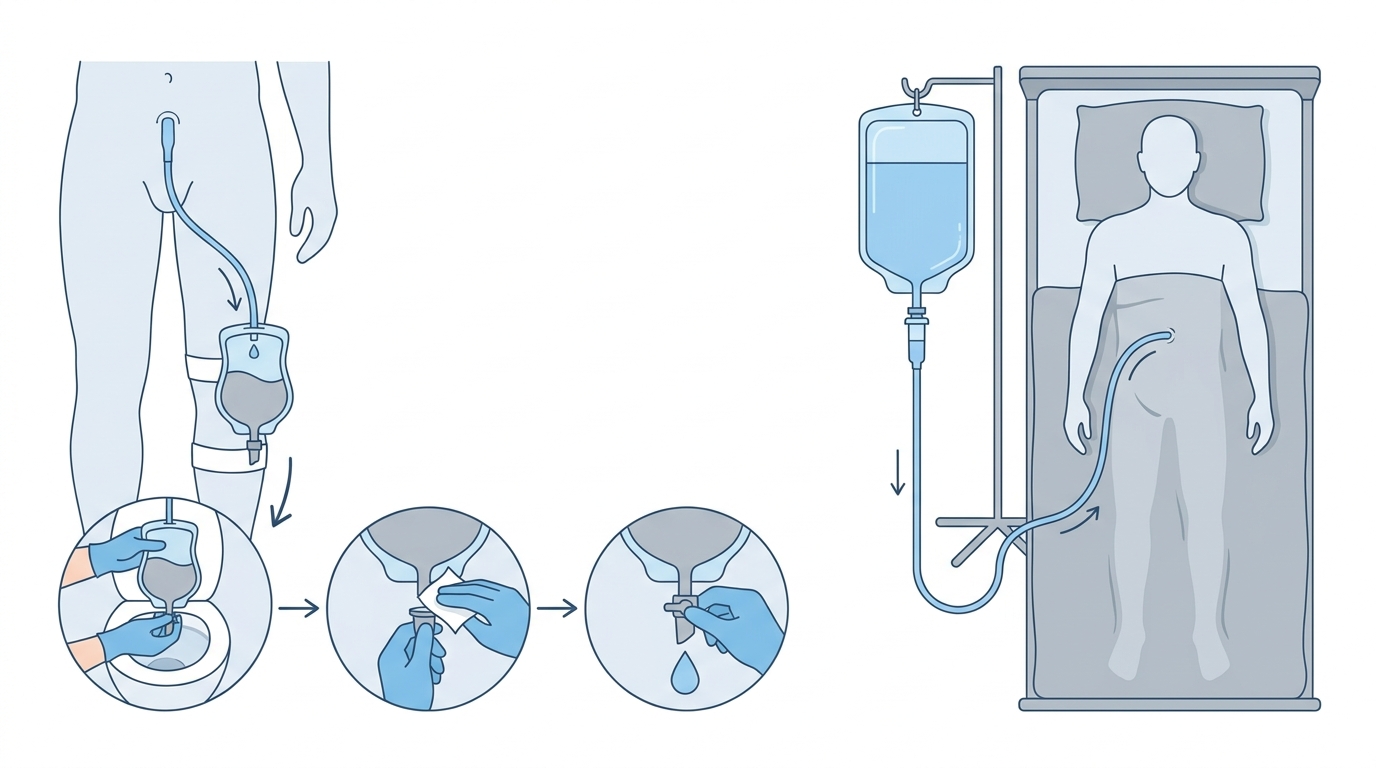
What is a Urine Drainage Bag?
Simply put, a urine bag is a bag used to collect your urine. It is connected directly to a thin tube, called a catheter, that is inserted into your bladder to drain urine. You may need both a catheter and a urine bag after surgery or because of a medical condition that makes it difficult to control your urination.
You will need to use these urine bags as long as you have a catheter in place. These urine bags mainly come in two sizes: small bags and large bags.
Leg Bags: You can wear them under your clothes, on your thighs or lower legs. They are not visible, so they are easy to hide under your clothes. These leg bags should always be below your waist , so that urine does not flow backwards. They are held in place by elastic bands, tape, or special support garments. These leg bags are usually worn during the day, while you go about your daily activities. These bags need to be emptied every two to four hours .
Night bags can hold more urine than a leg bag. A night bag is usually about twice as big as a small bag, but the size can vary depending on the type. A night bag can usually be left in place for about eight hours without emptying . These night bags are often kept on a stand next to your bed.
How does this bag work?
Urine from the bladder passes through the catheter and collects in this bag. The bag should be emptied when it is about 50% full . This urine bag is usually made of soft plastic. Leg bags may sometimes have a fabric backing to reduce the amount of plastic that rubs against the skin. Each bag has a tube at the top, which is attached to the other end of the catheter. There is a valve or tap at the bottom of the bag to allow urine to drain.
People usually use small bags during the day because they can be emptied more often. At night, when you go to bed, you take off the leg bag and put on the night bag instead. Since the night bag is large, you can go all night without emptying it. These large bags are not worn under your clothes, but instead are placed on a stand next to the bed. The most important thing is that your urine bag should always be below your waist level. If it is not, urine can flow back up the catheter.
How do you empty your urine bag?
You will need to empty this urine bag at regular intervals ( intervals ). Remember, small bags need to be emptied several times a day. The overnight bag may only need to be emptied once in the morning. Here's how to empty your leg bag:
- Empty the bag when it is about 50% full . Don't wait until it is full!
- Wash your hands thoroughly with soap to reduce the spread of germs.
- Do not let the bag, its opening, or any other dirty areas, such as the toilet or counter, touch it.
- When emptying the bag, keep it below your waist .
- You can empty the bag directly into the toilet or into a plastic container provided by your doctor.
- There are different ways to open urine bags: some have a tube that can be pulled out with a sleeve, some have a clip that opens to the side, and others have a twist-open design. Regardless of the method used, be sure not to touch the opening of the tube when emptying the urine .
- If possible, clean the mouth of the tube with a cotton ball or piece of gauze soaked in rubbing alcohol .
- Once the bag is empty, close the clip or tighten the lid.
- Attach the bag to your leg again. Don't put it on the ground .
- Wash your hands thoroughly with soap .
It's a good idea to switch your leg bag from one leg to the other from time to time. The best time to do this is when you wake up in the morning, after changing your night bag and putting on your day bag.
How do you clean the urine bag?
Every evening when you change into your overnight bag, you should clean your leg bag. When you go to bed at night, take off your leg bag and clean it to be ready for the next day. The same goes for your overnight bag – clean it every morning when you wake up (before you put on your leg bag) so it’s ready to use at night.
When you clean the bags, follow these steps:
- Wash your hands thoroughly.
- Remove the bag from the tube.
- Wash the bag with a solution of one part white vinegar and three parts cold water. Some people also like to use a mixture of bleaching powder and water.
- Close the bag and shake the liquid well inside the bag. Let the bag soak for about 20 minutes.
- Rinse the bag in cold water and hang it to dry (the opening of the tube should be facing down so that the water can drain out).
- Clean your bag every day.
How do you change the urine bag?
You will need to change the bags twice a day: once in the morning and once at night. Here are the steps for changing the urine bags:
- Wash your hands and prepare the things you need to clean. You will need a clean towel or piece of gauze, alcohol pads, and the new bag you are going to change into.
- Empty the urine in the urine bag into the toilet, do not leave any urine in the bag. Remember, every bag is different, but all should have a tube or valve at the bottom.
- Place a towel under the connection between the catheter and the bag so that any urine drops will collect in it.
- Pinch off the catheter tube slightly with your hand, and the urine will stop leaking out.
- Remove the catheter tube from the large urine bag you are currently using by twisting it. Keep the soft rubber tube (catheter tube) tight, so that urine does not leak. Be careful not to pull the catheter out.
- Place the used urine bag on top of the towel.
- Clean the corners of the tube with an alcohol pad or a cotton ball dipped in rubbing alcohol.
- Clean the connector on the new bag with a second alcohol pad or cotton swab.
- Attach the tube to the connector on the new bag.
- Check to see if the catheter tube is twisted or bent anywhere.
- Wash your hands thoroughly.
How long does it take to change these bags?
You should empty your leg bag every two to four hours during the day. But it can take up to two weeks to completely replace your bag. Some people say that when it's time to change your bag, it looks dirty or smells bad. If your bag is leaking or getting stuck, you should change it right away .
How can I reduce the smell?
Daily cleaning, timely changes, and proper care of the bag will go a long way toward controlling odor. You should always use clean hands when handling your catheter and bag. Don't store your urine bag in dirty places. If you follow all of your doctor's instructions and still have an odor coming from your bag or catheter, let them know. It could be a sign that you have an infection.
How to take care of the urine bag?
Taking good care of your urine bag can help reduce your risk of developing infections. Follow your healthcare provider's instructions carefully about how to empty and clean your bag. In addition, keep these things in mind:
- Do not pull or tug on the catheter tube.
- Do not step on the tube while you walk. When walking, keep the urine bag below your bladder, and hold the tube by the handle. If you want, you can attach the tube to your clothing with a clip or pin.
- There should be a little slack in your catheter, so that it doesn't stretch and put pressure on your urethra or bladder. But it shouldn't be so tight that it gets tangled or gets stuck in your bladder.
- Arrange the catheter tube so that it does not twist or loop.
- When you go to bed, hang the urine bag next to your bed. As long as the bag is lower than your bladder, you can sleep in any position. Do not place the bag on the floor.
- If your catheter comes loose, it may leak or stop urine flow. If this happens, call your healthcare provider.
- Always check to see if the catheter and urethra are tangled or kinked.
- Do not tighten the straps of your leg bag, as this can interfere with your blood circulation.
Can I shower with the catheter in the overnight bag?
Yes, you can shower with a urine bag. When you shower, you can leave the large urine bag as it is and hang it from a shower rail. Showering with a leg bag is generally not a good idea, as most of them can soak the soft outer covering and irritate the skin. If possible, shower before switching from the night bag to the day bag in the morning.
Many bags come with a plug that you can place where the catheter connects to the bag. This is an extra step to protect the catheter from water damage. When you are finished showering, remove the plug. It is also important to put a cap on the end of the urine bag tube to prevent contamination.
When should you see a doctor?
See your healthcare provider if you have these symptoms:
- Calorie-rich, stinky urine .
- Urine that looks red or pink .
- If you feel a burning sensation when urinating.
- If you have a fever over 101 degrees Fahrenheit (38 degrees Celsius) .
- If you have pain in your urethra, bladder, or lower abdomen.
- If you have swelling, pus, or redness in your urethra.
All of these could be symptoms of a urinary tract infection (UTI).
Also, if you haven't seen urine coming into the bag for more than six to eight hours, or if your catheter is leaking, see your doctor.
What is the difference between a Foley Bag and a Leg Bag?
Actually, these are the same thing. Some people may also call a urine bag a ``Foley Catheter Bag.`` ``Foley Catheter`` refers to the entire urinary catheter – that is, the catheter (thin tube), the opening through which urine comes out, and the bag.
Can you sleep with a leg bag?
You shouldn't sleep with a leg bag on. Leg bags are designed to be used during the day (when you can see how full the bag is). If you wear it and lie down, take a nap or sleep, it can overflow and urine can leak back into your bladder.
What are the disadvantages of a leg bag?
One of the biggest advantages of a leg bag is that it is small and can be hidden under clothing. However, the disadvantage is that it cannot hold as much urine as a large overnight bag. You have to change it frequently. This can be a bit of a hassle, but many people prefer the freedom of movement of a leg bag over a large, visible bag.
Another downside is that some people find leg bags uncomfortable. Many come with elastic straps, which can sometimes rub or hurt the skin, especially when the bag is full.
Can you wear a leg bag while leaning?
You shouldn't lie down with a bag on your leg for more than an hour. Lying down with it on can affect the way you urinate. If you have to lie down, make sure the bag is below your waist.
The most important things to remember (Take-Home Message)
If you have to use a catheter for a while, you will need a bag to collect your urine. There are different types and sizes of bags. Talk to your healthcare provider about which type of bag is best for your lifestyle. Make sure you know how to care for, change, and clean your urine bag. Talking to your doctor about your urine can be difficult. But remember, they are there to help you and make your life with a catheter as easy as possible. If you ever have any questions about how to care for your catheter, be sure to contact your doctor or healthcare provider.
` Urine bags, catheters, urinary tract infections, health advice, hospital care, home care, urinary system
Doctor's Note
The risk of urinary tract infections (UTIs) is very high when using a urinary catheter and a urine drainage bag. Therefore, a very high level of hygiene should be maintained. It is essential to wash your hands thoroughly before and after emptying the bag, always keep the bag below the bladder level, and make sure that the urine outlet valve of the bag is never buried in the ground or in a bowl.
❓ Some more questions you may encounter (FAQ)
What is the difference between leg bag (Leg bag) and night bag (Large drainage bag)?▼
A leg bag is a small bag worn on the thigh or arm for easy walking during the day. A night bag is a high-capacity bag that hangs next to the bed at night.
How often should a urine bag be emptied?▼
Usually the bag should be emptied when three quarters (3/4) full or every 4-8 hours.
What to do if you develop symptoms of a urinary tract infection?▼
Get medical attention immediately if you develop a fever, unusual odor or redness in the urine, and abdominal pain.


💬 Comments (0)
No comments yet. Be the first to share your thoughts here.
Add Your Comment