
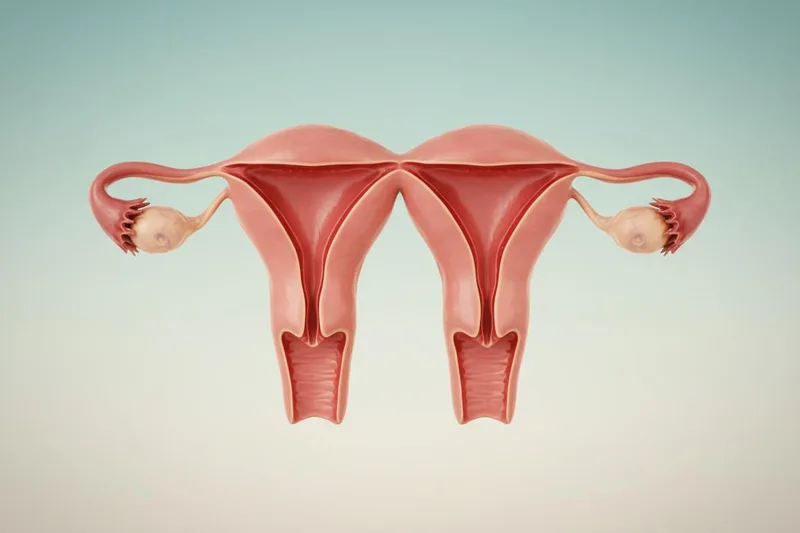
Today we are going to talk about a rare but very common health condition that can affect some women. Have you ever heard that a woman can have two uteruses? Isn't it amazing? This is what we call in medicine (Uterus Didelphys) . Think about it, we usually have one uterus. So, today we will talk in a simple way that you can understand what it means to have two uteruses, what can happen to it, and whether it is something to be afraid of.
What is Uterus Didelphys?
Simply put, (Uterus Didelphys) is a rare condition in which a woman has two uteruses. This is a congenital abnormality , meaning that it is present at birth. Now, look, normally, when you are in your mother's womb as a fetus, the uterus starts out as two tubes. Over time, these two tubes join together to form one uterus. A normal uterus is shaped like a pear that is turned upside down, wide at the top and narrow at the bottom.
However, in the case of (Uterus Didelphys), the two tubes mentioned earlier do not join together properly. Instead, two separate uteruses form from those two tubes. Then you have two uteruses. These two uteruses are smaller and narrower than a normal uterus. They are shaped like two bananas. Sometimes, people with two uteruses can even have two cervixes and two vaginal canals. Each uterus has a separate fallopian tube and ovary.
How common is this condition?
Uterus Didelphys is a very rare condition . It affects only 0.3% of the population. This means that most people do not have this condition. It is one of the least common abnormalities of the uterus.
What is the difference between a bicornuate uterus and a uterus with two uteruses (uterus didelphys)?
Both of these are abnormalities that are present at birth in the womb, but there is a slight difference.
A bicornuate uterus is a uterus that is shaped like a heart. It also has a single uterus, but the top part of it is sunken inward in the middle, forming a heart shape.
However, in Uterus Didelphys , this is not the case; there are two completely separate uteruses .
A bicornuate uterus is slightly more common than a uterus with two uteruses (uterus didelphys). Both conditions can cause complications during pregnancy.
Does this affect pregnancy?
Yes, Uterus Didelphys can affect pregnancy. Women with two uteruses are at slightly higher risk of miscarriage and preterm birth than others. This is because the uterus is smaller, which means there is less room for the baby to grow.
But this doesn't mean you won't have a healthy baby. Many women with Uterus Didelphys have successfully given birth to healthy babies. The most important thing is to talk to your doctor and stay well-monitored throughout your pregnancy.
What are the symptoms of this?
Surprisingly, many women don't even know they have Uterus Didelphys. This is because it often causes no symptoms . It is usually discovered during a pelvic exam for another reason, or when tests are done to find the cause of recurrent miscarriages or unbearable menstrual pain.
However, some people may develop symptoms. If so, they may experience:
- Experiencing severe pain during sex with your husband or partner.
- Severe cramps and pain before and during menstruation.
- Excessive bleeding during menstruation.
- Bleeding when using a tampon (this can be caused by the tampon being inserted into one vagina and bleeding coming out of the other, if you have two vaginas).
- Frequent miscarriages .
- Preterm labor .
What is the reason for this?
The main cause of Uterus Didelphys is that the two Mullerian ducts that form the uterus during the embryonic period do not join together properly. Normally, these two ducts join together to form one uterus. However, in a person with Uterus Didelphys, these two ducts do not join together, and each duct forms a separate uterus. As mentioned earlier, some people can also have two vaginas and even two cervixes.
Doctors still haven't been able to find a definitive reason why some people's Mullerian ducts don't fuse properly.
How does this affect menstruation?
A person with Uterus Didelphys may experience some changes in their monthly menstrual cycle. They may experience things like:
- Excessive or abnormal bleeding during menstruation.
- Very painful menstruation .
- Feeling of cramping and pressure in the lower abdomen.
- Difficulty using tampons (especially if you have two vaginas).
How do you recognize this?
Often, your doctor may suspect this if he or she sees two cervixes or two vaginas during a routine pelvic exam. Only then will he or she recommend more specialized imaging tests to confirm the condition (Uterus Didelphys).
What kind of tests are done?
To confirm the condition of Uterus Didelphys and to know the exact size and shape of the uterus, several tests can be performed:
- Ultrasound: This can be done either through the abdomen (abdominal ultrasound) or through the vagina (transvaginal ultrasound). This takes clear pictures of your uterus.
- MRI (Magnetic Resonance Imaging) scan: This uses a magnetic field and radio waves to produce very high-quality, clear images of the uterus.
- Sonohysterogram: In this test, your doctor inserts a thin tube (catheter) into each of your uteruses and injects a small amount of saline solution into it. Then, a transvaginal ultrasound is performed to see how the solution moves through the cervix and into the uterus.
- Hysterosalpingography (HSG): In this test, a special dye is injected into the uterus and X-ray images are taken. This allows for a clear view of the dye moving through the cervix, uterus, and fallopian tubes.
Can this condition be cured?
Doctors often do not recommend treatment for Uterus Didelphys, especially if you have no symptoms . However, if you have severe symptoms, such as repeated late pregnancy losses, surgery may be considered. However, surgery to join the two uteruses together can weaken the remaining uterus.
If you experience pain during sexual intercourse because you have two vaginas, you can get relief by surgically removing the wall between the two vaginas (longitudinal vaginal septum).
Can this be prevented?
No, there is no way to prevent a condition called (Uterus Didelphys). Because, this is something that is congenital. That is, a condition that occurs while you are developing as a fetus in your mother's womb. Doctors still cannot figure out exactly why such abnormalities of the uterus occur only in some people, or whether it is hereditary.
Can this cause infertility?
Some women may experience difficulty conceiving, or infertility , due to the condition (Uterus Didelphys). However, in most cases, the shape of the uterus does not completely prevent you from conceiving a child. However, as mentioned earlier, the risk of miscarriage is slightly higher than normal .
Will I have a miscarriage?
It is not certain that you will have a miscarriage just because you have Uterus Didelphys. However, the risk of miscarriage is slightly higher compared to others. There are several main reasons for this:
- Because both of your uteruses are smaller than a normal uterus, the space needed for the growing fetus is limited.
- The abnormal shape of the uterus can prevent the placenta from implanting properly and interfere with the blood supply to the uterus.
If you have persistent late second trimester miscarriages, your doctor may recommend surgery to repair both uteruses. This treatment may increase your chances of carrying your pregnancy to term.
Can someone with two uteruses have a baby?
Yes, it is possible! Most women with Uterus Didelphys give birth to healthy babies. However, once you become pregnant, your doctor will monitor you and your baby closely to make sure that both of you are healthy. This is because you are at a slightly higher risk of developing certain complications during pregnancy than others.
What are the possible complications during pregnancy?
Having two uteruses increases the risk of complications during pregnancy, such as:
- Miscarriage.
- Early labor / Preterm birth.
- Breech babies , meaning the head is facing up.
- Increased chance of having to deliver the baby by cesarean section .
- Low birth weight.
- Growth restriction in the baby.
- During normal childbirth, the vaginal septum, if there are two vaginas, may tear.
But, don't be alarmed when you hear these things. Many mothers with this condition have given birth to healthy babies without any problems. The most important thing is to talk openly with your doctor about any concerns or fears you may have. That way, you can be sure that you will receive the support and care you need.
Are there other health risks?
Most women with Uterus Didelphys live healthy, normal lives. Major health problems are rare. However, it's good to be aware of some of the risks, including:
- As discussed earlier, complications during pregnancy (such as miscarriage, premature birth).
- The risk of having to undergo a cesarean section increases depending on the position of the baby (not well positioned for birth).
- Excessive bleeding during monthly menstruation.
- Sometimes, a kidney may be in the wrong place, or one kidney may be missing (this is often discovered incidentally during a scan done for another reason).
What questions should I ask the doctor?
If a doctor tells you that you have Uterus Didelphys, ask them everything you have in mind. For example, you might ask questions like:
- "Why do I have these two wombs?"
- "What kind of treatment do you recommend for me?"
- "Can I still have a healthy pregnancy?"
- "What can I do to increase my chances of a successful pregnancy?"
- "Is it better to have surgery for this before I get pregnant?"
- "Are there any other health issues I should be aware of?"
Finally, things to remember
This condition called (Uterus Didelphys) is not caused by any fault of yours or anything you have done. It is a congenital condition that occurs before you are born, during the fetal stage . If you are pregnant or planning to become pregnant, be sure to talk to your doctor about your condition and get the necessary advice and guidance for a safe pregnancy. Your doctor may also suggest some treatment options based on your condition.
The most important thing to remember is that most women with this condition go on to have successful, healthy pregnancies and healthy babies. So don't be afraid, stay strong!
` Two uteruses, Uterus Didelphys, Double uterus, Pregnancy, Miscarriage, Menstrual pain, Women's health


💬 Comments (0)
No comments yet. Be the first to share your thoughts here.
Add Your Comment