
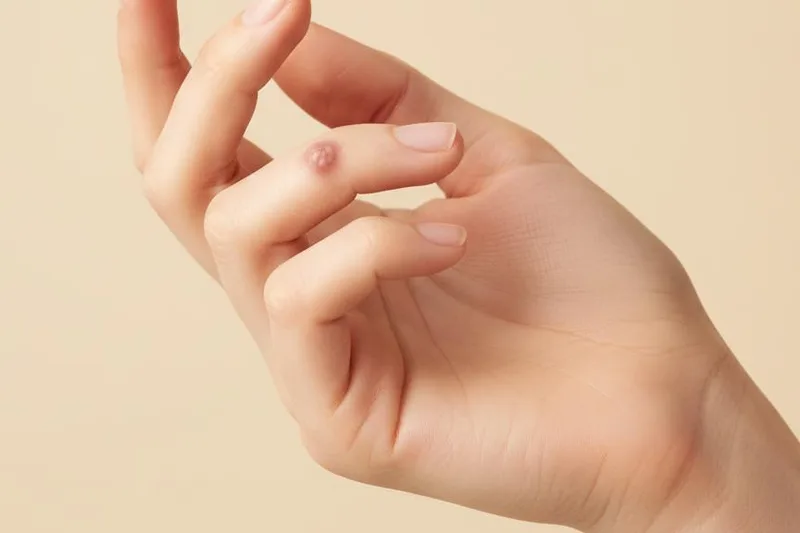
Have you ever had a small growth on your arm, leg, or anywhere else on your body? Sometimes rough, sometimes smooth, we call these 'warts'. These are actually very common. But none of us like them because they don't look good and sometimes they are annoying. So today, let's talk about warts, why they form, are they contagious, and what can be done about them.
What exactly are warts?
Simply put, warts are small, non-cancerous (benign) growths that form on our skin. Sometimes they can also form on mucous membranes, such as inside the mouth. The cause of this is the Human Papillomavirus , or HPV .
Just think, there are more than 100 types of this HPV virus family. But not all of them cause warts. Some specific types of HPV cause warts in different parts of our bodies.
The important thing is that warts are not usually harmful. However, depending on where they are located, they can be uncomfortable and painful. They can also be embarrassing and cause you to worry about their appearance.
Are there different types of warts? Let's see...
Yes, warts are not the same. Doctors classify them based on their appearance, the type of HPV virus that causes them, and where they occur on the body. Let's take a look at the main types.
| Type | Description and locations |
|---|---|
| Common warts (Verrucca vulgaris) | They usually appear on the hands. They look like rough bumps. Sometimes there are black dots that look like bones. These black dots are actually small blood vessels that have become blocked and dead. They can be anywhere from the size of a pinhead to the size of a pea. |
| Plantar warts | They most commonly occur on the soles of the feet. Since they grow inward, they can cause pain when walking or standing, as if you were stepping on a stone. Black dots can also be seen on these. |
| Flat warts | They can appear anywhere on the body. They are smaller and smoother than other warts. However, they can occur in large numbers, as many as 20-100 at a time. |
| Filiform warts | These look like long threads protruding from the skin. They most often form on the face, around the mouth, eyes, and nose. |
| Genital warts | They form around the genitals and anus. They are a sexually transmitted infection (STI). They are spread through skin-to-skin contact. |
How do warts develop? Are they contagious from person to person?
Warts are caused by the HPV virus that we talked about earlier. Think of your skin as a wall. If there is a small break or cut in this wall, the HPV virus can easily enter. Once inside, this virus causes skin cells to grow rapidly. Then the top layer of skin becomes thick and rough. Moist, soft skin and damaged skin are more likely to be infected with this virus.
Yes, warts are definitely contagious because the HPV virus is contagious.
There are two ways warts can be transmitted:
- Direct contact: It can be spread by touching someone else's skin or through skin-to-skin contact.
- Indirect contact: It can be spread by sharing items such as towels, razors, and clothing that have been contaminated by someone else. For example, this can happen through shared items in a dormitory or swimming pool.
Should I see a doctor when I get a lump? What are the treatments?
Most of the time, a doctor can recognize a mole as a mole immediately upon seeing it. Very rarely, if there is any doubt, a small piece of skin is taken and examined (a skin biopsy).
The good news is that most warts will go away on their own within a couple of years without any treatment . However, some people seek treatment because they can be contagious, painful, and uncomfortable. You can talk to your doctor about the best treatment for you.
There are several treatment methods.
| Treatment Method | What happens in that? |
|---|---|
| Medicines that can be purchased at the pharmacy (OTC products) | These contain a chemical called salicylic acid. This works by gradually dissolving the layers of the wart and removing it. They come in the form of liquids, gels, and plasters. But you have to apply them every day for months to completely remove the wart. |
| Special medicine from a doctor | The doctor can apply a solution containing a chemical called cantharidin to the wart. This will cause a blister to form under the wart, cutting off the blood supply to the wart. You will need to go back in about a week to have the dead wart removed. |
| Cryotherapy | In this, the wart is frozen using a very cold liquid called liquid nitrogen. The wart will fall off in a few days. You may need to do several treatments. |
What if you don't get rid of these methods?
If the above treatments do not clear up the problem, your doctor may suggest other treatments.
- Immunotherapy: This involves stimulating your own immune system to fight the virus that causes warts.
- Surgical removal: The doctor can cut out the wart and remove it. However, this may leave a small scar.
- Electrosurgery: A special heated needle is used to burn away the tissue. This can also cause scarring.
- Laser treatment: Laser rays are used to destroy the small blood vessels inside the tumor. The tumor then dies due to the loss of blood supply.
Most importantly: Never cut, pull, or pick at warts at home alone. Doing so can easily lead to infections and other problems.
How can you prevent warts from forming?
Although there is no way to 100% prevent the development of warts, there are several things we can do to reduce the risk of contracting the HPV virus.
- Don't touch someone else's warts.
- Do not share your personal items, such as towels, razors, nail clippers, and clothes, with others.
- Stop biting your nails and picking at the skin around your fingers. Even a small cut on the skin can easily introduce the virus.
- Wear a pair of slippers when using public bathrooms and swimming pools.
- Talk to your doctor about safe ways to prevent genital warts and about the HPV vaccine.
If you already have one, do these things to stop it from spreading:
- Put a plaster on the wound and keep it closed.
- Don't go scratching, breaking, or tearing your hair.
- If you touch someone, always wash your hands thoroughly with soap.
- Avoid shaving/removing moles with a razor where the area is.
When should you definitely see a doctor?
Although warts are usually not dangerous, there are times when you should be especially concerned about them. If you have any of the following conditions, be sure to see your doctor.
- If you have any doubts as to whether what you have is not a person, but something else.
- If you have warts on your face, genitals, anus, or inside your mouth.
- If you have a lot of warts.
- If the warts are painful, itchy, inflamed , or bleeding .
- If you have a weakened immune system (e.g. HIV, cancer).
- If you have diabetes and have developed a foot ulcer (diabetic foot ulcers heal slowly, so self-treatment can cause serious damage).
Finally, although warts can be annoying, they are treatable. Most of the time, they will go away on their own. So there is nothing to worry about. But if you are worried, in pain, or have any concerns, it is best to talk to your doctor.
Take-Home Message
- Warts are a type of non-cancerous skin growth caused by the HPV virus.
- These can be spread through contact (directly or indirectly), so be careful about personal hygiene.
- Most warts disappear on their own within two years without any treatment.
- Never try to cut or pull out warts yourself at home. This can lead to infection.
- If a lump is painful, bleeding, has growths in the genital area, or if you have a medical condition such as diabetes, be sure to seek medical advice.


💬 Comments (0)
No comments yet. Be the first to share your thoughts here.
Add Your Comment