Hello! Today we are going to talk about something that is very important for you men, but perhaps not talked about much. That is
the prostate gland , or as it is called in English
(Prostate Gland) . Especially with age,
various changes can occur in this prostate gland, so it is very important for you to be aware of it. Because, if you know in advance, many problems can be easily solved.
So, what is this prostate gland?
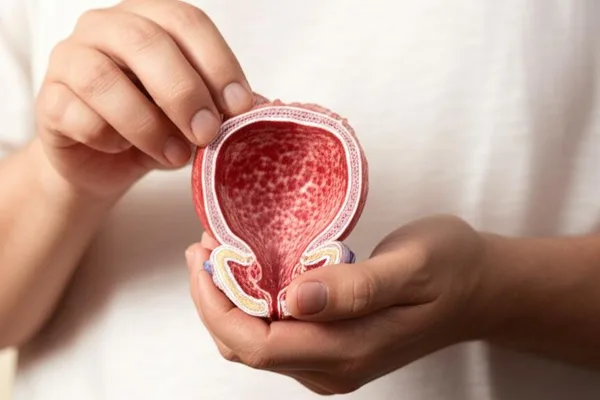
Simply put, the prostate gland is
a small gland in the male reproductive system . To be precise, a healthy prostate gland is usually
about the size of a walnut . Some people compare it to a chestnut. It weighs about 30 grams. So where is it located, you might be wondering? Imagine, this small gland is located
right below your bladder, and in front of your rectum . Another important thing is that the tube that carries your urine,
the urethra , passes through the prostate gland. It's like a tube that goes through a piece of cloth. The prostate gland is made up
of five sections, or lobes : the anterior, posterior, lateral lobes, and median lobe. These are made up of connective tissues and glandular tissues. The entire gland is covered by a thin layer of connective tissue called
the prostatic fascia .
What service does the prostate gland provide to a man?
Okay, now let's see what happens with this little gland. Here's the most important thing:
- Its main function is to add extra fluid to your semen (semen/ejaculate) , the white fluid that comes out of your penis when you ejaculate. This fluid is very special. It contains enzymes , zinc, and citric acid . These help nourish sperm cells, help them move better, and lubricate the urethra .
- Not only that, when you are aroused, the muscles in the prostate gland also help push the semen out through the urethra.
Do women also have a prostate gland?
No.
Women do not have a prostate gland. However, you may have heard of something called the "female prostate." What it really means is
Skene's glands. These Skene's glands are located on either side of the female urethra. Medical researchers believe that a fluid secreted by these glands may aid in the process of urination and cleanliness. Some theories also say that these glands are involved in the fluid released during a woman's menstrual cycle. Does the prostate gland enlarge with age?
Yes, this is something that happens to many men. Usually, in most men over the age of 40, the prostate gland starts to gradually enlarge. This is medically called 'Benign Prostatic Hyperplasia' , or BPH for short. The important thing is that BPH is not cancer, and it does not increase your risk of developing prostate cancer.
The prostate gland, which used to be about the size of a walnut, can sometimes grow to the size of a lemon. This is a common condition that many men experience as they age. However, when it gets bigger, it can cause some discomfort by constricting the urethra. We'll talk about that in a bit. There are several major medical conditions that are discussed regarding the prostate gland. 1. Prostate Cancer
This is the second most common type of cancer in men . Therefore, it is very important to be aware of this. If detected early, it is more likely to be treated successfully. 2. Prostatitis
This is an inflammation of the prostate gland. There are four main types of this:- Acute Bacterial Prostatitis : A condition that occurs suddenly and is caused by a bacterial infection.
- Chronic Bacterial Prostatitis: A long-term, recurring bacterial infection.
- Chronic Pelvic Pain Syndrome (CPPS): In this condition, pain can occur in the prostate gland even without a bacterial infection.
- Asymptomatic Inflammatory Prostatitis: In this case, inflammation is present but no symptoms occur. It is only detected during another test.
Prostatitis is the most common urinary tract infection in men under the age of 50 , and the third most common in men over the age of 50. 3. Benign Prostatic Hyperplasia (BPH)
We've talked about this before. Benign enlargement of the prostate gland can cause the urethra to become tight, making it difficult to urinate . As you get older,This condition occurs in many men. What are the warning signs that can identify prostate problems?
If there is a problem with your prostate gland, you may notice symptoms like these:- Pain in the penis, testicles , or perineum (the area between the testicles and the anus).
- The need to urinate frequently.
- Painful urination (Dysuria) or pain during ejaculation.
- A slow stream of urine, or a trickle of urine.
- Difficulty starting to urinate.
- Having to get up frequently at night to urinate.
- Sexual dysfunction ( Erectile Dysfunction / ED).
- Blood in the urine or semen (Hematospermia).
- Feeling pain in the lower abdomen, hips, or chest (this can happen especially if the cancer has spread).
If you have one or more of these symptoms, it's best to see a doctor for advice without fear or embarrassment. Not all of these symptoms are signs of a serious illness, but it's important to get checked out.
How to check the health of the prostate gland?
There are several main methods that doctors use to check the health of the prostate: 1. Digital Rectal Exam (DRE)
In this, the doctor inserts a gloved, lubricated finger into your rectum and feels the prostate gland. This can check the size, shape, firmness, and presence of any lumps . Although this may seem a little uncomfortable, it is a very important test that takes just a few minutes. 2. Prostate-Specific Antigen (PSA) blood test
PSA is a protein naturally produced by the prostate gland. If your PSA level is higher than normal , it could be a sign of prostate cancer. However, PSA levels can also be elevated in cases of BPH, prostatitis, or recent sexual activity. Therefore, PSA levels alone are not the only factor in the diagnosis, but are considered in conjunction with a DRE. 3. Biopsy test
If there is anything suspicious with the DRE or PSA level, your doctor may recommend a biopsy . This involves taking a small sample of tissue from the prostate gland, usually with the help of an ultrasound scan.The tissue sample is then examined under a microscope in the laboratory to see if there are any cancer cells . What are the treatments for prostate diseases?
Treatment depends on the disease affecting the prostate gland. There is no one-size-fits-all solution. For prostate cancer:
- Active Surveillance: If the cancer is in a low-risk, slow-growing stage, the cancer is monitored by regular testing (PSA, DRE, biopsy) without surgery or other treatment.
- Brachytherapy: This is an internal radiation treatment. Small radioactive seeds are placed inside the prostate gland.
- Focal Therapy: Treatments that target only the area of prostate cancer. Examples: High-Intensity Focused Ultrasound (HIFU), Cryotherapy (freezing cells), Laser Ablation, Photodynamic Therapy (PDT).
- Prostatectomy: Surgical removal of all or part of the prostate gland.
For Prostatitis:
- Medications: Medications that relax the muscles around the bladder and prostate (e.g., Alpha-blockers), painkillers , and antibiotics if there is a bacterial infection.
- Stress management: Sometimes stress can also increase these symptoms, so things like counseling can help.
- Exercise: Pelvic floor exercises are beneficial for some people.
For benign prostatic hyperplasia (BPH):
- Medications: Medications that reduce the production of hormones that affect prostate growth (e.g. 5-alpha reductase inhibitors) or medications that ease the flow of urine (e.g. Alpha-blockers).
- Surgery: Surgery to remove prostate tissue that is obstructing urine flow (e.g. TURP - Transurethral Resection of the Prostate).
- Water Vapor Therapy: A device is inserted through the urethra and water vapor is sent into the prostate gland, destroying excess cells and shrinking the gland.
How can I keep my prostate healthy?
Taking care of your prostate health is very important. Here are some things you can do to help:- Check your prostate regularly .It's usually best to start after age 50. But if someone in your family (like your father or brother) has had prostate cancer, it's wise to start screening even earlier, perhaps as early as age 40-45. Talk to your doctor about this.
- Exercise regularly. It has been found that people who are physically active have a lower risk of developing BPH.
- Eat a healthy diet. Include plenty of vegetables, fruits, and healthy proteins (fish, chicken, nuts) in your diet. Reduce red meat, processed foods, and high-fat foods.
- Avoid using tobacco products. Smoking can increase the risk of prostate cancer.
Are supplements good for the prostate?
You may have noticed that there are various supplements on the market these days that claim to be good for prostate health. For example, Saw Palmetto. However, many of these supplements have not been rigorously tested and approved by institutions like the US Food and Drug Administration (FDA). Therefore, there is not much scientific data on their effectiveness. While they may have a small benefit for some people, it is difficult to imagine that most people will benefit greatly from them or improve their prostate health. Therefore, think twice about using such supplements without medical advice. It is wise to talk to your doctor and seek his advice.
Is it possible to live without a prostate gland?
Yes, you can. For example, in a case like prostate cancer, doctors may decide to surgically remove the entire prostate (prostatectomy) . This can be life-threatening. However, two of the most common side effects of prostate removal are erectile dysfunction (ED) and urinary incontinence . There are various treatments to manage these. Can I feel my prostate?
You can't feel the prostate directly from the inside of your body. However, you can feel it from the outside to some extent, or you can feel it through your rectum. The easiest way to feel it from the outside is to feel your perineum (the area between your scrotum and your anus) from behind, close to your anus . This area has the most nerves and blood vessels, and the least tissue. A healthy prostate should feel soft and rubbery. If you put your finger about two inches into your anus, you can feel it in the area between your penis and your anus. It should also feel soft and rubbery. When you touch your prostate in this way, you may feel a sudden urge to urinate. But, keep this in mind: You can't accurately determine the health of your prostate by doing this self-examination.A DRE test performed by a doctor is the most accurate method. If you have any doubts or questions, be sure to see a doctor. He or she can answer your questions and accurately assess the health of your prostate.
Finally, some important things to remember...
The prostate gland is a small but very important organ in our male body. It is normal for it to change with age and become slightly larger (BPH). There is nothing to be afraid of. However, if the warning signs we have discussed appear, do not ignore them. See a doctor immediately and seek advice. It is a very good habit to have regular medical examinations (Screenings) after the age of 50, or even earlier if there is a family history of prostate cancer. A healthy diet, regular exercise, and avoiding smoking can protect the health of not only your prostate, but also your entire body. No matter what problem you have, talk to your doctor without fear or shame. He or she is ready to help you.





💬 Comments (0)
No comments have been posted yet. Add your comment here for the first time.
Add your comment