

Have you ever wondered if they all look the same when you say " eye doctor "? Sometimes we have minor eye problems and it's hard to know who to go to. Some people prescribe glasses, while others perform surgeries. So, in this article, we'll talk about the different types of eye care specialists who help us take care of our eyes. Let's get a clear understanding of who they are, what they do, and who you should seek help from if you have a problem.
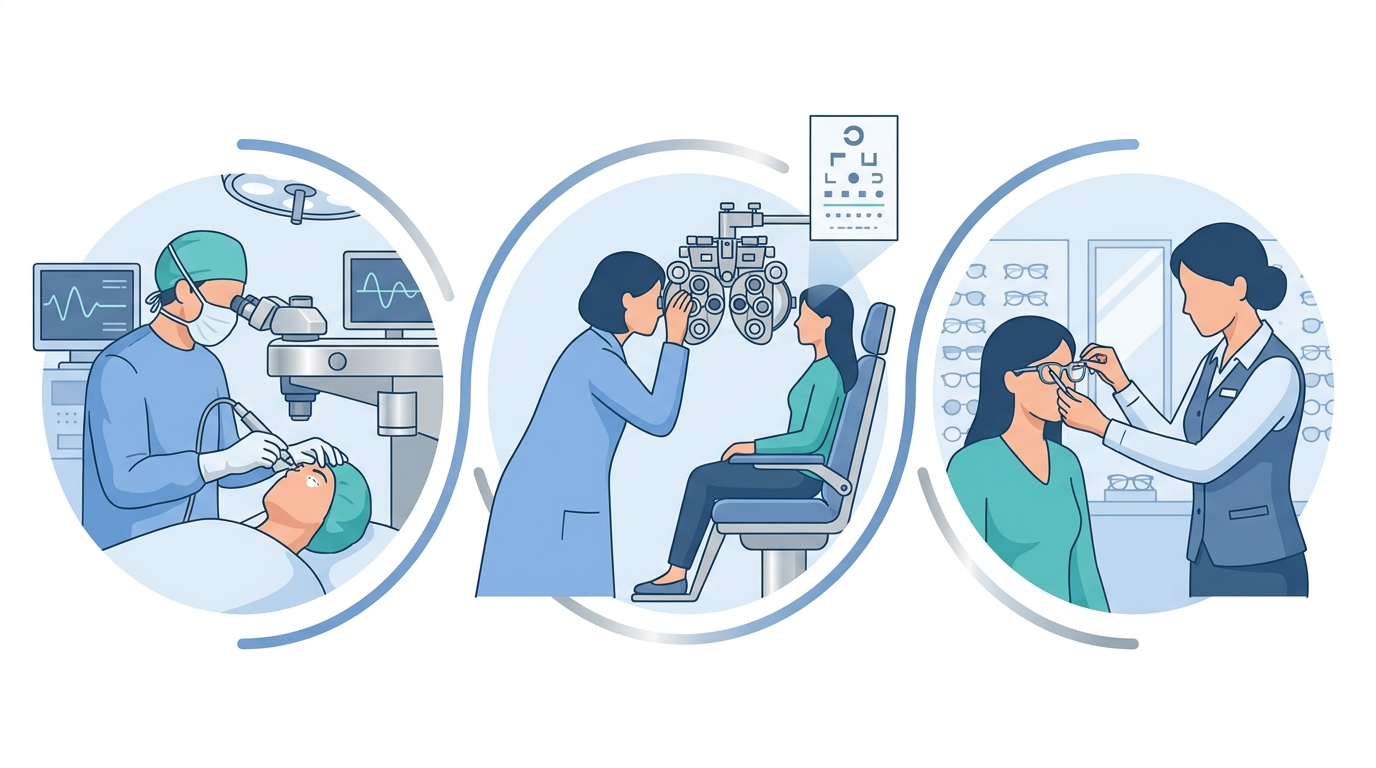
Who are these eye specialists? (Types of Eye Doctors)
Simply put, these are people who have received special training to take care of our eyes and vision. There are four main types among them. Let's see who they are.
1. Ophthalmologists
These are the real doctors (MDs or DOs) . Just like there are doctors who specialize in other parts of the body, these people go to medical school and then spend years of specialized training in the eye .
- What can they do?: They can diagnose any eye disease, from simple to complex. They are also the only ones who have the authority to treat it and, if necessary, perform eye surgeries.
- For example: If you have cataracts, a condition like glaucoma, or if you have had a serious eye injury and need surgery, you should definitely see an ophthalmologist. They can do a general eye exam and prescribe glasses.
2. Optometrists
Now let's look at optometrists. They are not like the ophthalmologists (MDs) mentioned earlier, but they have a special degree in eyesight, that is, a Doctor of Optometry (OD) . This means that they have studied eyesight and the functioning of the eyes in depth.
- What can they do?: They can give you a routine eye exam , get a prescription for glasses, get a prescription for contact lenses, and diagnose and treat some of the most common eye conditions (such as dry eyes, red eyes, and minor infections).
- Think about it this way: You can't see the letters in the newspaper as clearly as you used to. Or your child at school is staring at the blackboard with his eyes closed. That's when an optometrist can be very helpful. He or she can measure your vision and tell you if you need glasses or if there is some other minor problem.
- Important thing:Remember, optometrists are not licensed to perform eye surgeries .
3. Opticians
Next, let's talk about opticians. Simply put, after you get a prescription for glasses or contact lenses from an ophthalmologist or optometrist, they are the ones who help you choose the right glasses, adjust the lenses properly, and choose a frame that suits your face and is in the style you like.
- Their role: They will fit you with glasses and, if you have contact lenses, they will teach you how to use them properly, how to put them in, how to take them out, and how to keep them clean. They will also check to see if the glasses or lenses fit you properly. They do not directly examine your eyes or prescribe medication.
4. Ocularists
Finally, let me talk about ocularists. These people have a somewhat specialized job. Imagine, if someone loses all or part of an eye due to some serious accident, illness, or perhaps birth, these specialists help them make a prosthetic eye, adjust it to fit them properly, and teach them how to maintain it. This is a very delicate job, because the prosthetic eye needs to be made to match the other eye and look natural.
What kind of diseases do these eye doctors treat?
Ophthalmologists and Optometrists, which we talked about earlier, treat many common eye conditions and vision problems . Let's see what they are.
- Astigmatism: This is when the shape of the lens or cornea of the eye becomes slightly irregular. This causes the eye to focus light incorrectly, resulting in blurred vision and possibly headaches.
- Diplopia or double vision: Seeing two things at once. There can be many causes for this, so it's important to find the exact cause.
- Dry eye: A condition that occurs when the eyes do not produce enough tears or when the tears that do form evaporate too quickly. It can cause itchy, sore, burning, and sensitivity to light.
- Low vision: A condition in which vision cannot be fully corrected even with glasses, contact lenses, or surgery.
- Myopia (nearsightedness) and Hyperopia (nearsightedness): These are problems that many people have and can be easily corrected with glasses.
- If your eyes are not soreConjunctivitis (Pink eye): An infection of the membrane that covers the white part of the eye (conjunctiva). Symptoms include redness, tearing, and itching.
- Presbyopia and other eye problems that come with age: This is when it becomes difficult to see close-up objects, such as books and newspapers, usually around the age of 40-45. This is because the flexibility of the eye's lens decreases with age.
However, if you have a more complex eye condition, such as diabetic retinopathy, glaucoma, or if you absolutely need surgery, you should see an ophthalmologist. Other specialists, such as opticians and ocularists, work with your ophthalmologist to provide you with the care you need. It's like a team effort.
How do I choose the right eye specialist for me?
Now that you have a good idea of who each type of ophthalmologist is, you may be wondering, 'Okay, with all these different types, who is the right one for my problem? Who should I go to?' It really depends on what symptoms you have and what problem you want to solve. Let's take a look at how to choose simply.
- If you need a routine eye exam: that is, to get your eyes checked every few years, get a prescription for glasses, or check if your current prescription is correct, you can see an optometrist . They also treat minor eye conditions.
- If you have a more complex problem or need surgery: If you think you have a serious condition like cataracts, glaucoma, or if you need surgery for an eye injury, you should definitely see an ophthalmologist . Remember, only they can perform surgery. However, these ophthalmologists can also do a general eye exam and prescribe glasses.
- If you need glasses or contact lenses: After a doctor gives you a prescription, opticians help you choose the right glasses, adjust them properly, make them fit your face, and teach you how to wear them. They are usually located in eye clinics or optician's shops, and work with other eye doctors.
- If you need a prosthetic eye: As we discussed earlier, ocularists help fit a prosthetic eye to someone who has lost an eye, such as in an accident.They also work in conjunction with other eye specialists, as an examination by an ophthalmologist may be required before implanting an artificial eye.
Most importantly: If you still can't figure out who to go to, it's best to ask your family doctor (Primary Care Physician - PCP) for advice without thinking too much. He or she can tell you which specialist is best for your situation.
So, what are the most important things we should take home from this story? (Take-Home Message)
Our eyes are like precious gems, aren't they? So, ophthalmologists and other eye specialists help us a lot to keep them healthy and see this beautiful world clearly.
- Remember: If you notice any sudden changes in your vision, or if you experience any unusual eye symptoms (for example, sudden blurred vision, eye pain, severe redness, difficulty looking at light, or seeing flashing lights in front of your eyes), do not waste time and see an ophthalmologist or emergency room as soon as possible.
- Don't skip regular checkups: Even if you don't have any problems, it's important to have your eyes checked at least once every few years (especially if you're over 40, have a family history of eye problems, or have conditions like diabetes). This can help detect any undetected eye problems early.
- Choose the right one for you: Now that you know the roles of different eye specialists, choose the one that best suits your needs and follow their advice.
It is our responsibility to take care of our eyes. So, I hope this information is useful to you. Got it?
` Ophthalmologist, eye doctor, eye specialist, Ophthalmologist, Optometrist, Optician, Ocularist, eye exam, glasses, vision, eye diseases, cataracts, glaucoma, eye health
ukat juk’ampinaka Doctoran qillqatapa
ukat juk’ampinaka Kunayman yatxatirinakax nayran uñjañapataki ukhamarak k’umaräñapatakiw irnaqapxi. Kimsa jach’a t’aqaw utji: Oftalmólogos, Optometricos ukat Ópticos. Janïr nayra uñakipañar sarkasaxa, kuna qullanaktï munkta ukarjamaw suma yatxattʼat jaqir ajlliñax wali wakiskirixa. Nayrajj wali usutäspa, akatjamat jan uñjañjamächi jan ukajj mä accidente utjchi ukhajja, jankʼakiw Oftalmólogo ukar sarañama.
❓ ukat juk’ampinaka Mä qawqha juk’amp jiskt’äwinakampiw jikisipxasma (FAQ) .
ukat juk’ampinaka ¿Khitis Oftalmólogo satäkis ukajja?▼
ukat juk’ampinaka Jupax qulliriwa, qullañ yatiqañ uta tukuyatatx nayra k’umaräñ tuqit especialista postgrado ukan yatiqatawa. Jupanakax nayran diagnostico, qullanak qullañ ukhamarak operaciones ukanakax Catarata ukat Glaucoma ukham lurapxi.
ukat juk’ampinaka ¿Kuna servicios ukanakas mä optómetro ukan utji?▼
ukat juk’ampinaka Nayranakan uñjatap uñakipapxi, lentes jan ukax lentes de contacto ukanakaw jaya uñjañ/jak’a uñch’ukiñatak churapxi.
¿Qhawqha kutis nayra uñakipañax wakisi?▼
ukat juk’ampinaka 40 maranitxa, sapa 1-2 marat mä kutis nayrax taqpach uñakipañax glaucoma ukham usunak nayraqat uñt’añatakiw yanapt’aspa.





💬 Comments (0)
No comments have been posted yet. Add your comment here for the first time.
Add your comment