
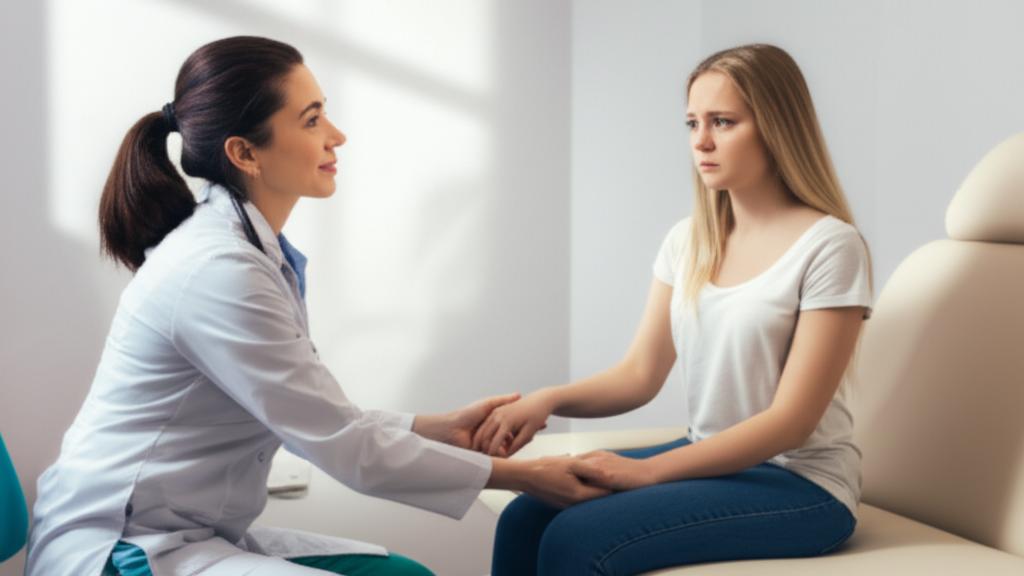
It's normal to feel a little scared and nervous when your doctor tells you that you need to have a breast biopsy . When you hear the word "biopsy," the first thing that comes to mind is cancer, right? But in reality, not every lump found in the breast is cancer. This test is done to confirm if there is any suspicious area. So, don't worry, let's talk about this clearly today.
Anxiety Test (GAD-7)
Check if you have anxiety with the internationally accepted GAD-7 system
Simply put, what is a breast biopsy?
Simply put, a breast biopsy is a procedure in which your doctor takes a very small piece of tissue sample) from a suspicious area of the breast. This tissue sample is then examined under a microscope to see if there are cancer cells or other abnormalities.
Remember, the only and best way to know with 100% certainty whether a breast problem is cancerous or not is through a biopsy.
Why is it necessary to conduct such a test?
Your doctor may recommend this test if they have any concerns during a routine breast exam, mammogram, or ultrasound . Here are some of the most common reasons for suspicion:
- Having a lump, cyst, or thickening in your breast that you can feel.
- Fluid-filled cysts or small calcium deposits (microcalcifications) visible on scans.
- Abnormal discharge from the nipple, such as bloody discharge.
- A change in the shape of the breast skin or nipple.
What are the types of biopsy tests?
Your doctor will decide which biopsy method is best for you based on several factors, including the size of the suspicious lump, its location, your other health problems, and your preferences.
There are two main types of biopsies : minimally invasive methods, and surgical methods.
Minimally Invasive Biopsies
These methods are now used more often because they have many advantages.
- Scarring is very rare.
- The pain is less.
- The risk of infection is low.
- You can recover quickly and resume normal activities.
Let's see what these methods are.
| Biopsy method | What happens is simple. |
|---|---|
| Fine-Needle Aspiration (FNA) | A very fine needle is used to remove some cells from the suspicious area. If the lump is filled with fluid, this procedure can also drain the fluid and shrink the lump. |
| Core Needle Biopsy (Ultrasound/MRI-guided) | A slightly thicker needle is used than for FNA. Using an ultrasound or MRI scan, the needle is inserted to find the right spot and a piece of tissue is obtained. |
| Vacuum-Assisted Biopsy | This is similar to a core biopsy, but here a vacuum (suction) device can be used to obtain more tissue at once. |
| Stereotactic Biopsy | A special mammogram machine precisely locates the suspicious area, and with the help of a computer, the needle is guided and tissue is extracted. |
Surgical Biopsies
In some cases, the doctor may have to perform surgery to remove the entire tumor.
- Open Excisional Biopsy: This is a surgical procedure that removes the entire lump. Sometimes, some of the normal tissue around the lump is also removed. This is also called a Lumpectomy . This is used as a test and as a treatment for noncancerous lumps.
- Sentinel Node Biopsy: This is a slightly more specialized test. If cancer cells have spread, they will first go to the nearby lymph nodes. This first lymph node is called the sentinel node.In this test, a special dye or radioactive substance is injected near the node, this first lymph node is identified, removed, and examined.
Are there any risks with a biopsy?
Biopsy tests are a relatively safe procedure, but like any medical procedure, there are some minor risks.
- Bruising at the site of the examination.
- Slight swelling and pain.
- A little bleeding.
- Infection (this is very rare).
- There may be a slight change in the appearance of the breast depending on the amount of tissue removed.
Your doctor will inform you about these things in advance.
Recovery time and things to consider after the test
You will be asked to wear a special bra and have dressings over the wound for a few days after the biopsy. There may be small strips of tape or stitches over the wound. Do not remove these yourself. Your medical team will advise you when and how to remove them.
Painkillers may be taken if necessary for pain, but a simple painkiller such as paracetamol is usually sufficient. Avoid taking medicines such as aspirin for the first 3 days after the test without medical advice, as they may increase the risk of bleeding.
If you have these symptoms, call your doctor immediately:
* Fever or chills.
* If the pain gradually increases.
* Redness, swelling, bleeding, or other discharge around the wound.
How long does it take to get the biopsy result?
It may take a few days for a pathologist to examine the tissue sample taken from you and prepare a report. Once you receive the report, your doctor will explain it to you.
- If the result is normal (Benign/Non-cancerous): If the report says it is a normal condition that is not cancerous, that is very good news. Most lumps in the breast are harmless like this.
- If the result is Cancerous: If the report confirms that it is cancerous, it will state the type of cancer and other details. Don't worry. Based on that information, your doctor will be able to devise the most appropriate treatment plan for you.
💡 Take-Home Message
- A biopsy is the only way to know with 100% certainty whether a suspicious breast condition is cancerous or not.
- Many lumps found in the breast are benign and harmless, so don't be afraid to ask for a biopsy.
- Your doctor will decide which biopsy method is best for you. If you have any questions about it, don't hesitate to ask.
- Recovery after most biopsy procedures is quick and discomfort is minimal.
- Follow your doctor's instructions carefully after the test. If you experience any unusual symptoms, inform your doctor immediately.





No comments yet. Be the first to share your question or experience below.