
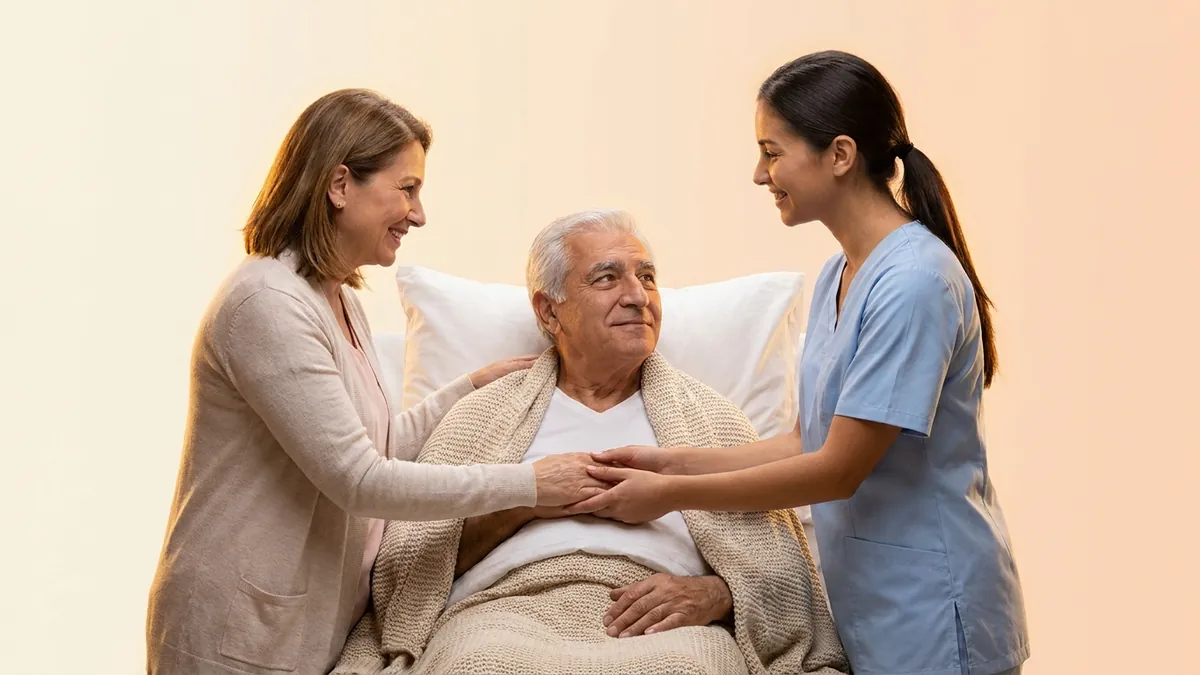
Has a loved one or family member been diagnosed with advanced cancer and their treatment is no longer effective? This is a very emotional and difficult time. At times like these, we all strive to go beyond curative treatments and make the remaining days of the patient’s life as comfortable, painless, and reassuring as possible. This is where the concept of “Hospice Care” comes to our rescue. Simply put, it is loving, comforting care that protects/takes care of both the patient and their family.
When should hospice care begin?
This type of care is usually considered when, according to the treating doctor, the patient has less than 6 months to live. The most important thing to understand here is that the main goal of hospice care is not to cure cancer . Its sole purpose is to create the environment necessary for the patient to spend the remaining few months or weeks of his life as pain-free, comfortable, and dignified as possible.
Imagine, after being admitted to this service, if the patient's condition improves in some way? No problem. There is complete freedom to withdraw from the hospice service at any time and return to active cancer treatment. Also, if the patient lives beyond the 6 months that the doctor has said, he can renew this hospice service and continue to receive it for as long as necessary.
If one or more of the following apply to you or your loved one, it may be time to consider hospice care:
- If the cancer is in a very advanced stage.
- If you have had to be hospitalized continuously over the past period of time.
- If you wish to stop treatment because the treatment is not having much effect or because you cannot tolerate the side effects of the treatment.
- If your body weight has decreased significantly.
- If you would rather spend the rest of your time at home with your loved ones than in the hospital.
What help does hospice provide?
This is not a one-person service. This care is provided by a large team of people, including your doctor, a specially trained hospice nurse, a social worker, a health aide, and volunteers. Let's take a look at the main services they provide.
| Service Division | Assistance and explanation received |
|---|---|
| Pain management | The main focus of hospice care is to make the patient as comfortable as possible. They do everything they can to manage symptoms such as physical pain, breathing difficulties, and fatigue. |
| Supporting family | This care is not limited to the patient alone. The patient's family is constantly informed about the condition of the patient and what may happen next. The family is provided with psychological support about the process of death and how to cope with it. |
| Spiritual healing | Everyone has religious and spiritual beliefs. The hospice team respects the patient's beliefs and works to provide the spiritual healing they need. They help by discussing the patient's thoughts about death and any religious rituals they need to perform. |
| Respite Care | If the patient is receiving care at home, the family also needs a break to care for them. Under this service, a health professional will come to the patient's home or in a hospice center and care for them for up to 5 days. This gives the family a chance to take some time off and be refreshed. |
| Bereavement Care | Hospice care does not end after the patient dies. Even after that, the family is provided with the counseling and support they need to overcome the grief that ensues. Counselors, clergy , or volunteer professionals help with this. |
Is this the same as palliative care?
You may have heard the term “palliative care.” It is also called “comfort care.” There is a slight difference between the two.
Hospice is a part of palliative care. Palliative care can begin at any stage of illness, but hospice service begins at the end of life.
Simply put, palliative care can be used to reduce the side effects of treatment (e.g., pain, nausea ) from the very beginning of cancer diagnosis. That is, palliative care can be used to reduce the discomfort caused by treatment while also treating the cancer.
But hospice is a specialized form of palliative care that is not aimed at curing the disease but at making the end of life more comfortable. Its main goal is to help you manage your stress and physical pain, be happy with your loved ones, and keep you sane enough to make important life decisions.
How do you find a service like this?
This concept is gradually becoming popular in Sri Lanka. You can ask your treating doctor or a social worker at the hospital about this and be referred to a group that provides this type of service.
This service can be provided at home, in a hospital, nursing home, or specialized hospice center. You can also switch between these options depending on your needs.
Before choosing a hospice service, ask yourself these questions:
- Do you like the environment of that place?
- Is this in a convenient location for your family and friends?
- Are your loved ones allowed to visit you at any time?
- Who will take care of you? What are their qualifications?
- What services do they provide? (Do they provide all kinds of medical, psychological, and spiritual care?)
- Can family members contact them at any time?
- Do you allow your family to help you with your care?
- How much does this cost? Is it covered by insurance?
It is very important to make a decision with a clear understanding of this.
💡 Take-Home Message
- Hospice care is not a treatment aimed at curing the end of life of a patient with advanced cancer. Rather, it is a palliative care aimed at reducing pain, improving comfort, and improving quality of life .
- This service is not limited to the patient alone. It is a care that provides mental and emotional support and awareness to the entire family of the patient .
- You can receive this care at home, in a hospital, or at a dedicated center.
- Don't make a decision like this alone. Be sure to talk openly with your doctor to determine if this is the right step for you or your loved one.






Janiw kuna arsuwinakas jichhakamax uñt’ayatäkiti. Aka chiqanx amuyt’awim jan ukax jiskt’awim yapxatañamawa.