

Imagine a painful cough that lasts all night... You can't sleep, you're so tired. Or you can't even do anything useful when you cough all day long, right? At times like these, many of us are used to rushing to the pharmacy and asking for something like a cough syrup. But did you know that not all coughs are treated with the same type of medicine? Yes, there are types of coughs. So today, let's talk about the medicines given for this cough, how they work, and the things you should consider when choosing a medicine.
Know your body mass index (BMI) and weight classification
First, let's understand, there are two types of coughs.
Before we talk about cough medicine, we need to understand the two main types of coughs, because the type of cough you have will determine the medicine you should use.
1. Dry Cough / Non-productive Cough: This is a cough that does not produce mucus. It is a scratchy, painful, and persistent cough. Sometimes it can even cause sore throat.
2. Wet Cough / Productive Cough: This is what we call a "wet cough" or "chest phlegm". When you cough, you feel like you're coughing up mucus from your chest. This mucus can be thick, yellow, or green. This is actually a good thing, because this is how the body gets rid of unwanted mucus and germs in the lungs.
The important thing is that the medications for these two types of cough are completely different. If you give one medicine to the other, the cough may get worse.
What are the types of cough medicines?
Simply put, over-the-counter cough medicines that can be purchased at the pharmacy without a doctor's prescription can be divided into three main types.
1. Cough suppressants
This medication works by controlling your dry cough . Just think of it like there's a "cough center" in your brain. What these medications do is temporarily block the signal going to that center. Then the cough stops.
- Use: Only for dry coughs that are not productive, painful, and interfere with sleep.
- Main ingredient: The most common ingredient in this type of medication is Dextromethorphan. If you look at the medicine bottle, it is often abbreviated as DM .
- Very important: Do not take this medicine for a cough with mucus.** Because if you do, the mucus in the lungs will remain trapped inside instead of coming out, increasing the risk of infection.
2. Expectorants
These are used for coughs with mucus . This medicine does not stop the cough. Instead, it works by thinning the thick, sticky mucus in your lungs and airways. When the mucus is thin, you can cough it up more easily.
- Used by:A cough that feels like the chest is full of mucus and is blocked.
- Main ingredient: The most common ingredient in this type of medicine is Guaifenesin.
- Side effects: Some people may experience nausea and vomiting when taking this medication.
- The best expectorant: According to doctors, the best and most natural way to thin out mucus is to drink plenty of water . So, while taking this medicine, try to drink at least 8-10 glasses of water a day.
3. Topicals
These are the familiar ointments that contain menthol and other ingredients. For example, products like Siddalepa and Vicks. When these are rubbed on the neck and chest, inhaling the pungent vapors can help relieve coughs and reduce nasal congestion. These also come in liquid form to be used with a vaporizer. Lozenges containing menthol can also provide temporary relief to the throat.
| Type of medicine | What to do | Which cough is suitable for? |
|---|---|---|
| Cough suppressants | It stops signals from going to the cough control center in the brain. | Only for a dry, painful cough without mucus. |
| Expectorants | It thins thick mucus and makes it easier to expel. | Cough with mucus and a feeling of chest tightness. |
| Topicals | The fragrant steam provides temporary relief from nasal congestion and cough. | To get relief from any cough. |
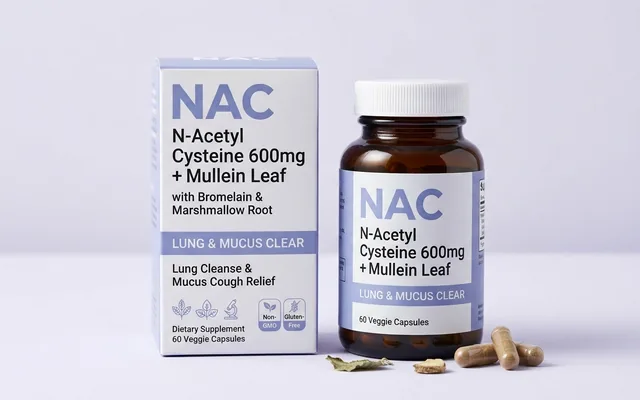
Clinical mucolytic NAC 600mg with organic Mullein leaf extract to break down thick bronchial mucus, soothe sore throat/cough, and replenish intracellular glutathione.
View Clinical Details →Let's also learn about "Combination" medicines.
Many cold medicines available in pharmacies are not just one medicine. They are "combination" medicines. That is, several types of medicine are mixed together in a single syrup or pill.
For example, a single medicine may contain:
- A cough suppressant
- An expectorant (Expectorant)
- A medicine that reduces congestion (Decongestant)
- A medicine that reduces headaches and body pain (Pain reliever)
- An antihistamine that reduces mucus secretion
If you have several cold symptoms (e.g., cough, stuffy nose, body aches), this type of medicine can be helpful. But the downside is that it can also put you in a lot of medicine that you don't need. For example, if you don't have a stuffy nose, there's no point in taking a medicine that contains a decongestant,' right?
Consider this when using cough medicine.
In fact, coughing is a defense mechanism of our body. Therefore, doctors do not recommend taking medicine for every minor cough unless it is disturbing your sleep or daily activities. Especially if you are a smoker or have a condition like asthma or emphysema, do not try to stop coughing up mucus. Because it is by expelling mucus that your lungs are kept clean.
When you should definitely see a doctor
The cough that comes with a common cold will subside in a few days, or a week or two. However, if you have the following symptoms, you should definitely see a doctor without taking over-the-counter medication:
- Cough that persists for more than 2-3 weeks .
- High fever with cough, feeling weak.
- If you experience difficulty breathing or chest pain when coughing.
- If there is blood coming out with the mucus.
- If you are losing weight due to coughing.
- Severe cough in young children and the elderly .
Be careful if you are taking other medications.
- High Blood Pressure: If you have high blood pressure, avoid taking cough medicines that contain decongestants. These can increase your blood pressure even more.
- Antidepressants: If you are taking these medications, be sure to consult your doctor before taking cough medicine containing Dextromethorphan (DM). Interactions between these two types of medications may occur.
- Other diseases: If you are taking medication for any other chronic disease, such as heart disease, diabetes, or thyroid problems, it is safest to talk to your doctor before buying a cough medicine from the pharmacy.
💡 Take-Home Message
- First, identify whether you have a dry cough or a cough with mucus. The medications given for these two are different.
- Use cough suppressants for dry coughs and expectorants for phlegmy coughs.
- When you have a cough with mucus, avoid taking cough suppressants (containing DM).
- One of the best natural remedies for a phlegmy cough is to drink plenty of water.
- If you have high blood pressure, heart disease, or other chronic illnesses, be sure to consult your doctor before purchasing medication from the pharmacy.
- If the cough lasts for more than two weeks, or if there are severe symptoms such as difficulty breathing, fever, or bloody phlegm, see a doctor immediately.


No comments yet. Be the first to share your question or experience below.