
Are your breasts too dense? (Dense Breast Tissue) - Let's talk about this!

Are your breasts too dense? (Dense Breast Tissue) - Let's talk about this!

If your mammogram report says "Your breast tissue is too dense" or "Dense Breast Tissue", you might be a little worried, right? You might be thinking, "Oh, do I have something serious?" But there's no need to worry . This is something that many women, especially those of us in Sri Lanka, see very often. So, let's talk about this clearly and simply today.
What is this "dense breast tissue"?

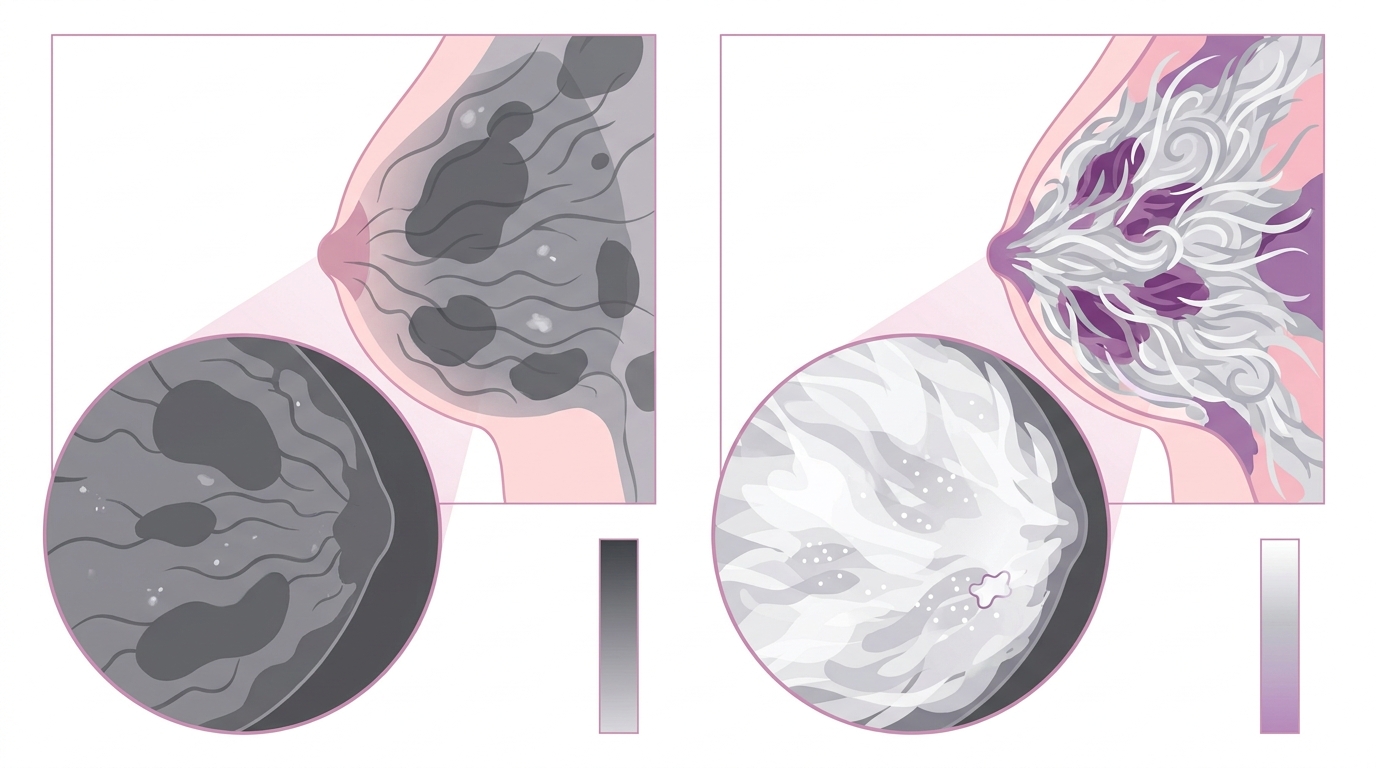
Simply put, it means that your breasts have too much fibrous and glandular tissue and too little fatty tissue . This is not a disease. Just think, about half of all women have this condition.

The important thing is that you don't feel any symptoms of having dense breast tissue. You won't feel any breast pain, changes, or even a self-breast examination at home. Even if a doctor examines you, it won't be noticeable.

So how do you know this? Usually, when you have a mammogram (especially a 3D mammogram - aka digital breast tomosynthesis), this is mentioned in the report. The radiologist will look at your mammogram and tell you whether your breast tissue is dense or not. Doctors may also call this 'breast density' or 'fibroglandular density'.

So, why is it important to know this?

It can be a bit surprising to find out that your breast tissue is dense. But it's not something to worry about. However, it's important to talk to your doctor about this and understand what your mammogram report says.

There are two main issues in this:

1. As breast tissue becomes denser, it can be harder to find things like cancer cells on a mammogram. Because dense tissue and cancer cells appear white on a mammogram. It's like looking for a white rabbit in a snowstorm.

2. People with extremely dense breast tissue may have a slightly higher risk of developing breast cancer than others. This does not mean that they will definitely develop cancer, but rather that they are at slightly higher risk.

So, don't be alarmed by the "Dense Breast Tissue" report. But, don't forget to talk to your doctor about this.

Let's learn a little about our breast tissue?

To understand this "solid tissue" story, it's helpful to have a little idea of ​​the types of tissue that make up our breasts. There are three main types of tissue:

  • Fatty tissue / Adipose tissue:These are less dense. On a mammogram, they appear darker, sometimes translucent. So if there is something white (like cancer) in a breast like this, it can be easily detected.
  • Fibrous connective tissue: This is a dense tissue. It helps support, protect, and hold our muscles and other tissues together. It appears white on a mammogram.
  • Fibroglandular tissue: This is where the milk-producing glands and the ducts that carry milk to the nipple are located. Like fibrous tissue, this is dense and appears white on a mammogram.

So, if the amount of fibrous and fibro-glandular tissue in your breasts is greater than the amount of fatty tissue, then we call them "dense breasts."

How do doctors measure this thickness?

Radiologists use a system to classify the thickness of breast tissue. It is called the Breast Imaging Reporting and Data System (BI-RADS) . Under this system, breast thickness is divided into four main categories. Think of it like this:

  • Type A (Almost entirely fatty): Breasts are made up mostly (more than 90%) of fatty tissue. These are very thin. If there is anything unusual, it can be easily seen on a mammogram.
  • Group B (Scattered areas of fibroglandular density): Dense tissue (fibroglandular tissue) is scattered here and there with fatty tissue. It is still easy to detect things like cancer.
  • Category C (Heterogeneously dense): The breast is filled with a significant amount of dense tissue. However, this density is not uniform, but varies from place to place. In these types of breasts, some cancers may be hidden behind the dense tissue on a mammogram, making it a little harder to find.
  • Category D (Extremely dense): The breast is extremely dense. This means that it is mostly composed of fibrous and glandular tissue. In this case, it can be even more challenging to detect cancer with a mammogram alone. Because both the cancer and the tissue are white, it is difficult to distinguish them.

Your mammogram report will list this BI-RADS category, which will help you understand how dense your breasts are.

What causes these breasts to become dense?

There is no single specific cause of breast engorgement, but there are several factors that can contribute:

  • Age: Breasts are usually naturally denser in your 20s and 30s. As you age, this density can gradually decrease, especially after menopause.
  • Body weight: A low Body Mass Index (BMI) means that thin people are more likely to develop dense breast tissue.
  • Family history: Breast density is genetic.It could be something that comes with it. That means if your mother or sisters have dense breasts, you're likely to have them too.
  • Medications: Some hormone treatments, such as hormone replacement therapy for menopause, can cause changes in breast density.

Is there a treatment for this?

No. There is currently no specific medication or surgery that can reduce the amount of fibrous and fibroglandular tissue in your breasts. This is not a disease, so there is no treatment.

However, if your mammogram shows that you have dense breasts, your doctor will perform a breast cancer risk assessment. This looks at your lifetime risk of developing breast cancer.

Based on this risk assessment and the mammogram results, the doctor may order additional tests. These include:

  • Breast MRI (Magnetic Resonance Imaging): This test uses magnetic fields, radio waves, and a computer to produce very clear, detailed images of breast tissue. It is more likely to detect even small cancers hidden among dense tissue.
  • Breast ultrasound: This test uses sound waves to create images of breast tissue. It helps to obtain information in addition to a mammogram.
  • Molecular Breast Imaging (MBI) test: This is a special test. A radioactive substance is injected into the body and viewed with a special scanning device. If there are cancer cells within the dense breast tissue, they are clearly highlighted.

Not everyone needs these additional tests. Your doctor will decide whether or not they are necessary based on your weight, family history, and other risk factors.

Can solid tissue turn into cancer?

This is a question that many people ask. No, dense tissue does not directly turn into cancer. Breast cancer occurs when breast cells mutate and become cancerous. This can happen in breasts with more fatty tissue or in breasts with more dense tissue.

But, as mentioned earlier, having extremely dense breast tissue does slightly increase your risk of breast cancer . That's because breast cancer often starts in what's called fibroglandular tissue. So, the more fibroglandular tissue you have in your breasts, the more "places" cancer can grow. That's why your risk is slightly increased.

Remember, having dense breasts does not mean you will get cancer. However, it is important to be aware of it and get proper screening.

So, what are the most important things we need to remember?

Okay, so, from what we've talked about about "Dense Breast Tissue," here are some things you should definitely remember:

  • This is normal: Increased breast tissue density is not a disease, but a condition that affects many women.
  • Find out from a mammogram report: You can find out whether you have this condition or not with a mammogram test.
  • Talk to your doctor: If you find out that your breasts are too dense, talk to your doctor about it and discuss your risks and what to do next. Also discuss additional testing, especially if your tissue is "extremely dense" (BI-RADS D).
  • Get regular checkups: Whether you have dense breasts or not, the best way to detect breast cancer early is to have regular mammograms and other tests if needed. Don't forget to do monthly self-breast exams.
  • Hard tissue cannot be removed: There is no way to remove this hard tissue. Therefore, we need to focus on early detection.

So, I hope you now have a better understanding of "Dense Breast Tissue". The most important thing is to not be afraid, to be informed, and to stay healthy. If you have any further questions, be sure to ask your doctor.

👩🏽‍⚕️ Additional questions (FAQs)

💬 Is Dense Breast Tissue a form of breast cancer?

No! This is not cancer or a disease. This is a normal condition in women's breasts. A woman's breast is made up of a combination of 'fat' and 'glandular/connective tissue' (Dense tissue). This is a condition in which the breasts of younger women and those with higher hormone levels have less fat and more of that 'dense tissue'.

💬 Is it dangerous if I have this dense tissue in my breasts?

The only danger with this is that if a lump develops in your breast, the lump is white, and the dense tissue is also white. Therefore, it is very difficult for doctors to find the cancerous lump 'hidden behind that white tissue' with a regular mammogram. Also, these people are at slightly higher risk of developing breast cancer.

💬 How do you detect cancer if it doesn't show up on a mammogram?

Don't be alarmed if your doctor tells you that you have 'Dense Breasts'. In addition to the mammogram, your doctor will definitely recommend a 'Breast Ultrasound Scan' or a 'Breast MRI' for more complete information as another safety measure.


` Breast density, mammogram, breast cancer, breast health, women's health, BI-RADS, breast tissue

⚠️ Important: The medical articles and information on Nirogi Lanka are for general awareness only, and are by no means a substitute for professional medical advice, diagnosis, or treatment. For any medical problem you have, consult a qualified physician immediately.

💬 Comments (0)

No comments have been posted yet. Add your comment here for the first time.

Add your comment

Please calculate: 4 + 2 =
Are your breasts too dense? (Dense Breast Tissue) - Let's talk about this!
Women's HealthApril 29, 2026

Are your breasts too dense? (Dense Breast Tissue) - Let's talk about this!

If your mammogram report says "Your breast tissue is too dense" or "Dense Breast Tissue", you might be a little worried, right? You might be thinking, "Oh, do I have something serious?" But there's no need to worry . This is something that many women, especially those of us in Sri Lanka, see very often. So, let's talk about this clearly and simply today.

What is this "dense breast tissue"?

Simply put, it means that your breasts have too much fibrous and glandular tissue and too little fatty tissue . This is not a disease. Just think, about half of all women have this condition.

The important thing is that you don't feel any symptoms of having dense breast tissue. You won't feel any breast pain, changes, or even a self-breast examination at home. Even if a doctor examines you, it won't be noticeable.

So how do you know this? Usually, when you have a mammogram (especially a 3D mammogram - aka digital breast tomosynthesis), this is mentioned in the report. The radiologist will look at your mammogram and tell you whether your breast tissue is dense or not. Doctors may also call this 'breast density' or 'fibroglandular density'.

So, why is it important to know this?

It can be a bit surprising to find out that your breast tissue is dense. But it's not something to worry about. However, it's important to talk to your doctor about this and understand what your mammogram report says.

There are two main issues in this:

1. As breast tissue becomes denser, it can be harder to find things like cancer cells on a mammogram. Because dense tissue and cancer cells appear white on a mammogram. It's like looking for a white rabbit in a snowstorm.

2. People with extremely dense breast tissue may have a slightly higher risk of developing breast cancer than others. This does not mean that they will definitely develop cancer, but rather that they are at slightly higher risk.

So, don't be alarmed by the "Dense Breast Tissue" report. But, don't forget to talk to your doctor about this.

Let's learn a little about our breast tissue?

To understand this "solid tissue" story, it's helpful to have a little idea of ​​the types of tissue that make up our breasts. There are three main types of tissue:

  • Fatty tissue / Adipose tissue:These are less dense. On a mammogram, they appear darker, sometimes translucent. So if there is something white (like cancer) in a breast like this, it can be easily detected.
  • Fibrous connective tissue: This is a dense tissue. It helps support, protect, and hold our muscles and other tissues together. It appears white on a mammogram.
  • Fibroglandular tissue: This is where the milk-producing glands and the ducts that carry milk to the nipple are located. Like fibrous tissue, this is dense and appears white on a mammogram.

So, if the amount of fibrous and fibro-glandular tissue in your breasts is greater than the amount of fatty tissue, then we call them "dense breasts."

How do doctors measure this thickness?

Radiologists use a system to classify the thickness of breast tissue. It is called the Breast Imaging Reporting and Data System (BI-RADS) . Under this system, breast thickness is divided into four main categories. Think of it like this:

  • Type A (Almost entirely fatty): Breasts are made up mostly (more than 90%) of fatty tissue. These are very thin. If there is anything unusual, it can be easily seen on a mammogram.
  • Group B (Scattered areas of fibroglandular density): Dense tissue (fibroglandular tissue) is scattered here and there with fatty tissue. It is still easy to detect things like cancer.
  • Category C (Heterogeneously dense): The breast is filled with a significant amount of dense tissue. However, this density is not uniform, but varies from place to place. In these types of breasts, some cancers may be hidden behind the dense tissue on a mammogram, making it a little harder to find.
  • Category D (Extremely dense): The breast is extremely dense. This means that it is mostly composed of fibrous and glandular tissue. In this case, it can be even more challenging to detect cancer with a mammogram alone. Because both the cancer and the tissue are white, it is difficult to distinguish them.

Your mammogram report will list this BI-RADS category, which will help you understand how dense your breasts are.

What causes these breasts to become dense?

There is no single specific cause of breast engorgement, but there are several factors that can contribute:

  • Age: Breasts are usually naturally denser in your 20s and 30s. As you age, this density can gradually decrease, especially after menopause.
  • Body weight: A low Body Mass Index (BMI) means that thin people are more likely to develop dense breast tissue.
  • Family history: Breast density is genetic.It could be something that comes with it. That means if your mother or sisters have dense breasts, you're likely to have them too.
  • Medications: Some hormone treatments, such as hormone replacement therapy for menopause, can cause changes in breast density.

Is there a treatment for this?

No. There is currently no specific medication or surgery that can reduce the amount of fibrous and fibroglandular tissue in your breasts. This is not a disease, so there is no treatment.

However, if your mammogram shows that you have dense breasts, your doctor will perform a breast cancer risk assessment. This looks at your lifetime risk of developing breast cancer.

Based on this risk assessment and the mammogram results, the doctor may order additional tests. These include:

  • Breast MRI (Magnetic Resonance Imaging): This test uses magnetic fields, radio waves, and a computer to produce very clear, detailed images of breast tissue. It is more likely to detect even small cancers hidden among dense tissue.
  • Breast ultrasound: This test uses sound waves to create images of breast tissue. It helps to obtain information in addition to a mammogram.
  • Molecular Breast Imaging (MBI) test: This is a special test. A radioactive substance is injected into the body and viewed with a special scanning device. If there are cancer cells within the dense breast tissue, they are clearly highlighted.

Not everyone needs these additional tests. Your doctor will decide whether or not they are necessary based on your weight, family history, and other risk factors.

Can solid tissue turn into cancer?

This is a question that many people ask. No, dense tissue does not directly turn into cancer. Breast cancer occurs when breast cells mutate and become cancerous. This can happen in breasts with more fatty tissue or in breasts with more dense tissue.

But, as mentioned earlier, having extremely dense breast tissue does slightly increase your risk of breast cancer . That's because breast cancer often starts in what's called fibroglandular tissue. So, the more fibroglandular tissue you have in your breasts, the more "places" cancer can grow. That's why your risk is slightly increased.

Remember, having dense breasts does not mean you will get cancer. However, it is important to be aware of it and get proper screening.

So, what are the most important things we need to remember?

Okay, so, from what we've talked about about "Dense Breast Tissue," here are some things you should definitely remember:

  • This is normal: Increased breast tissue density is not a disease, but a condition that affects many women.
  • Find out from a mammogram report: You can find out whether you have this condition or not with a mammogram test.
  • Talk to your doctor: If you find out that your breasts are too dense, talk to your doctor about it and discuss your risks and what to do next. Also discuss additional testing, especially if your tissue is "extremely dense" (BI-RADS D).
  • Get regular checkups: Whether you have dense breasts or not, the best way to detect breast cancer early is to have regular mammograms and other tests if needed. Don't forget to do monthly self-breast exams.
  • Hard tissue cannot be removed: There is no way to remove this hard tissue. Therefore, we need to focus on early detection.

So, I hope you now have a better understanding of "Dense Breast Tissue". The most important thing is to not be afraid, to be informed, and to stay healthy. If you have any further questions, be sure to ask your doctor.

👩🏽‍⚕️ Additional questions (FAQs)

💬 Is Dense Breast Tissue a form of breast cancer?

No! This is not cancer or a disease. This is a normal condition in women's breasts. A woman's breast is made up of a combination of 'fat' and 'glandular/connective tissue' (Dense tissue). This is a condition in which the breasts of younger women and those with higher hormone levels have less fat and more of that 'dense tissue'.

💬 Is it dangerous if I have this dense tissue in my breasts?

The only danger with this is that if a lump develops in your breast, the lump is white, and the dense tissue is also white. Therefore, it is very difficult for doctors to find the cancerous lump 'hidden behind that white tissue' with a regular mammogram. Also, these people are at slightly higher risk of developing breast cancer.

💬 How do you detect cancer if it doesn't show up on a mammogram?

Don't be alarmed if your doctor tells you that you have 'Dense Breasts'. In addition to the mammogram, your doctor will definitely recommend a 'Breast Ultrasound Scan' or a 'Breast MRI' for more complete information as another safety measure.


` Breast density, mammogram, breast cancer, breast health, women's health, BI-RADS, breast tissue

⚠️ Important: The medical articles and information on Nirogi Lanka are for general awareness only, and are by no means a substitute for professional medical advice, diagnosis, or treatment. For any medical problem you have, consult a qualified physician immediately.

💬 Comments (0)

No comments have been posted yet. Add your comment here for the first time.

Add your comment

Please calculate: 4 + 2 =