
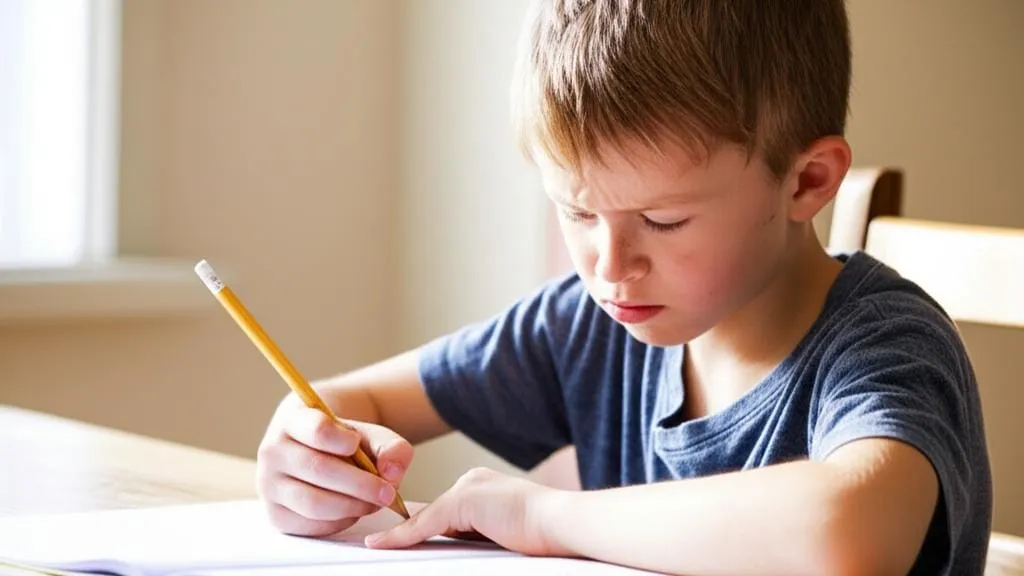
Is your child's handwriting very messy? Does he write in different ways and sizes? Maybe he is very lazy to write. But the reason for all this may not be the child's laziness or mischief. Perhaps the reason for this is a learning disability called ' Dysgraphia '. Let's talk about this simply today.
eGFR calculadora ukaxa CKD-EPI 2021 ukampi luratawa. Creatinina uksatxa riñon lurawipa jakhthapiña ukhamaraki CKD etapa uñt’aña.
Simply put, what is dysgraphia?
Dysgraphia is a learning disability. Strictly speaking, it is a neurological disorder . It affects the brain processes and fine motor skills needed to write. This means that the child has difficulty writing down what is in their mind and writing it down clearly on paper. In some cases, it also affects the ability to pronounce and spell words correctly.
Writing clearly and accurately is one of the primary expectations of a child in school. So when this ability is lacking, it can have a major impact on a child's education.
Are dysgraphia and dyslexia the same thing?
Yes, although both of these are learning disabilities, there is a difference between the two.
- Dyslexia : In this, the problem a child has is difficulty decoding written letters or words. This is a reading problem.
- Dysgraphia: The problem here is that it is difficult to write down the ideas in your mind as words on paper. That is, it is a writing problem.
Think of it this way: dyslexia is like not being able to read a map someone else has drawn. Dysgraphia is like not being able to draw a map yourself. Some children may have one of these two conditions, but some children may have both.
Is there a connection between autism and ADHD?
Dysgraphia is a learning disability. Autism, also known as Autism Spectrum Disorder (ASD), is a different condition. It mainly affects communication and social interactions. However, because language skills are affected, a child with autism is likely to have dysgraphia as well. Dysgraphia is also common among children with attention deficit hyperactivity disorder (ADHD) .
What are the main types of dysgraphia?
There are several types of dysgraphia. Sometimes a child may have more than one of these types. Let's take a quick look at what these are.
| Type of dysgraphia | Simply put... |
|---|---|
| Dyslexic Dysgraphia | What happens in this case is that you can pronounce words correctly when you speak, but when you write, you make mistakes and your spelling is often wrong. However, your handwriting may be a little clearer. |
| Motor Dysgraphia | This is directly related to the function of the hand. It is difficult to hold a pen/pencil properly, and it is impossible to write neatly. The handwriting is very messy. However, the words can be pronounced (spelled) correctly with the mouth. |
| Spatial Dysgraphia | These children do not understand how to write with spaces between letters and words. It is difficult to write neatly on a ruler. This problem also occurs when copying something from somewhere. These children may also have difficulty drawing. |
| Phonological Dysgraphia | The problem with these children is that they have difficulty connecting the sound of a word with the corresponding letter (spelling). Although they can write words they know, they have a hard time writing new, unfamiliar words. |
| Lexical Dysgraphia | Although they can write words with simple rules, these children are unable to write difficult words that are formed irregularly. For example, they cannot write the correct positions of letters like '', '', '', ''. |
What causes dysgraphia?
The exact cause of this condition in children is not yet known. However, in adults, it can sometimes occur after brain damage, such as a stroke. In children, it often occurs along with other learning disabilities, such as ADHD and dyslexia.
What symptoms can we see?
Parents and teachers only notice these signs when a child starts writing at school. See if your child has any of these signs.
- The handwriting is very unclear and inconsistent (e.g., the same word is written in a mix of lowercase and capital letters, italics and vertical letters).
- When I write, I write very carefully . It takes me a long time to copy something on the board.
- They hold the pencil very tightly , so they say their hands hurt after writing for a while.
- The space on a sheet of paper is not used properly . It is difficult to write between two rulers and within the margins.
- I always erase when I write.
- The amount of space between letters and words is not the same.
- Spelling is very incorrect . Sometimes words are not completed, or words or letters are omitted.
- When writing, they hold their body or head in a strange way , or they write with the paper turned in a strange way.
- It's hard to think and write at the same time . So when you're asked to write something creative like an essay, it becomes very difficult.
How to diagnose this condition?
The most important thing is to investigate this issue, rather than blaming the child for their messy handwriting, thinking it's due to laziness .
The first step is to see your pediatrician to check for any other physical conditions that may be affecting your writing.
Then, a psychologist or educational specialist trained in learning disabilities will determine whether this is dysgraphia. You can also seek the help of the psychologist at the child's school for this.
The specialist will give the child several tests that measure writing and academic abilities. For example,
- Let them write words and sentences.
- They are looking for something and letting you copy it.
- It tells you to do something with your fingers or rotate your wrist in a certain way.
At this time, the specialist examines the child's pen grip, body posture, writing speed, and the quality of the finished work.
How can I help as a parent?
There is no specific "cure" for dysgraphia. But there are many things we can do to help a child and teach them to live successfully with the condition. The most important thing is to identify it early and provide the child with the support they need.
| Ways to help the child | |
|---|---|
| Things you can do at home | |
| Writing instruments | Use books with wide rulers, square rule books, or sheets of paper with raised lines. Use things like 'pencil grips' that you put on your pencil. |
| Use of technology | Teach your child to type on a computer instead of writing by hand. Teach them to type as early as possible. |
| Positive encouragement | Don't blame your child for the messy work. Instead, praise their efforts. Encourage them positively. Talk to them about the situation and make them understand that it's not their fault. |
| Stress reduction | Before you start writing, do simple things like shaking your hands quickly, rubbing them together, or squeezing a stress ball to strengthen your hand muscles. |
| Benefits available from the school | |
| Talking to the teacher | Talk to the teacher about your child's situation and needs. Your child may be eligible for special education services or other special accommodations (such as an Individualized Education Program). |
| Relief that can be requested |
|
💡 Take-Home Message
- Dysgraphia is not a child's laziness or a mistake. It is a real medical condition related to brain function.
- It is very important to identify and address a child's writing difficulties early on.
- Although there is no specific treatment for this, with the right support, strategies, and accommodations from school, the child can continue to learn successfully.
- If your child has these symptoms, first consult your family doctor, and then refer them to an appropriate specialist. The most important thing is to understand and help the child, not scold them.





Janiw kuna arsuwinakas jichhakamax uñt’ayatäkiti. Aka chiqanx amuyt’awim jan ukax jiskt’awim yapxatañamawa.