
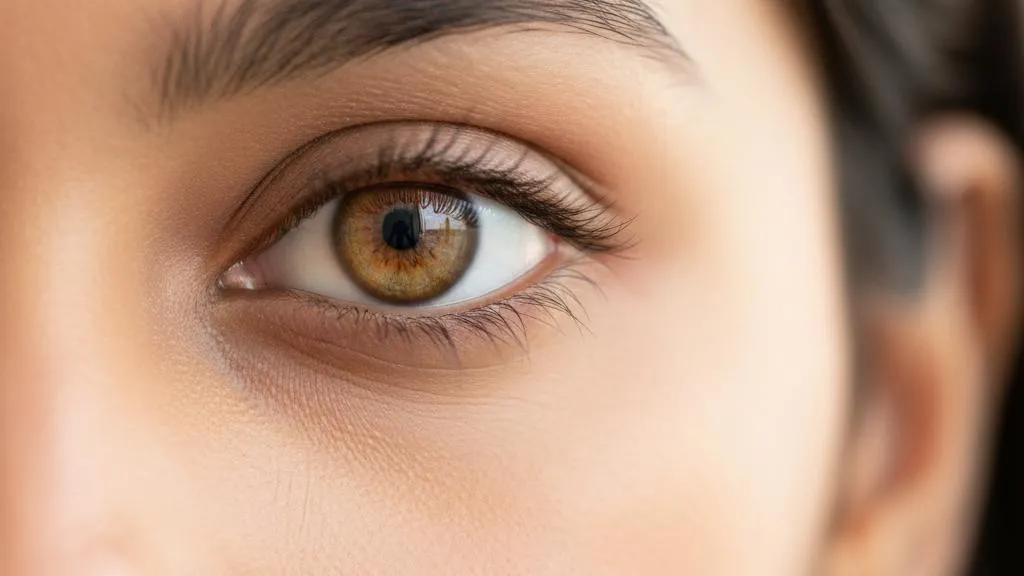
Have you ever looked at your eyes in a mirror? When you look at them, you see that there is a round part that gives your eyes a beautiful color. Some people have it dark brown, others have it light brown, and sometimes it can be blue or green. That colored part is what we medically call the 'iris'. It's like your fingerprint. It's unique to you. No one else in the world has the same eye color.
What is the actual function of the iris?
Simply put, the main function of the iris is to control how much light enters your eye. It's like the aperture in a camera lens. You see that little black spot in the middle of your eye? We call it the pupil. Light actually enters your eye through that pupil.
So, the very delicate muscles in the lens of the eye are what control the size of this black ring.
- When you go to a sunny, well-lit place: The muscles in the lens of the eye make the iris as small as possible (contract) . Then only the amount of light that is needed enters the eye. Too much light passes through and damages the eye.
- When you go into a dark, dimly lit place: The lens of the eye enlarges (dilates) the iris, allowing as much light as possible into the eye, helping you see things around you clearly.
Imagine coming inside after being in the sun for a while and suddenly feeling like you can't see anything, right? It takes a while for your eyes to adjust to the darkness. That's when your iris slowly enlarges and adjusts to the darkness. All of this happens automatically, without you even realizing it .
Where is this located inside the eye?
Our eyes are like an onion. They are made up of several layers. The iris is located below the cornea, which is the clear part of the eye, and above the lens, which is inside the eye. That is, the colored part is located around the black ring.
What is this made of? How is eye color determined?
The iris is made up mainly of muscles and nerves. These operate automatically, without our control.
Now let's look at how eye color is formed. You may have heard of the natural pigment called Melanin'' that gives color to our skin and hair. The color of the eyes is determined by the amount of that melanin pigment in the lens of the eye.
- If there is too much melanin: the eyes become dark brown.
- If melanin is low: Eyes may be light brown, green, or blue.
How much melanin we have is determined by our genes. This means you get these traits from your mother and father .
What are the conditions that affect the iris?
Any condition that affects the eye can also affect the lens of the eye. Here are some of the most common conditions.
| Condition | Simply put... |
|---|---|
| Aniridia | The complete or partial absence of the lens of the eye at birth. |
| Horner's syndrome | Damage to a nerve in the face can cause symptoms such as a small black eye and drooping eyelid. |
| Glaucoma | Increased pressure inside the eye can damage the optic nerve. This can also affect the function of the lens of the eye. |
| Albinism | The body has very low or no melanin pigment, which causes the eyes to be very light in color. |
| Cataracts | Clouding of the lens of the eye. This directly affects vision. |
| Uveitis | Inflammation of the middle layer of the eye, including the lens. The eyes may become red and painful. |
| Waardenburg syndrome | A genetic condition that causes changes in eye color, skin and hair pigmentation, and sometimes hearing loss. |
The most important thing is that if you notice anything like a change in your vision, pain, or color change in your eyes, you should see a doctor immediately .
What happens if the iris is damaged?
Any accident to the eye can damage the lens of the eye. The nature of the damage depends on how the accident occurred. Some minor injuries can be treated with rest and home remedies. However, some accidents can cause serious damage and even vision loss .
Therefore, if there is any danger to the eyes, the best thing to do is to see an ophthalmologist. If the situation is serious, for example, if you suddenly lose your vision or experience severe pain, go to the Emergency Department (ETU) of the nearest hospital immediately.
What tests are performed to check the iris?
When you go for a routine eye exam, the eye doctor will also examine your lens. They may use a special device called a Slit Lamp'' to do this.
If there is suspicion of a medical condition, tests like this may need to be done to confirm further.
| Test | Description |
|---|---|
| MRI (Magnetic Resonance Imaging) | Using a magnetic field to obtain detailed images of the inside of the body. |
| CT Scan (Computed Tomography) | Obtaining cross-sectional images of the inside of the eye using X-ray technology. |
| Ultrasound | Examining the structures inside the eye using sound waves. |
| Optical Coherence Tomography (OCT) | Using light waves to obtain very clear, detailed images of the retina and other parts of the eye. |
So, how do we take good care of this precious organ?
Our eyes are our most precious asset. So follow these simple steps to protect your entire eye, including the lens.
- Wear sunglasses: Whenever you go out in the sun, wear a good pair of sunglasses with 100% UV protection or a UV400 label. This will protect your eyes from the sun's harmful ultraviolet (UV) rays.
- Seek medical advice as soon as you notice a change: If you notice any changes in your vision, such as eye pain or redness, see a doctor immediately , rather than waiting to see. It could be something as simple as changing your glasses, or it could be an early sign of a serious condition.
- In an emergency: If you suddenly lose your vision, experience unbearable pain, or have a serious eye injury , go to a hospital's Emergency Department (ETU) immediately .
Are Iris Scanners in Phones Harmful to the Eyes?
Nowadays, facial and eye scanning technology (Iris Scanners) is very common to unlock things like phones and computers. These devices identify you by emitting a very small, invisible infrared light to your face and eyes. According to current research, there is no evidence that these devices are dangerous or harmful to the eyes . So there is no need to be afraid of them.
Finally, your iris is not just something that is unique to you and gives your eyes their beautiful color. It is a very important part that helps you see clearly in any lighting condition. So get your eyes checked regularly and take good care of them.
💡 Take-Home Message
- The iris is the part of your eye that gives it its color and is unique to you.
- Its main function is to control the light entering the eye.
- Always wear good quality sunglasses to protect your eyes from the sun's harmful rays.
- If you notice any changes in vision, pain, or any unusual condition, see a doctor without delay.
- In the event of an accident or sudden loss of vision, go to a hospital's Emergency Department (ETU) immediately.
- Many eye conditions can be detected early by having regular eye exams.





Janiw kuna arsuwinakas jichhakamax uñt’ayatäkiti. Aka chiqanx amuyt’awim jan ukax jiskt’awim yapxatañamawa.