
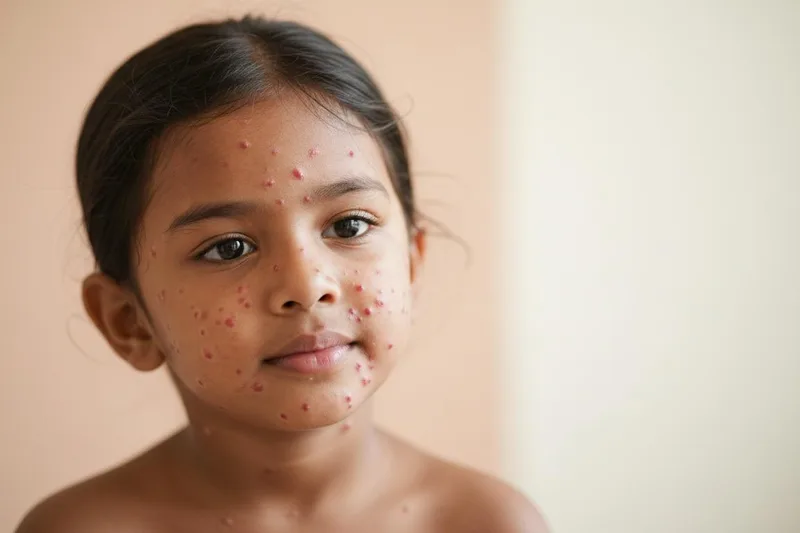
Has your little one recently had chickenpox? Or are you a little scared about chickenpox? To be honest, chickenpox is usually not that serious, but it can be very distressing for us when a little one gets it. So, let's learn everything about chickenpox today? Then you can deal with this situation better.
What is chickenpox? What are the symptoms?
Simply put, chickenpox is a disease caused by a virus . Doctors also call it ``Varicella``. Although it was very common in the past, the current chickenpox vaccine has greatly reduced the incidence. However, our little ones can still get it.
Okay, now let's look at the main feature of this, the blisters .
These blisters don't come all at once. They appear in waves over two, three, maybe four days.
1. First, small red blisters appear, either like pimples or mosquito bites .
2. Then these become fluid-filled, thin-skinned vesicles . Like little water bubbles. These tend to burst very quickly.
3. Next, the skin on these watery patches will crack and become like small wounds.
4. Eventually, these wounds dry out and form a brown crust .
The important thing is that because these blisters come in clusters, you may see all three of these stages (red blisters, oozing, and crusting) on your baby's body at the same time. Imagine that while there are some new red blisters, some of the previous ones may have become oozing, and some may have dried up and crusted.
These blisters usually start on the stomach, back, or face. They can then spread throughout the body, including the scalp, inside the mouth, arms, legs, and even the genitals. Some children only get a few blisters, while others may get many blisters all over their body.
In addition to blisters, your little one may also have symptoms like:
- You may get a high fever , and sometimes you may even feel cold and shiver.
- You may develop a sore throat .
- You may get a headache .
- It may even feel like a stomach ache .
- Things like a little bit of fatigue and loss of appetite can start to appear within a day or two before the blisters appear.
What can you do at home when you have chickenpox?
Okay, now that your baby has chickenpox, there are a lot of things we can do at home. The main thing is to reduce the baby's discomfort and make him comfortable. Remember, chickenpox usually doesn't require any specific treatment, it heals on its own. All we can do is control the symptoms.
Do these things to reduce itching
The biggest problem for children with chickenpox is the constant itching . It is unbearable. So to reduce this itching, we can try these things:
- Apply a clean cloth dampened with cool water to the blistered area. Alternatively, take a bath in lukewarm water three or four times a day. This is best for the first few days.
- When bathing, there are bath lotions that you can make with oatmeal, right? They are available in pharmacies and supermarkets. Using them can greatly reduce itching. Also, remember that bathing does not spread blisters.
- After bathing, pat your body dry gently. Do not rub vigorously. Doing so can cause blisters to break and become sore, and may also make the itching worse.
- Apply calamine lotion to the itchy areas. But do not apply it to your face, especially around your eyes. The area around your eyes is very sensitive, so be careful.
- Sometimes there are pain-relieving creams that can be applied to sores in the genital area. Ask your doctor or pharmacist about them.
- There are also OTC (Over-the-counter) medications that can be taken to relieve itching, such as antihistamines. It is best to ask a doctor about this as well and find out the appropriate dosage for your child's age and weight.
These things are important to prevent minor scratches.
Scratching can cause blisters, wounds, and scars later on. Not only that, but the germs on the nails can also cause infections. So, here are some things you can do to stop your baby from scratching:
- When your baby sleeps, put a pair of small mittens on his hands, or even a pair of clean socks. This will reduce the amount of scratching he does in his sleep.
- Keep your nails as short as possible and clean at all times. This will reduce the risk of injury and the spread of germs.
What if you have blisters in your mouth?
Sometimes chickenpox blisters can also get inside the mouth. Then it becomes very difficult to eat and drink. This is very annoying for little ones. If this happens, do these things:
- Give your baby cold, soft, and bland foods . For example, you can give him yogurt, ice cream (without a lot of sugar), well-cooked soups, mashed rice, and jelly.
- Avoid giving sour foods (like orange juice, tomatoes) and salty foods (like crackers, pretzels). They can make the mouth sores worse.
- To reduce pain, you can give acetaminophen (also known as paracetamol) in the prescribed dosage as prescribed by your doctor.
This is very important! You have to keep this in mind!
Never give aspirin to a child with chickenpox, especially if they have a fever! It can cause Reye's Syndrome.This is a very dangerous condition that can affect the brain and liver and can even be life-threatening. Therefore, you need to be very careful about this.
When should you see a doctor?
Chickenpox usually goes away on its own within a few days to a week or two. However, sometimes unexpected complications can occur. If your baby has any of the following symptoms, you should definitely see a doctor right away:
- If the fever persists for more than four (4) days, or if the fever suddenly becomes very high.
- If you have a very bad cough or have difficulty breathing (like your chest going in when you breathe, like you're breathing fast).
- If pus (a thick, yellow or green fluid) is coming out of the blister, or if the area is red, swollen, and warm to the touch, or if the child is still in pain when touched (these could be signs of a bacterial skin infection).
- If the child says they have a very bad headache , or if a small child keeps crying.
- If the baby is very sleepy, or if it is difficult to wake him up, or if there is a big change in his behavior.
- If you find it difficult to look at bright light, say your eyes hurt.
- If you have difficulty walking , like stumbling.
- If the baby seems agitated or confused .
- If you vomit frequently , especially to the point where you can't keep food or drink down.
- If the baby seems to be having a hard time and is very weak .
- If your neck is stiff and difficult to bend , it may be accompanied by a fever.
If you see something like this , it's best to see a doctor without wasting time. That way, the necessary treatment can begin quickly.
What are the ways to avoid chickenpox?
It's better to avoid chickenpox before it happens than to suffer after it happens. Fortunately, there are good ways to avoid chickenpox.
- The most important thing is to get the chickenpox vaccine. Doctors usually recommend that children get the first dose between 12 and 15 months of age and a booster dose between 4 and 6 years of age . This vaccine can greatly reduce the risk of getting chickenpox. Even with the vaccine, chickenpox can sometimes develop very mildly, but if it does, it is usually mild, with few blisters and little discomfort.
- Chickenpox is a very contagious disease . Therefore, if someone in the family has chickenpox, the rest of the family should wash their hands frequently with soap and water. It is also important to keep the child with chickenpox at home until all the blisters have dried and crusted over.We need to stop sending them to school and taking them to public places. This will help stop others, especially those with weakened immune systems (e.g. pregnant mothers, cancer patients), from getting infected.
The most important things we need to remember
Okay, so we've talked a lot about chickenpox. I hope you've found some relief. Finally, here are some important things to keep in mind:
- Chickenpox is a mild illness that usually resolves within a few days, so don't be unnecessarily afraid.
- Your main focus should be on reducing the baby's itching and discomfort and making him comfortable. It is also very important to treat him with love and not leave him alone.
- Remember to never give aspirin to a child with chickenpox . Instead, give a safe painkiller like acetaminophen.
- Always be aware of the warning signs we talked about. If you see any of these, don't panic, see a doctor right away.
- The chickenpox vaccine is the best way to protect against this disease. So don't forget to vaccinate your baby on time.
Remember, your doctor is the best person to advise you and your baby. While this article provides general information, every baby is different. So, if you have any questions or concerns, never hesitate to talk to a doctor.
Wishing you and your little one a speedy recovery!
` Chickenpox, chickenpox, varicella, chickenpox in children, chickenpox symptoms, chickenpox treatment, chickenpox vaccine


💬 Comments (0)
No comments have been posted yet. Add your comment here for the first time.
Add your comment