
🎂 — | ♂/♀ M/F | ⚖️ — kg | 📏 — cm | BMI — | 👟 —
⚡ 88%
🩺 Nutrition and food

Should you start feeding your 8-12 month old baby solid foods at home? (Introducing Solid Foods) Let's talk about this!

MBBS
Medically Reviewed by MBBS ✓ Medically Reviewed
📅 Updated: Aug 20, 2026 • ⏱ 4 min read • Editorial policy
Should you start feeding your 8-12 month old baby solid foods at home? (Introducing Solid Foods) Let's talk about this!
Table of Contents ▾

As your little one gets older, it's time to introduce new foods to their diet, right? By about 8 months, most babies are eating iron-fortified infant cereals and pureed foods. In fact, they're already getting used to drinking breast milk or formula with these foods. Now is the time for them to start trying home-cooked meals , which is the kind of food we eat all the time. This is a wonderful experience for you and your baby.
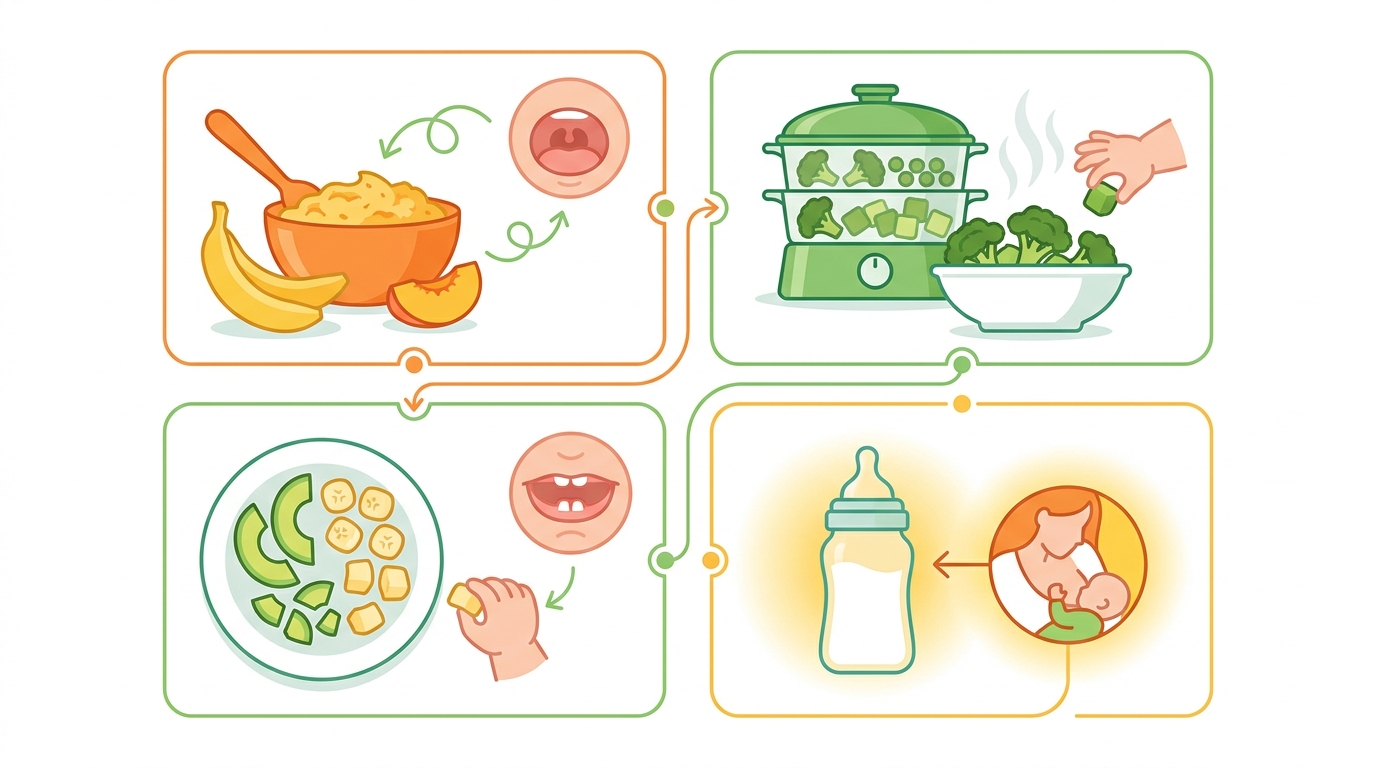
Should you start feeding your 8-12 month old baby solid foods at home? (Introducing Solid Foods) Let's talk about this! Infographic
⚡ Interactive Clinical Tool
⚡

TDEE Calculator

Calculate the number of calories needed per day to lose, gain or maintain weight

Open Interactive Calculator →

How do you know for sure if your baby is ready to eat at home?

There are a few small signs to look for to see if your baby is ready for this new challenge. If you recognize these correctly, you can start feeding your baby solid foods at a very early age.

  • Can your baby sit up well? If your baby can sit up straight for a while without any help, that's a good sign. It's very important to stay upright while eating, or they could choke.
  • Do you have good head control? If you can hold your head straight and turn it from side to side, that's also important.
  • Does your baby look at the food with interest? When you eat, does your baby stare at it as if he's eating? Does he try to reach for your plate? That means your little one is interested in food.
  • Do they put things in their mouths? Trying to put toys and other objects in their mouths is also something we see at this time. This shows that they are getting ready to explore things with their mouths and eat food.
  • Has the tongue-thrust reflex decreased? In the early days, babies tend to push their tongue out when they put something non-liquid in their mouth (tongue-thrust reflex). If this gradually decreases and they start to swallow food while holding it in their mouth, that's also a good sign.
  • Can he grasp small objects with two fingers? If he can use his thumb and index finger to grasp a small piece of food (pincer grasp), that means he's ready to pick up and eat food on his own.

Not all of these things have to happen at once, but if you see a few of these signs, you can start introducing new foods to your baby gradually.

What are the best foods to give to a baby during this time?

There are many foods that can be given to babies between 8 and 12 months. The main thing is variety and nutrition. Since their taste buds are developing during this time, it is very important to offer a variety of foods.

What should the texture of food be like?

You should start with pureed foods (purées) and gradually change the nature of the foods.

  • Mashed foods: Vegetables like potatoes, sweet potatoes, and pumpkin can be boiled and mashed. Fruits like bananas and avocados are also good to be given this way.
  • Finely chopped or minced foods:When they are used to chewing small pieces, give them well-cooked meat, fish, and chicken, then cut or grind them into very small pieces.
  • Soft finger foods: When your baby is ready to eat on their own, offer them soft finger foods. This will help them develop their chewing skills and fine motor skills .

Imagine what a new experience it will be for a baby when he first drinks things like porridge, then eats mashed food, and now eats small pieces on his own!

❓ FAQ

FAQ

Evidence-based clinical answers to common patient questions

ukat juk’ampinaka ¿Kuna manq’anakasa 8-12 phaxsini wawaru churañatakixa?

ukat juk’ampinaka Ch’uxña achunaka t’amt’ata ukatsti puré (zanahoria, brinjals, papa), fruta (platano, aguacate, papaya), t’amt’ata aycha jisk’a t’ant’a khuchhurata, challwa jankucha t’ant’a ch’uñu ukatsti arroz ukaxa manq’aña.

ukat juk’ampinaka ¿Wawanakarux ampar luk’ana manq’anak churañax walikiti?

ukat juk’ampinaka Jisa, llamp’u manq’anaka (jan ukaxa, suma puquta aguacate, zanahoria t’amt’ata t’ant’anaka) churañaxa walikïskiwa, ukaxa wawaxa sapaki katxaruñapawa ukatxa manq’añapawa. Ukampis sapa kutiw wawar jakʼachasiñama, ukhamat jan chʼallxtañapataki.

¿Aka marani waka leche umañaxa walikiti?

ukat juk’ampinaka janiwa Waka leche ukaxa 1 mara phuqhañkamaxa jach’a umañatakixa churatäñapäkiti. Kunattix wawax riñonanakapax wali jan puqutäxiwa, ukhamatwa uka proteína ukat mineralanak digerirïspa.

📚

PubMed / WHO

✓ Peer-Reviewed Sources
  1. Vegetables: Give well-cooked carrots, beans, pumpkin, sweet potatoes, potatoes, spinach, and cabbage, either mashed or cut into small pieces.
  2. Fruits : Give things like well-ripened bananas, mangoes, papayas, avocados, and apples (boiled/steamed and mashed).
  3. Grains: Boil rice well and mash it, make porridge from things like kurakkan and oats. Small pieces of bread (choose breads with less sugar, healthier than white bread).
  4. Protein -rich foods:
  5. Eggs: You can give the yolk of a well-boiled egg first, followed by the white (be careful about allergies).
  6. Chicken/Meat: Boil well, cut into small pieces or grind them.
  7. Lentils and nuts: Grind well-cooked lentils, chickpeas, and green beans.
  8. Dairy foods: Yogurt (unsweetened), cheese (low-salt varieties, small amounts) can be given. Cow's milk should not be given as a drink until after a year, but it is okay to add a little when preparing food.
  9. Round, hard foods: grapefruit (whole),Never give sausage pieces (cut into rounds), nuts (like peanuts, cashews), or hard candies. If you do give something like grapes, cut them lengthwise into quarters.
  10. Sticky foods: Don't give things like peanut butter by itself with a big spoon. Spread it thinly on bread or a biscuit.
  11. Uncooked food: Do not give undercooked vegetables or pieces of meat.
  12. Small nuts: Be very careful with things like cherry pits and fish shells.
  13. Iron-fortified cereals
  14. Well-cooked red meat, chicken (especially the tenderloin parts)
  15. Green vegetables like lentils and spinach
  16. Egg yolk
  17. Fine motor skills develop: The muscles in their fingers and hands become stronger as they pick up small pieces of food and bring them to their mouths. That 'pincer grasp' mentioned earlier also helps with this.
  18. Hand-eye coordination improves.
  19. They learn to recognize their hunger and fullness.
  20. Interest in food and self-confidence increase.
  21. Cut well-boiled carrots, beans, potatoes, and sweet potatoes into sticks.
  22. Small pieces of banana, mango, and avocado.
  23. Boiled pasta (without salt or sauce).
  24. Low-sugar biscuits or rusks.
  25. Small pieces of bread.
  26. Small pieces of well-cooked chicken or meat (only if you can chew them).
  27. For babies 8-9 months: Give solid foods first, then breast milk/formula.
  28. For babies 10-12 months: As the amount of solid food increases, the frequency of feedings may decrease slightly. However, it is important to feed several times a day.
  29. Be patient: Don't give the food back just because it's refused once. Try again after a few days. Sometimes you may have to try 10-15 times.
  30. Make mealtimes enjoyable: Don't get angry or yell while feeding. Feed while playing and talking.
  31. Eat meals together with your family: When your baby sees you eating, he or she will be more interested in eating.
  32. Prepare food in different ways: Prepare the same vegetable in different ways (boiled, mashed, as a soup).
  33. Serve food in an attractive way: Decorate the plate by adding colorful vegetables and fruits.
  34. Give some boiled water during or after meals.
  35. Practice giving from a cup or sippy cup.
  36. Giving fruit juice (especially packaged ones) is not a good idea. They contain a lot of sugar. It is best to give the fruit as is.
  37. Honey: Do not give honey to babies under one year of age. It can contain a dangerous bacteria called Botulism.''
  38. Cow's milk: Do not give cow's milk as a main drink to babies under one year old. The nutrients in it are difficult for the baby to absorb, and can be a burden on the kidneys. It also reduces iron absorption. (It's okay to use a little to prepare food).
  39. Salt and sugar: Do not add salt or sugar to your baby's food. Their kidneys cannot handle it. Get them used to the natural flavors of food.
  40. Processed foods: Things like sausages, noodles (instant), and packaged soups are high in salt, sugar, and preservatives.
  41. Coffee, tea: These are not suitable at all.
  42. Patience and affection are the most important things. Not all babies are the same. Go at your baby's pace.
  43. Prioritize diversity. Introduce nutritious foods from each culture.
  44. Always be mindful of safety. Be careful of foods that can get stuck.
  45. Encourage your baby to eat on their own. It helps them a lot in their development.
  46. Don't stop giving breast milk or formula. It is still a major source of nutrition.
  47. If you have any questions or doubts, don't be afraid to talk to your pediatrician.
  48. NHS: Introducing Solid Foods
  49. Mayo Clinic: Solid Food Guide
  50. Cleveland Clinic: Infant Feeding 8-12 Months
  51. WHO: Complementary Feeding
🔍 Search Keywords: parents feed812m • parents feed812m symptoms • parents feed812m causes and treatment • parents feed812m sri lanka • Should you start feeding your 8-12 month old baby solid foods at home? (Introducing Solid Foods) Let's talk about this!

🩺 Articles For You

Is your baby vomiting after eating? It could be FPIES! (Food Protein-Induced Enterocolitis Syndrome)

The wonder of baby's first milk - everything you need to know about colostrum

Is your baby having trouble digesting milk sugar? Let's talk about Galactosemia!

Are you worried about your child's growth? Could this be Growth Hormone Deficiency (GHD)?

Are you worried about your child's hormones? Let's talk about a pediatric endocrinologist!

How to make your baby's diet balanced? Some easy ways!

💬 Patient Questions & Comments (0)

Have a question or experience to share? Post a comment or reply to other readers below.

🛡️ Plain Text Only • No Links
👤

No comments yet. Be the first to share your question or experience below.

⚠️ Important: Medical articles and information on Nirogi Lanka are strictly for educational and awareness purposes and do not substitute professional medical advice, diagnosis, or treatment. Always consult a qualified physician for any medical concerns.