

Did you know that our bodies produce heat from within? Normally, our body temperature is controlled by sweating and the heat is released from our skin. But sometimes, especially during extreme heat or when the humidity is high, this natural cooling mechanism doesn't work properly. Then the body temperature can rise dangerously, and various illnesses, which we call heat illness , can occur. These include heat cramps, heat exhaustion, and even life-threatening heatstroke.
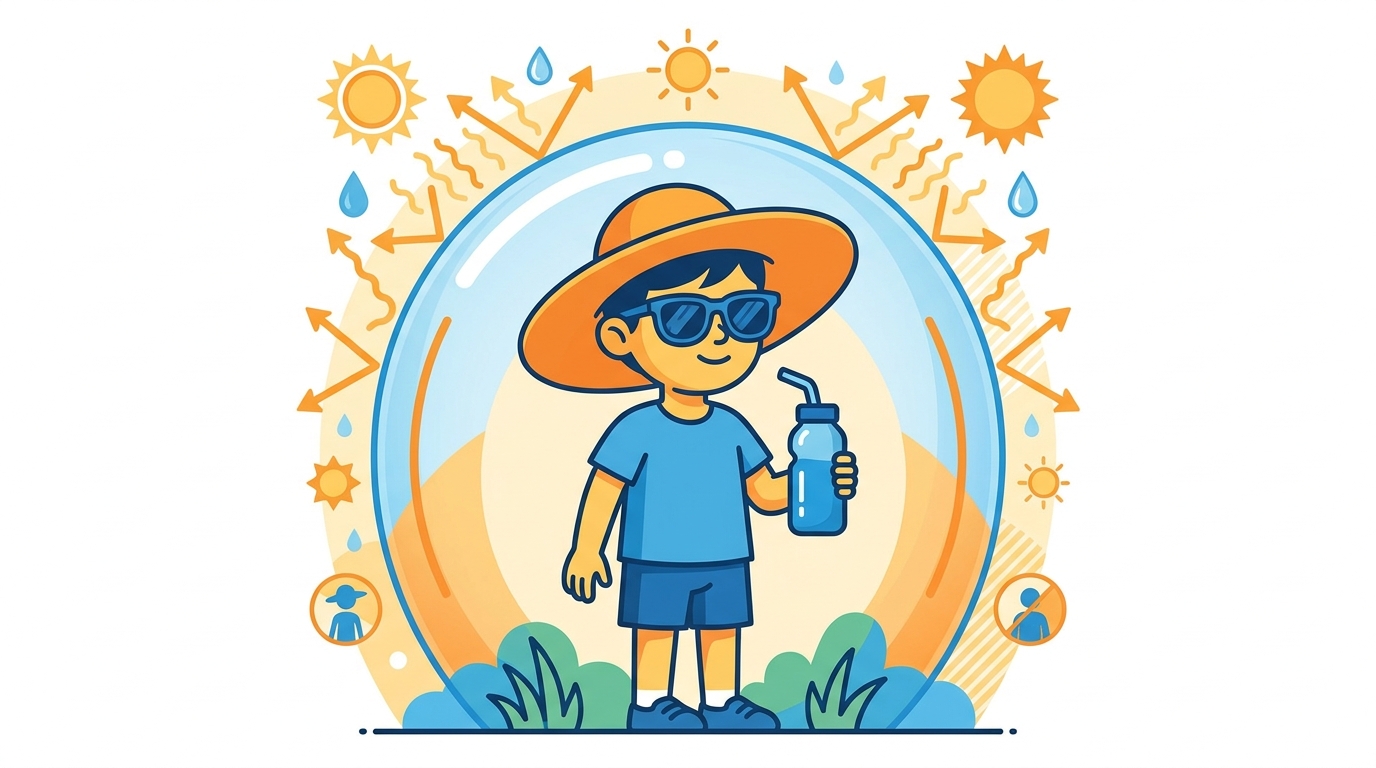
What are the main problems caused by this extreme heat? `(Types of Heat Illness)`
Extreme heat can have various effects on our bodies. Let's look at some of the most common conditions.
First, let's look at heat cramps.
Imagine your child has just come back from playing in the sun, or you yourself have been exercising hard in the heat. Suddenly , your muscles in your legs, arms, or stomach start to cramp . Ah, that's what heat cramps are. This is a very painful experience.
The main reason for these `(Heat Cramps)` is that when we sweat in extreme heat, not only water but also salts are released from the body. When the salt level in the body decreases, the muscles suddenly tighten and twitch. Especially young people, that is, children, have to face this condition easily if they do not drink enough water . Because they forget to drink water in the excitement of playing.
Although this is a bit painful, it usually gets better with a drink of water and some rest. However, this muscle twitching can sometimes be an early sign of a more serious condition . Therefore, it is not a good idea to simply ignore it. It is very important to get treatment quickly.
What do you do if you get heat cramps?
There are a few simple things to do:
- First, take the child to a cool place . Either indoors or somewhere with good shade.
- Let them rest well . Tell them to stop running around for a while.
- Give plenty of water to drink. It's best to give him fluids that contain a little salt and sugar, such as the ``Sports Drinks'' that are sometimes given, as well as plain water. Even a drink like Jeevani is fine.
- You can also gently stretch and massage the area where the muscle is twisted.
- This should usually relieve the pain within an hour. Even if the pain subsides, avoid strenuous activities such as running or exercising for a few hours.
- Important:If the muscle twitching does not subside within an hour, or if the person experiencing the twitching has a history of heart disease , or is on a low-sodium diet , you should definitely seek medical advice . Don't put it off.
Next, what is Heat Exhaustion?
Okay, now let's talk about `(Heat Exhaustion)`. This is a condition that needs to be taken into account a little more than the `(Heat Cramps)` mentioned earlier, and can be serious. This condition occurs when you are in a very hot environment and do not drink enough water . Imagine, a child has been playing in the sun since morning and has not drunk enough water. Then these symptoms may appear:
- The thirst for water is increasing greatly.
- I feel weak and very tired.
- Dizziness occurs, and sometimes fainting may occur.
- Muscle cramps (similar to ``Heat Cramps'' as mentioned earlier).
- Nausea and vomiting may occur .
- Very irritable , gets angry over small things, feels anxious.
- Headache may occur.
- Sweating excessively (heavy sweating). Clothes can get so wet.
- The skin feels cool and clammy to the touch.
- The body temperature may be slightly elevated, but is usually less than 104°F (40°C).
What do we do if that happens? What if we see the symptoms of `(Heat Exhaustion)`?
These things need to be done quickly, because this could be serious:
- Take your child to a cool place . Find an air-conditioned room, a car, or at least a place with good shade.
- Remove any extra clothes or thick clothing you are wearing. Lighten up so that the air can blow through your body.
- Give them water or cool liquids with a little salt and sugar (like sports drinks). Encourage them to drink small amounts at a time, rather than large amounts at a time.
- Wipe your body with a cloth dampened with cool water, or splash some cool water on your body, especially on areas like your forehead, neck, and armpits.
- Call a doctor and get advice. It's best to ask a doctor at this time.
- To the childIf you are too tired to drink water, are vomiting, or have not had any relief after doing these things for about an hour, you may need to be given intravenous fluids (IV). This means that you will need to be taken to a hospital without delay.
This is very important: If heat exhaustion is not treated properly, it can develop into a more serious condition called heatstroke. So don't take it lightly, act quickly.
Now let's look at the most dangerous condition: Heatstroke.
We are now going to talk about the most dangerous and life-threatening medical emergency caused by this extreme heat. That is heatstroke. What happens in this is that the body is unable to control its own temperature. It is as if the ``thermostat`` in our body is broken. Imagine, the body temperature can go up to 106°F (41.1°C), and sometimes even higher. If not treated quickly, not even a minute late, brain damage or even death can occur. Therefore, this is a medical emergency that requires urgent medical attention.
Young children are more likely to develop heatstroke, especially if they are wearing thick, windproof clothing on a hot day, or if they play in a way that causes excessive fatigue without drinking enough water.
Another very dangerous thing, but one that some of us don’t realize, is when a small child is left alone or trapped in a car parked in the sun. Imagine, when the outside temperature is about 93°F (33.9°C), the temperature inside a parked car can reach 125°F (51.7°C), which is like an oven, in as little as 20 minutes. This can quickly raise the body temperature to dangerous levels. So never, for any reason, leave a child alone in a parked vehicle.
What to do if you suspect a child has symptoms of `(Heatstroke)`? This is an emergency!
If your child has a high fever and has one or more of the following symptoms, call emergency medical assistance (for example, 1990 Suwaseriya Ambulance Service) immediately , or take them to the nearest hospital immediately:
- Severe headache.
- Weakness, dizziness.
- Confusion - You may get confused even when speaking, and you may forget where you are.
- Nausea and vomiting.
- Rapid breathing and heartbeat.
- Loss of consciousness.
- Seizures may occur.
- Most importantly: you can stop sweating!While sweating occurs in other conditions (`Heat Cramps`, `Heat Exhaustion`), sweating may stop completely in ``Heatstroke``.
- The skin becomes flushed, hot, and dry. It feels like it's burning to the touch.
- Body temperature rises to 104°F (40°C) or higher.
What can you do until medical help arrives?
At this time, don't panic and do these things:
- Take the child indoors or in the shade as soon as possible.
- Take off your clothes and relax.
- Sponge your body with cool water, or pour water over your body. It's also a good idea to soak your body in a basin of water if possible. Don't use ice water right away. Regular cool water is fine.
- Important: Only give your child something to drink if they are conscious, talking well, and acting normally. If they are unconscious, confused, or having a seizure, do not give them anything by mouth. This can cause more problems.
So how do we protect our children from the problems caused by this heat? `(Prevention)`
Okay, now we know what these `(Heat Illness)` conditions are and how serious they can be. So, the most important thing is to protect our children from them. The saying "Prevention is better than cure" applies to this as well. How do you do that?
- Water, water, water! This is the most important thing. We need to teach children to drink plenty of water on hot days, when playing in the sun, before and during play, even if they are not thirsty . When children are playing, they forget to drink water. So we need to remind them often. If a child is going to school, give them a bottle of water and tell them to finish it and come back.
- Be careful about your clothing. Wear light-colored, loose clothing on hot days. Sweat-wicking fabrics like cotton are best. Tight, tight, and thick clothing will make you hotter. Using sunscreen when you go outside is also good for your skin, and wearing a hat is also helpful.
- Choose your play times. On hot, humid days, try to do outdoor activities early in the morning (like before 10 a.m.) or in the late afternoon (like after 4 p.m.), when the heat is less intense . It's best to limit outdoor play and exercise as much as possible during the hottest hours of the day, like 11 a.m. to 3 p.m.
- Teach your children to stop playing and come inside, rest, and drink some water as soon as they feel hot, tired, or dizzy . Make them understand that they should not just say, "I'll play some more and come back."
- Never, for any reason, leave a child alone in a parked vehicle.We've said this before, but we need to remind you again how important it is.
Remember, never leave a small child alone in a car, even for a minute, especially on a hot day. The inside of a car can heat up like an oven very quickly, which can be fatal for a child.
Finally, a few things to remember (Take-Home Message)
Okay, so I think you'll definitely remember a few important things from what we've talked about.
- Extreme heat is no joke. It can lead to serious conditions such as ``Heat Cramps'' and ``Heat Exhaustion'', as well as life-threatening ``Heatstroke''.
- Encourage children to drink water regularly, especially when playing and exercising outside on hot days. Keep their water bottle filled.
- If your child seems to be feeling unwell due to the heat, quickly identify the symptoms and act accordingly. Don't panic, but don't delay.
- If you have symptoms of ``Heat Exhaustion'' (such as excessive sweating, weakness, nausea), cool down, give water, and seek medical advice if necessary.
- If you have symptoms of heatstroke (especially loss of consciousness, seizures, lack of sweating, high fever, confusion), it is an emergency! Go to the hospital immediately or call 911. Time is of the essence at a time like this.
- Prevention is the best way to protect yourself from the heat. So, make it a habit to follow the methods we've discussed to protect yourself from the heat.
If not only your child, but the entire family is aware of this, you can avoid a lot of trouble. Because, these days, the heat in our country is increasing day by day. Therefore, being careful is the most important thing. May you all stay healthy!
` Heat Illness, Heat Stroke, Heat Exhaustion, Heat Cramps, Heat Stroke, Children's Health, Emergency Treatment
ukat juk’ampinaka Doctoran qillqatapa
ukat juk’ampinaka Wawanakan junt’u usupax jilïr jaqinakat sipanx juk’amp jach’apunispawa. Wawanakan sistema de control de temperatura corporal ukax janiw jichhakamax taqpach luratäkiti, ukatwa chhullunkhayat usump usuntapxi. Junt’u pachanxa, wawaxa sapa kutiwa uma umañapa, algodón k’achañata isimpi isthapt’asiñapa, ukatxa inti jalsunxa jani juk’ampi junt’u pachanakanxa (10 alwata 4 jayp’ukama) anatt’añapakiti. Janipuniw mä wawarux sapak auton jaytañamäkiti (ukax mä ratukiw junt’u usump usuntayaspa).
❓ ukat juk’ampinaka Mä qawqha juk’amp jiskt’äwinakampiw jikisipxasma (FAQ) .
ukat juk’ampinaka ¿Kuna kasta junt’u usunakas utji?▼
ukat juk’ampinaka Junt’u usuxa ch’uñuru, junt’u qarjata, ukhamaraki chhullunkhayata kawkhantixa cuerpon temperaturapaxa sinti jilxati ukatxa jani amuyt’asiraki.
ukat juk’ampinaka ¿Kunjamatsa wawaruxa junt’u pachana jark’aqsna?▼
ukat juk’ampinaka Sapa kutiw uma umañama, jan sayt’asa umax umañkama, inti jalsur mistuñatakix jach’a borde sombreros uchasiñamawa, ukat ventilación ukat ch’amakt’at chiqanakan qhiparañamawa.
¿Kuna nayrïr yanapt’anakas mä wawarux churañapa, jupax chhullunkhayat usunïki ukhaxa?▼
ukat juk’ampinaka Jank’akiw wawarux ch’amakan thaya chiqar irpañapa, isinak ch’uqt’ayaña ukat janchiparux q’añu umampiw jariqañapa. Ukatxa jankʼakiw qullirir sarañama.


💬 Comments (0)
No comments have been posted yet. Add your comment here for the first time.
Add your comment