Is it normal for your child to get minor cuts and scrapes while running, jumping, or playing? It's very common. Most of the time, you can wash a minor wound like this at home, apply some medicine, and cover it with a bandage, and it will heal in two to three days. But sometimes, there are some wounds that are a little more serious, and sometimes they require medical attention and
stitches . So, today we'll talk about exactly what kind of wound we should be more concerned about, see a doctor, and maybe even get stitches.
When does a wound need stitches?
Okay, now let's look at what kind of wounds typically require medical attention, such as stitches. If your child's wound has any of these symptoms, it's best to see a doctor.
1. Will the bleeding not stop?
If you've applied pressure to the wound with a clean cloth for about 5 minutes and it still doesn't stop bleeding, it's something to be concerned about. Usually, bleeding from a small wound will stop after a short period of pressure. If it doesn't stop, there may be
a problem with blood clotting , or the wound may be deeper than you think.
2. Is the wound gaping or wide?
Are the two sides of the wound far apart, with a large gap? Does it look like the wound is "opening"? A wound like this is difficult to heal with simple home treatments. If that happens, the wound will not heal properly. This can leave
a large, unsightly scar . Also, because the wound is open
, there is a greater chance of germs entering and causing infection . Stitching is done to bring the two sides of the wound together and help them heal properly.
3. Is the wound very deep?
Does the wound seem deeper than it appears on the surface? Sometimes, if you can see
the muscles or
fat layer underneath the wound, it is definitely a deep wound. These types of wounds also need stitches. This is because deep wounds
are more likely to become infected if they are not properly cleaned and stitched. They can also damage nerves or large blood vessels.
4. Is the wound on the face, lips, or neck?
If your child has a wound on their face, lips, around their eyes, or in a sensitive area like their neck, it is important to see a doctor, even if it is small. This is because scars from other wounds in these areas can affect the child's appearance. Therefore, it is important to have stitches placed according to specialist medical advice to ensure
that the wound heals as well as possible and with minimal scarring .
5. Are there any objects, such as glass splinters or dirt, stuck inside the wound?
Sometimes, when a wound is cut, small pieces of glass, stone chips, wood chips, or dirt can get stuck inside. If these are left inside the wound
, the chances of infection are much higher., and the wound will also heal more slowly. All of these can be difficult to remove at home. A doctor can properly clean the wound, remove any debris, and apply stitches if necessary.
6. Is anything coming out of the wound? (e.g. a piece of wood)
Sometimes, something (such as a wooden stick or a piece of wire) can get stuck in a wound, and part of it is visible.
If you try to pull it out, don't! Doing so can cause more damage and increase bleeding. Take the wound to a doctor immediately. They will carefully remove it and give you the necessary treatment.
7. Does the wound spurt blood? (Spurts blood)
This is
an emergency! If the wound is bleeding like a faucet, it could mean that a major
blood vessel, an artery, has been damaged . It's not a good idea to wait.
What to do immediately: Take a clean piece of cloth (if possible, a piece of sterile gauze) and place it over the wound, pressing it firmly. It is better if the wound is above the heart (for example, if it is on the arm, keep the arm elevated). Then take the person to the Emergency Department (ETU) or the nearest medical center as soon as possible. Do not stop pressing the wound on the way.
These points we've discussed will help you decide whether or not to stitch a wound. But ultimately,
only a doctor can examine your child's wound and tell you for sure whether it needs stitches or other treatment. Therefore, if you have any doubts, it's safest to consult a doctor.
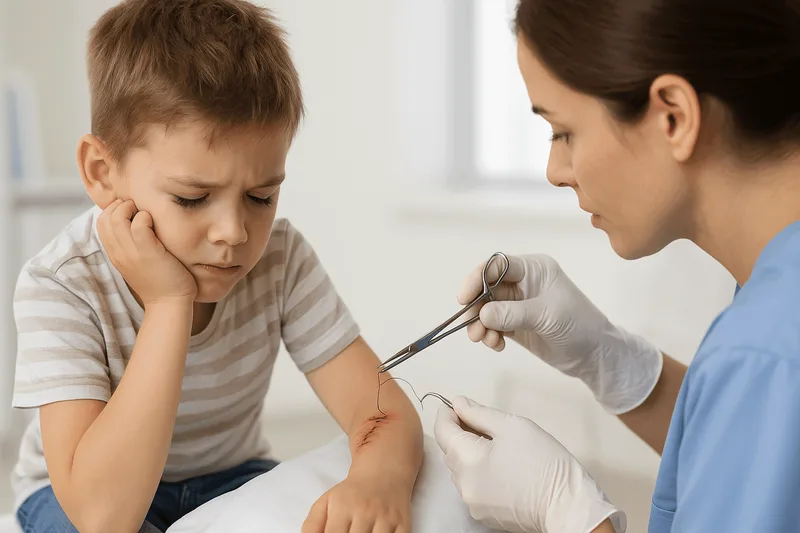
If the child gets stitches...
Doctors clean the wound thoroughly before putting stitches, as this is very important to prevent infection. It is your responsibility to take good care of the wound at home after the stitches are put in.
How do you care for a stitched wound?
- Follow the doctor's instructions exactly: The doctor will explain everything to you, including how to keep the wound clean after the stitches are placed, when you can shower, what kind of creams to apply, and when to come back to have the stitches removed. Follow those instructions exactly.
- Keep the wound clean and dry: Clean the wound as your doctor tells you. Usually, you'll be told to clean it daily and apply a new bandage. Don't let the wound get wet.
- Watch out for signs of infection :
- Is there redness and swelling around the wound?
- Is there anything yellow or green pus coming out of the wound?
- Does the child experience unbearable pain when touching the wound?
- Does the area around the wound feel hot?
- Does the child have a fever?
If you have any of these symptoms,
see a doctor immediately . It could be a sign of an infection.
- Don't play with stitches: Don't let your child scratch or pull at the stitches. Doing so can cause the stitches to break and the wound to open again.
- Cut the stitches on the due date: Go and cut the stitches on the day the doctor tells you. It's also not good to leave the stitches in for too long.
Remember the tetanus vaccine too!
A wound, especially one that comes in contact with dirt or rust
, can lead to a dangerous disease called tetanus . Make sure your child is up to date with their tetanus vaccinations. If in doubt, ask your doctor about it when you go to get treatment for the wound. Your doctor may decide to give you an additional
tetanus booster .
How to care for a minor wound at home
You don't need to rush to the doctor for every minor scrape or wound. For minor, superficial wounds, you can take care of them at home by: 1.
Wash your hands: Wash your hands thoroughly with soap and water before touching the wound. Otherwise, germs from your hands can be transferred to the wound. 2.
Stop the bleeding: Apply pressure to the wound with a clean cloth or gauze. The bleeding should stop within a few minutes. 3.
Wash the wound: After the bleeding has stopped, wash the wound thoroughly with clean water (warm water is best) and a mild soap. Wash until all dirt and debris around the wound is removed. Do not get soap inside the wound. 4.
Apply an antibiotic ointment: After the wound has healed, you can apply a thin layer of an antibiotic ointment recommended by a doctor. This will help prevent infection. 5.
Cover the wound: Cover the wound with a clean bandage or gauze. This will help keep the wound clean and prevent re-injury. Change the bandage daily, or if it gets wet or dirty.
Remember, if the wound seems a little large, deep, or if you have any doubts, it is wise to see a doctor rather than treat it at home .
Most importantly: trust your instincts!
As a mother or father, you have a good understanding of your child. If you look at a wound and think, "This looks a little strange," let that feeling go. Don't be afraid to go to a doctor and say, "Look at this, Doctor, I'm a little suspicious." It may not be anything serious. But it's a relief to have that suspicion cleared up.
Finally, things to remember (Take-Home Message)
- BleedingIf the wound does not stop within 5 minutes, is open , deep , on the face/neck , has dirt trapped inside , or is bleeding, seek medical advice immediately.
- A bleeding wound (spurting blood) is an emergency ! Immediately press it with a clean cloth and take it to a hospital.
- Also consider getting a tetanus vaccine if you get an injury.
- After getting stitches, follow your doctor's instructions exactly and watch for signs of infection .
- If you have any doubts , don't hesitate to see a doctor. The child's safety is the most important thing.
So, I hope you found this information useful. While it's impossible to prevent minor accidents in children, it's important to know how to treat them properly.





💬 Comments (0)
No comments have been posted yet. Add your comment here for the first time.
Add your comment