
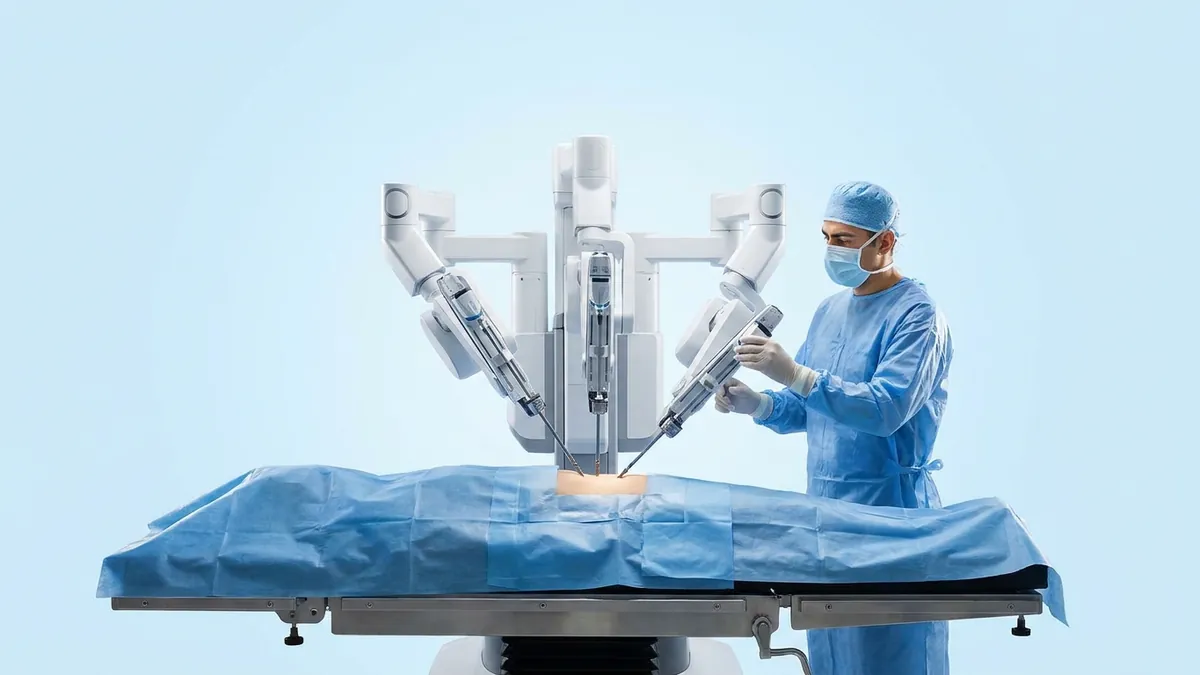
When the doctor told you that you had a hernia, you must have felt a little scared about having to have an operation, right? Many people think that when they say hernia surgery, it means something that is done through a large incision in the abdomen. But now medicine has advanced a lot. There are new and very safe surgical methods that use robotic technology without the large incisions that used to be possible.
What is robotic hernia surgery?
Simply put, a hernia is an organ inside our body, for example a part of the intestine, that protrudes through the muscles where it should be. In robotic surgery, the organ that has protruded is put back into place, and the weak spot between those muscles is strengthened and closed.
But the special thing about this is that the doctor does not directly touch your body. He is at a computer system (Console) next to your bed. He looks at the screen and controls high-tech robotic arms (Robotic Arms) to perform this surgery. This method is very different from open surgery . In open surgery, one large incision is made. But in robotic surgery (sometimes called laparoscopy ) , only three or four very small holes are made.
This is a small camera (laparoscope) that is inserted through a single hole, allowing the organs inside the body to be seen clearly and magnified in three dimensions (3D). This allows the doctor to perform the surgery with great precision and accuracy . Because the incisions are small, there is less bleeding, less pain, and faster healing.
What types of hernias can be treated with robotic surgery?
This modern technology can be used to treat everything from small hernias to major surgeries that reconstruct the entire abdominal wall. The types of hernias most commonly treated with this method are listed in the table below.
| Hernia Type | A simple explanation |
|---|---|
| Inguinal Hernia | A portion of the intestine or fatty tissue protruding from the groin area. |
| Femoral Hernia | A portion of abdominal tissue protruding from the thigh area, just below the groin. |
| Hiatal Hernia | The upper part of the stomach is pushed into the chest cavity through the diaphragm. |
| Incisional Hernia | A protrusion of an organ through a scar from a previous surgery. |
| Umbilical Hernia | A portion of the intestine protruding from the anus. |
How should I prepare for this surgery?
This is a very important question. Robotic surgery is not suitable for everyone. Whether this surgery is suitable for you or not is determined by a careful discussion with your doctor. He or she will specifically consider the following factors:
- The size of your hernia.
- How complicated the surgery will be.
- Is this your first hernia surgery, or is a previous one a recurrence?
- How general anesthesia affects you.
- Whether it is necessary to remove other things like scars along with the surgery.
Sometimes, the doctor can see a small, hidden hernia (occult hernia) during surgery that is not even detected on scans. It is a good idea to discuss with the doctor beforehand what to do if something like this is found.
How is the surgery done?
Don't be afraid of the surgery. Once you know the steps involved, your fear will disappear.
1. Anesthesia: First, you will be given general anesthesia, which will put you completely asleep so you won't feel any pain.
2. Incisions: The doctor will then make 3 or 4 very small incisions in the abdomen.
3. Camera insertion: A small camera called a laparoscope is inserted through one of the incisions. This allows the organs inside to be viewed clearly in 3D on a monitor.
4. Inflation of the stomach: Next, a small amount of harmless carbon dioxide gas is injected into the stomach to inflate it. This creates space inside, making it easier to perform the operation.
5. Surgery: The doctor now uses a computer-controlled robotic arm to repair the hernia. This may involve stitches or the use of a special mesh to reinforce the area.
6. Closure: When the work is finished, the small incisions are closed with dissolvable stitches or regular stitches.
The time required for this surgery varies depending on the nature of the hernia. While a simple surgery may take around 30 minutes, a complex surgery may take several hours.
What are the advantages of robotic surgery?
This method has several advantages compared to open surgery.
- Clear vision: The doctor can see inside in 3D, much clearer than the 2D images of a typical laparoscopic surgery. This makes the surgery very precise.It can be done.
- Precision: Robotic hands can move more freely, delicately, and without jerking than a human hand.
- Small scars: Instead of a large incision scar, there are only a few small scars.
- Less pain: There is much less pain after surgery than after open surgery.
- Quick recovery: You can recover quickly and resume normal activities.
Are there any risks or complications?
As with any surgery, there are some risks involved. However, it is a largely safe procedure. Some of the possible complications include:
- Bleeding .
- Reactions to anesthesia.
- Fluid accumulation (Seroma) or blood accumulation (Hematoma) at the surgical site.
- Wound infection .
- Damage to surrounding tissues or organs (this is very rare).
- Hernia recurrence.
It's normal to have some pain for a few weeks after surgery, but if the pain persists for more than three months , you should definitely tell your doctor.
What should I expect after surgery?
Your doctor will give you precise advice on your recovery time.
- Discharge from the hospital: In most cases, you can go home the same day. However, if you have a complicated surgery, you may need to stay in the hospital for about a day. Do not drive on the way home , and go with someone else.
- Recovery time: Usually, you will be advised to avoid heavy lifting or strenuous activity for two to four weeks.
- Returning to work: You can resume light work, such as office work, in a few days. However, heavy lifting may take a little longer.
When should I see the doctor?
If you have any of these symptoms after surgery, call your doctor immediately:
- If you have a fever and chills and are shivering.
- If you cannot pass air or have a bowel movement.
- If pus is draining from the wound.
- If the wound is red, swollen, hot, and painful.
- If blood is oozing from the wound over the bandage.
Very important: If you experience pain, sudden swelling, redness, or warmth in your leg (especially behind the knee) , which could be a sign of a blood clot in your leg ( Deep Vein Thrombosis – DVT ), go to the nearest hospital Emergency Department (ETU) immediately.
Take-Home Message
- Robotic hernia surgery is a modern and safe procedure performed through a few small incisions, using a 3D camera and a robotic arm.
- This method is less painful, heals faster, and does not leave large scars than traditional open surgery.
- The surgery is not performed by a robot, but by an experienced doctor who controls the robotic technology. So there is no need to be afraid.
- Talk to your doctor carefully about whether this surgery is right for you and about the instructions you need to follow after surgery.
- If you experience any unusual symptoms (fever, excessive pain, swelling of the wound) after surgery, seek medical advice immediately.






Janiw kuna arsuwinakas jichhakamax uñt’ayatäkiti. Aka chiqanx amuyt’awim jan ukax jiskt’awim yapxatañamawa.