
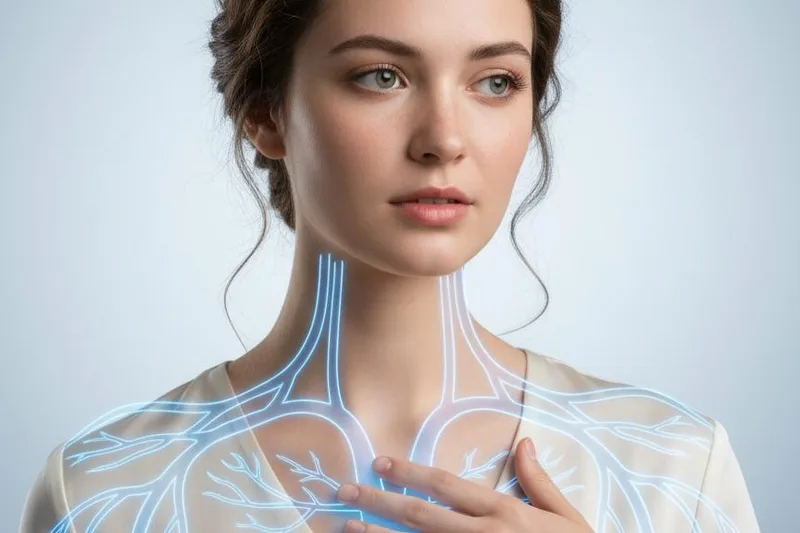
Our body is like an amazing machine, isn't it? For this machine to keep working, every part needs to receive oxygen and nutrients. This work is done by blood. The heart is like a water pump, sending clean, oxygen-rich blood throughout the body. But, after being used for body functions, the blood that has lost oxygen needs to be brought back to the heart, right? That's why our body has two special "main roads". Today we're talking about those two main blood vessels, the 'Vena Cava'.
Simply put, what is the Vena Cava?
Very simple. The Vena Cava is the two largest veins in our body. Veins are the vessels that carry blood to the heart. These are like two highways. All the deoxygenated, "used" blood collected from all over the body is carried to the heart through these two main veins.
There are two of these veins:
1. Superior Vena Cava: This is the second largest vein in our body. "Superior" means "above." Also, this vein collects the oxygen-poor blood from the upper part of our body, that is, the neck, head, arms, and upper chest, and brings it back to the heart.
2. Inferior Vena Cava: This is the largest vein in our body. "Inferior" means "lower." Accordingly, this vein collects and brings oxygen-poor blood from the lower parts of our body, such as the legs, stomach, kidneys, and liver, to the heart.
Imagine this as if it were like the bus routes in Sri Lanka. It is as if small buses (small veins) coming from each village of the country come to a major city and from there join the main road (the vena cava) leading to Colombo. Small blood vessels coming from different parts of the body join these two main veins and bring the blood to the main station called "Colombo", which means "the heart".
What is the actual function of these two veins?
The main and only function of these two veins is to carry oxygenated and carbon dioxide-laden "dirty" blood back to the heart throughout the body.
Let's see how this process works:
- Blood from both the superior and inferior vena cava joins the right atrium of the heart.
- Then that blood goes to the right ventricle of the heart.
- This blood is pumped from the right ventricle to the lungs through the pulmonary artery .
- The real magic happens in the lungs. They remove carbon dioxide from the blood and add oxygen to it for us to breathe. It's like "purifying" the blood.
- The now "clean" blood, full of oxygen, returns to the left atrium of the heart.
- From there it goes to the left ventricle , and from there it is pumped to the entire body through the aorta .
This cycle continues. So you see, this cycle wouldn't be complete without these two veins, right? They are that important.
Where is the Vena Cava located? How does it look?
Both of these veins are located on the right side of the heart. The Superior Vena Cava is located on the right side of the sternum, the large bone in the middle of our chest. It connects directly to the right atrium of the heart.
The inferior vena cava is a bit longer. It starts where two major veins in our abdomen join. From there, it goes up and connects to the right atrium of the heart.
In terms of size:
- Superior vena cava (SVC): About 7 centimeters (about 3 inches) long and about 2 centimeters (less than an inch) wide.
- Inferior vena cava (IVC): 100 millimeters (about 4 inches) long. About 22 millimeters (about an inch) wide.
Their walls are made up of special types of cells, connective tissue, nerve fibers, and muscle tissue, which gives them the flexibility and strength they need.
What conditions can affect the Vena Cava?
Like all other organs, these two major veins can also have problems. The main problem is that there is an obstruction in the blood flow inside these veins. This obstruction prevents blood from flowing properly to the heart. We call this condition 'Vena Cava Syndrome'. Depending on the vein that is obstructed, this can be 'Superior Vena Cava Syndrome' or 'Inferior Vena Cava Syndrome'.
When this type of obstruction occurs, just like when a main road is blocked and a traffic jam occurs, blood begins to pool in the body parts that connect to that vein.
There may be several main reasons for this:
- Tumor: A tumor, such as a lung cancer, can grow and put pressure on this vein.
- Blood Clots: A blood clot can form inside a vein and block it. Sometimes, catheters or pacemakers that are placed after surgery can increase the risk of blood clots.
- Congenital Malformation: Some people may be born with a defect in these veins.
The symptoms that arise in this situation vary depending on which vein is the problem.
| The vein with the problem and the cause | Common symptoms |
|---|---|
| Superior Vena Cava (Upper Vein) Related Problems | |
| Vein compression or blockage (Syndrome) | Swelling of the face, neck, arms and upper chest, difficulty breathing, chest pain (angina). |
| A blood clot or tumor | Swelling in the upper body, difficulty breathing. |
| Problems related to the inferior vena cava | |
| A blood clot | Swelling of the legs, back pain, sudden weight gain, severe pain in the legs. |
| A tumor | Stomach pain, leg swelling, weight loss. |
| Vein compression or blockage (Syndrome) | Low blood pressure, swelling of the lower body, and tachycardia. |
How do you check the health of these veins?
If you have these symptoms, your doctor will first examine you and may then perform several tests to confirm the exact cause of the problem.
- Chest X-ray: An X-ray examination of the chest.
- Ultrasound scan: Taking images of the inside of the body using sound waves.
- CT scan (Computed Tomography): A test that uses special computer images to create a cross-sectional view of the body.
- MRI scan (Magnetic Resonance Imaging):Obtaining very clear images of the body using a magnetic field.
- Coronary Angiography: A test that uses X-rays to look at blood flow by injecting a special dye into the arteries.
What are the treatments for such problems?
The treatment method depends on the cause of the problem. Your doctor will choose the treatment that is most suitable for you.
- Medications: Diuretics or steroids may be given to reduce swelling. If there are blood clots, medications may be given to dissolve them (thrombolytics) or to stop further clots from forming (anticoagulants).
- Blood clot removal: Sometimes a small tube (catheter) can be passed through the vein to remove the blood clot.
- Angioplasty and Stent: Inflating the blocked artery with a balloon-like device and inserting a small mesh-like tube (stent) to prevent it from narrowing again.
- Surgery: If a tumor is causing the blockage, surgery can be performed to remove the tumor. Sometimes, bypass surgery can be performed to create a new path for blood to flow.
- Cancer treatment: If cancer is the cause, chemotherapy or radiation may be required.
- Vena Cava Filter: If you have a blood clot in the deep veins of your legs (Deep Vein Thrombosis - DVT) and are at risk of a pulmonary embolism, your doctor may insert a small filter into the inferior vena cava. This stops the clot from traveling up the leg.
What can we do to keep these important veins healthy?
It's really important to keep all the blood vessels in our body healthy, not just the two vena cava veins. There are a few simple things we can do to help.
- A good diet: It is very important to eat a diet that is low in saturated fat and high in fruits and vegetables.
- Exercise: Stay active every day. Even something simple like walking or running can make a big difference.
- Reduce stress: Stress is not good for your blood vessels. Try to relax your mind through things like yoga and meditation.
- Control other diseases: If you have diseases like high blood pressure, cholesterol, or diabetes, control them well according to your doctor's instructions. These diseases can damage blood vessels.
If you have any of the symptoms mentioned in this article, please do not ignore it. See your doctor immediately for advice. Following the treatment he prescribes exactly is very important for a speedy recovery.
Take-Home Message
- The Vena Cava is the two main and largest veins that return used blood from the body to the heart.
- Blockage of these veins can cause serious symptoms such as swelling in the body, difficulty breathing, and chest pain.
- Never ignore sudden swelling, especially in the upper or lower body. Seek medical advice immediately.
- You can protect the health of your blood vessels by following a healthy diet, exercising, and controlling other diseases.




💬 Comments (0)
No comments have been posted yet. Add your comment here for the first time.
Add your comment