What are lymphocytes? Let's learn about our body's defense forces!
Dr. Priya SammaniMedically Reviewed
Have you ever looked at a blood test and noticed the number of White Blood Cells (WBCs) in it? In addition to the red blood cells that give our blood its red color, we also have white blood cells that are very important to our body. These white blood cells are our own army that protects our body from diseases and germs. The most special and skilled soldiers in that army are the lymphocytes that we are talking about today.
What is the function of lymphocytes?
Simply put, lymphocytes are the backbone of our body's immune system. They make up about 20% to 40% of our total white blood cells. Like an army defending a country, these cells fight against enemies that enter our body. These enemies can be:
Lymphocytes immediately start working to fight any foreign invader (we call these antigens). And these lymphocytes have a very amazing ability. That is memory . Imagine, after you had chickenpox as a child, you don't get chickenpox again. The reason for this is that when the chickenpox virus enters our body, these lymphocytes recognize it and fight against it. Then, they store a memory of that virus in the form of "memory cells". If the virus enters our body again, these memory cells recognize it as soon as they see it and quickly destroy it. Before we even get sick! The vaccines we use to protect ourselves from diseases work on this principle. Lymphocytes are produced in our bone marrow. From there, they are added to the blood and spread throughout our lymphatic system. The lymphatic system includes organs like our lymph nodes and the thymus gland.
What are the main types of lymphocytes?
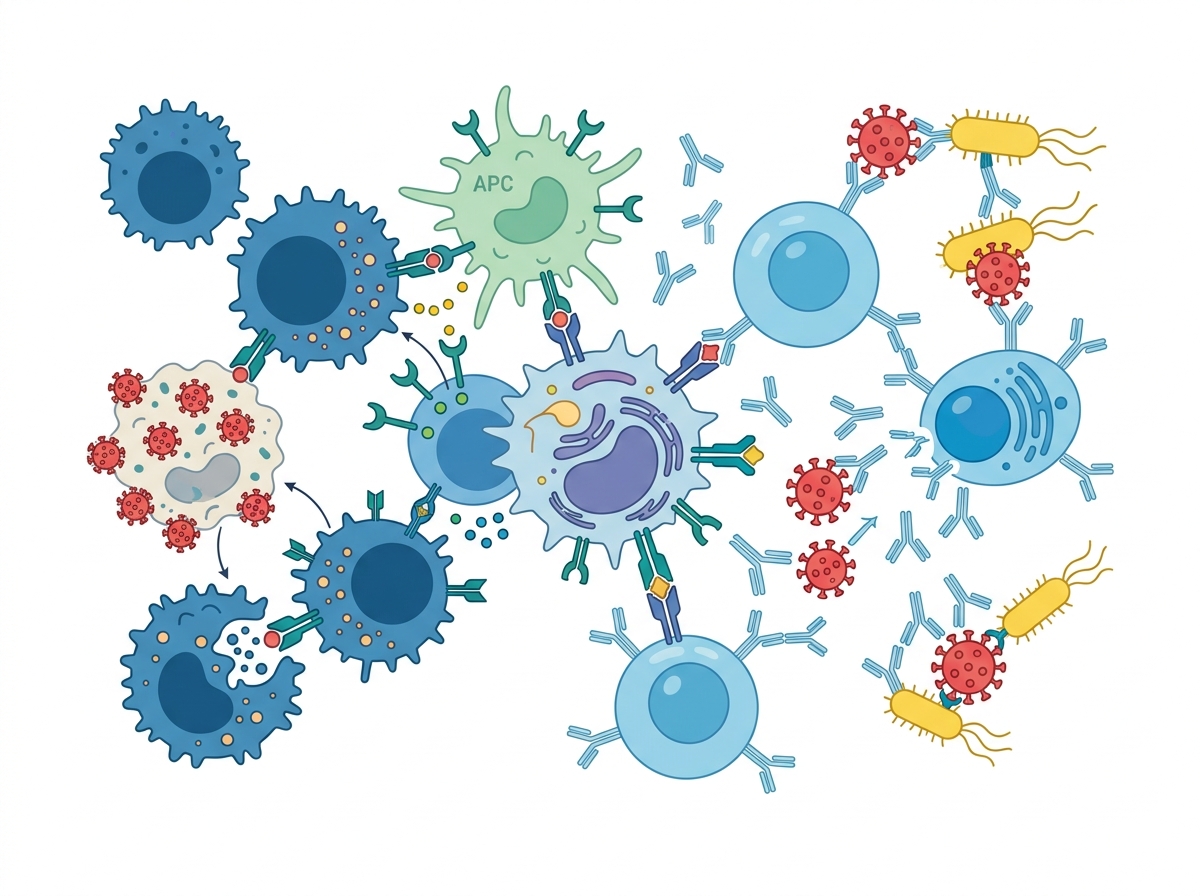
Lymphocytes can be divided into two main types: B cells and T cells. Together, these two strengthen our immune system.
Cell type
Main function
B cells (B Lymphocytes)
These make special proteins called antibodies. These antibodies can destroy germs or mark other cells for attack.
T cells (T Lymphocytes)
They recognize and destroy abnormal cells, such as our own cells infected with viruses or cancer cells.
Natural Killer Cells
These are also a type of lymphocyte. They can detect and destroy things like viruses and cancer cells at their earliest stages.
How B Cells Work
When B cells recognize an antigen, they respond in two ways. 1. Primary Immune Response: The first time the antigen enters the body, the B cells recognize it, and some B cells become memory cells. Others become plasma cells and begin to make antibodies that are specific to that antigen. This can take several days. 2. Secondary Immune Response: If the same antigen is encountered again, the memory cells quickly recognize it, rapidly make plasma cells, and quickly produce the necessary antibodies.
Types of T Cells
T cells have a hard time working alone, they need help from other immune cells. After receiving help, T cells divide into several types and work.
Cytotoxic/Killer T cells: These go directly to virus-infected cells or cancer cells and destroy them.
Helper T cells: As the name suggests, these help other immune cells. They do things like help B cells make antibodies and activate killer T cells.
Regulatory T cells: These prevent the immune system from overreacting and damaging our own bodies. That is, they control the system.
How to check lymphocyte levels?
There are several blood tests that can be done to determine your lymphocyte count.
Complete Blood Count (CBC): This is the same FBC ( Full Blood Count ) report we usually do. It measures the amounts of everything in the blood, including red cells, white cells, and platelets.
Flow Cytometry:This is a slightly more complex test than the CBC. It can count different types of lymphocytes, such as B cells and T cells, and determine their exact levels.
B and T cell screen: This test may be ordered by your doctor if you suspect you have an immune system disorder. It can also help detect cancers of the blood or bone marrow.
The most important thing is that your doctor should decide what tests you need. So don't panic on your own after seeing the values on a blood report.
Let's learn about the increase and decrease in the number of lymphocytes.
The normal range of lymphocytes can vary slightly depending on age, gender, altitude, and lifestyle. So talk to your doctor to get an accurate reading on your report.
Normal range for adults: Between 1,000 and 4,800 lymphocytes per microliter of blood.
Normal range for children: Between 3,000 and 9,500 lymphocytes per microliter of blood.
An increase or decrease in the number of lymphocytes above normal levels can be a symptom of a certain medical condition.
Status
Possible reasons
Lymphocytosis - increased number of lymphocytes
The body produces more lymphocytes to fight against an infection in the body.
Minor infections like the flu and cold can temporarily reduce the symptoms, but they can also be serious.
HIV/AIDS
Tuberculosis (TB), Typhoid fever
Autoimmune diseases such as lupus
Radiation or chemotherapy for cancer
Some genetic conditions
What are the symptoms of lymphocyte abnormalities?
Most of the time, there may be no symptoms at all, but some people may experience symptoms like:
Swelling of the joints (swelling of the joints)
Night sweats
Fever
Stomach pain
Appetite
Difficulty breathing
If you have symptoms like these, or if you have any doubts about the values in your blood report, the best thing to do is to see a doctor as soon as possible and seek advice.
Take-Home Message
Lymphocytes are a major type of cell in our immune system. They protect our body from germs, viruses, and cancer.
Because these cells have a "memory," they prevent us from developing certain diseases once they have developed them.
An increase (Lymphocytosis) or decrease (Lymphopenia) in the number of lymphocytes in a blood report can be a sign of an infection or other medical condition.
Do not make decisions on your own based on the values in your blood test report. Always consult your doctor for a clear understanding and for necessary treatment.
Lymphocytes, White Blood Cells, Immune System, B cells, T cells, Blood tests
ukat juk’ampinaka
Wilaman taqpach jakthapiwipax jan normaljam jach’a jan ukax jisk’a nivel de linfocitos uñacht’ayaspa ukhaxa, janiw jan yäqañamäkiti ukat doctoraruw uñjañama.
Kunayman infecciones jan ukax inflamación crónica cuerpon utjki ukanakax chiqapuniw nivel de linfocitos ukarux jan walt’ayi.
ukat juk’ampinaka ¿Linfocitos ukanaka jiskʼachañax jan waliti?
ukat juk’ampinaka
Jïsa, ukanak tukusiñajj jan waliruw puriyistaspa. Kunatix ukapachax cuerpon inmunidad ukax jan ch’amanïxiwa. VIH, Autoinmune usunaka jan ukax yaqhip cáncer qullanakax (quimios) uka linfocitos ukanakax juk’ampiw jilxattaspa.
⚠️ IMPORTANT: The medical articles and information on the Nirogi Lanka website are for general informational purposes only, and are in no way a substitute for professional medical advice, diagnosis or treatment. Consult a doctor immediately for any medical problems you may have.




💬 Comments (0)
No comments have been posted yet. Add your comment here for the first time.
Add your comment