
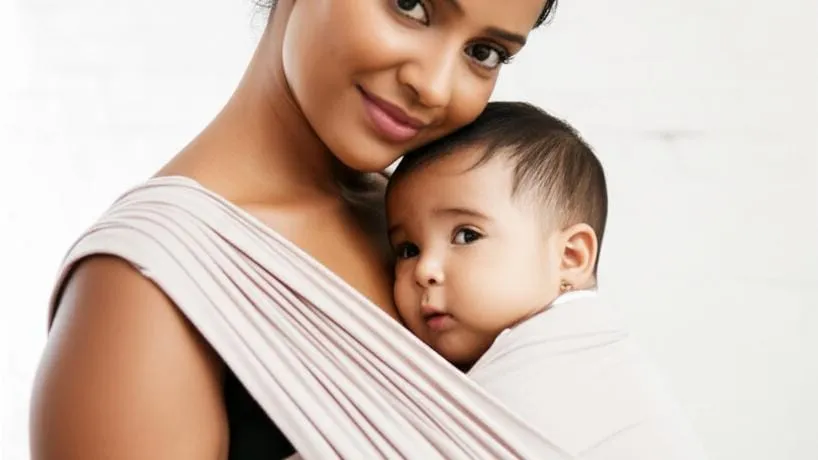
You must have seen some mothers and fathers carrying their little baby on their chest and back, tying it like a cloth. Isn't it a very cute sight to see? This is actually what we call 'Baby Wearing'. This is not just a way to hold the baby. There are many benefits for both you and your baby. It is also a very convenient way to free up your hands to do household chores or go to the store to buy some groceries. However, along with the benefits of this, there is also a safety aspect that we need to be careful about. Let's talk about all of this today.
Gratis usurïña uruxa calculadora. Qhipa periodo uru jan ukax concepción uru qillqt’aña, EDD, jichha trimestre ukat jach’a lurawinakat jikxatañataki.
Why is 'Baby Wearing' good for both you and your baby?
This method provides many benefits for both the baby and you as you care for the baby.
1. The baby is happy.
This is the main reason why many parents turn to this method. Studies have found that babies who are held in this way cry less. It is said that when babies are held in this way for at least 3 hours a day, their crying is significantly reduced. Especially at the age of 6 weeks, when babies cry the most, research has shown that babies who are held in this way cry 43% less during the day and 51% less in the evening.
2. Makes breastfeeding easier
If you're a breastfeeding mom , holding your baby close to your chest can make breastfeeding much easier. This makes the process of breastfeeding more natural and easier. In one study, mothers who 'baby wore' were twice as likely to continue breastfeeding their babies until they were 5 months old, compared to mothers who didn't.
This will also help you practice what is called Responsive feeding. Simply put, Responsive feeding is when you feed your baby as soon as he shows signs of hunger (such as mouth movements or sucking). It has also been found that mothers who 'baby wear' are more likely to adopt this method.
3. Very good for the baby's health
Research has shown that skin-to-skin contact with your baby is very beneficial for their development. We also call this 'Kangaroo care' . The benefits for your baby include:
- Sleep well.
- The heart rate stabilizes.
- Crying decreases.
- Weight gain.
- Breastfeeding for a long time.
- Breathing patterns improve.
- The oxygen level in the blood (Oxygen saturation) is at a good level. This determines whether the baby's organs are receiving enough oxygen.
Really?You don't necessarily need a 'Baby Carrier' to do Kangaroo Care . However, using a carrier makes it easier for you to carry your baby, do household chores, and do your own work. So 'Baby Wearing' is a very easy way to get the benefits of 'Kangaroo Care'.
Do you need to be concerned about safety when 'Baby Wearing'?
Yes, absolutely. The biggest risk here is suffocation , especially for babies under 4 months old. At this age, babies' neck muscles are weak, so they can't control their head well. So if the baby's mouth and nose are blocked, the baby may not be able to breathe. Also, holding the baby in a 'C' position can cause breathing difficulties.
But don't worry. If you are aware of this and do it correctly, you can enjoy the benefits of 'Baby Wearing' without any fear.
For this, it is very important to remember the rules called "TICKS" that experts introduce.
| Letter | Meaning and What to Remember |
|---|---|
| T — Tight | The carrier you use should be tight enough to keep your baby snug against your body. Don't let it hang loose. |
| I — In view at all times | You should be able to see the baby's face when you tilt your head. It is absolutely impossible for the face to be covered with cloth. |
| C — Close enough to kiss | The baby's head should be as close to your chin as possible, just far enough away that you can give the baby a light kiss on the forehead when you tilt your head. |
| K — Keep chin off chest | Don't let your baby's chin touch his chest. This can make it difficult for him to breathe. You should be able to insert at least one of your fingers between his chin and chest. |
| S — Supported back | The baby's back should be straight. Don't hold him in a 'C' shape or hunched over. The back should be well supported. |
What types of carriers can be used to carry a baby? (Types of Carriers)
There are many different types of baby carriers and slings on the market. Depending on what you do and the age of your baby, different types may be more suitable. Some parents switch carriers every day, while others use the same one from newborn to older. No matter which type you choose, it's important to read the instructions that come with it carefully and understand how to use it safely .
| Carrier Type | A little description about it |
|---|---|
| Baby wraps | These are like long strips of fabric. You can wrap them around your body and hold your baby on your chest or back. They come in stretchy and woven fabrics. The stretchy ones are great for newborns. The woven ones are strong enough to use even for older babies. |
| Pouches and ring slings | These are worn over one shoulder like a shawl. The fabric is folded to form a small pouch for the baby to hold. Ring slings have a ring on them that you can adjust to fit your needs. Pouches cannot be adjusted that way. |
| Soft-structured carrier | These are like a backpack, but can be worn from the front. They have a waist belt and padded shoulder straps. They can be adjusted to fit with buckles. |
| Meh dais | These are a type of carrier made in the Asian style. Straps attached to a square piece of fabric are tied around the waist and over the shoulders. These can be used to hold the baby in front, behind, or on the waist. |
💡 Take-Home Message
- 'Baby Wearing' is a wonderful way to strengthen the bond between you and your baby, calm your baby, and make your work easier.
- The most important thing is safety . Always follow the "TICKS" rules. Always check that the baby's nose and mouth are not covered and that the airway is clear.
- You want to be able to see your baby's face at all times. Choose a carrier that provides good support for your baby's back and allows them to sit upright.
- Choose a carrier that is appropriate for your baby's age and weight. Learn the correct way to use it.
- If you have any concerns or questions, especially if your baby was born prematurely or has other health problems, talk to your doctor before starting 'Baby Wearing'.






Janiw kuna arsuwinakas jichhakamax uñt’ayatäkiti. Aka chiqanx amuyt’awim jan ukax jiskt’awim yapxatañamawa.