

Are you also tired of not being able to do your daily tasks properly due to back pain and not being able to be happy? Doing household chores, gardening, going out with friends, and playing with your children have become unimaginably difficult due to this back pain. The main reason for such persistent back pain is damage to the joints in our back called (Lumbar Facet Joints). In fact, about 45% of patients suffering from back pain have problems related to these joints. So if you also have back pain or difficulty bending and twisting your back, it is very important to know about this treatment called (Lumbar Facet Joint Injection).
Know your body mass index (BMI) and weight classification
What are these Lumbar Facet Joints?
Simply put, Lumbar Facet Joints are the small joints in our lower back, behind the vertebrae (spine). These are also called (Zygapophysial joints).
Think about your knee. Just as the knee joint allows us to bend and extend our leg, these facet joints allow us to bend forward, rotate to the sides, and keep our spine straight. There is a lubricating fluid inside these joints. This helps these joints move smoothly without rubbing against each other.
However, when these joints wear out, that is, when arthritis conditions such as Facet Arthropathy'' occur, unbearable back pain can occur.
So what is this Lumbar Facet Joint Injection?
This is also called a Lumbar Facet Joint Block. This involves injecting a local anesthetic agent into or near the painful spinal joint. Sometimes a steroid is also added to this to reduce pain and swelling. Depending on your condition and the number of joints that are affected, you may need to have one or more injections.
This is a standard treatment method commonly used by doctors who treat back pain. It is particularly effective for pain caused by degenerative disc disease and some mechanical causes of lower back pain (mechanical lower back pain).
This treatment is performed by doctors or specially trained nursing staff who have received specialist training in pain management , spinal treatment, or physical therapy and rehabilitation.
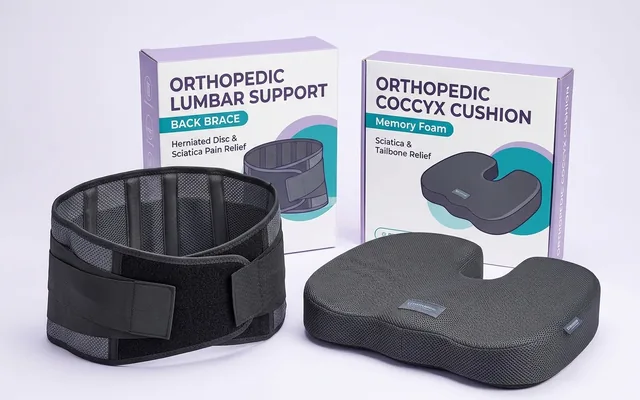
Breathable medical lumbar spine support belt with bionic stays to decompress herniated/bulging discs, relieve lower back pain, ankylosing spondylitis, and sciatica nerve pain.
View Clinical Details →Are there any side effects of this treatment?
As with any medical treatment, there are some risks and side effects. But theseIt is important to remember that these are very rare events. Your doctor will inform you about this in detail.
| Side effect | A simple explanation |
|---|---|
| Allergic reaction | Allergy to the medications used. |
| Infection | Germs entering the injection site. (Very rare) |
| Bleeding | It can especially occur in people taking blood-thinning medications. |
| Nerve injury | It can happen very rarely. |
| Temporary increase in pain | The pain may increase slightly for a few days after the injection. |
| Other (rarely) | High blood sugar levels, temporary flushing of the face, decreased bone density, and severe arthritis of the hip (avascular necrosis) can occur. |
How do you prepare for the injection?
There are several steps you need to follow before, during, and after this treatment.
People who should not have this injection
This treatment is not suitable for some patients. If you fall into one of these categories, you should definitely tell your doctor .
- People who are allergic to the medications used (headache medications, steroids, contrast agents).
- People who have an infection in their body.
- Pregnant women .
- People with bleeding disorders.
- People with spinal cord cancer or infection.
- People with uncontrolled diabetes or congestive heart failure .
Things to do before and during treatment
Your doctor will review your complete medical history, explain the pros and cons of this treatment, and answer your questions. If you are taking any blood thinners, you may be advised to ask your general practitioner if you need to stop taking them and how.
On the day of treatment, be sure to do the following:
- Take a good shower, apply soap, and clean yourself.
- Do not apply any lotion or medicated cream to the injection site.
- Wear comfortable, slightly loose, dark-colored clothing.
- Arrive at the hospital or clinic about 30 minutes before your treatment.
- Please bring someone to take you home. It is not advisable to drive after treatment.
- Bring a list of all the medications you take and any allergies you have.
- If you have your latest X-ray or MRI reports, bring them too.
What happens during treatment?
The entire process takes between 10 and 30 minutes. Most of the time, you won't be put to sleep completely, so you'll be conscious.
1. First, you will be given a hospital gown to wear. You will also have to sign a consent form.
2. A nurse will take you to the treatment room and ask you to lie face down on the bed. A blood pressure monitor will be attached to your arm and a heart rate monitor will be attached to your finger.
3. The doctor uses an X-ray device to find the right joint to inject the medicine.
4. Then the skin in that area is cleaned with an antiseptic solution and a small amount of numbing medicine is injected. You may feel a slight burning sensation at this time.
5. Next, the main needle is inserted, a contrast agent is injected, the joint is precisely identified, and a steroid and painkiller mixture is injected. You may feel a slight pressure in your back at this time.
6. When the work is finished, the needle is removed, the area is cleaned, and a small plaster is applied.
7. You will then be taken to a separate room for observation for about 15-45 minutes.
After treatment
If you have an IV line, it will be removed. A nurse will check your blood pressure and give you instructions on what to do and what not to do when you go home. They will also tell you when to remove the bandage, a pain log to record your pain, and when to see your doctor again.
Very important: If you experience sudden shortness of breath, fainting, allergic symptoms (itching, hives), severe headache, increased pain, or incontinence after treatment, call your doctor immediately or go to the nearest hospital Emergency Department (ETU).
💡 Take-Home Message
- Lumbar Facet Joint Injection is an effective and widely used treatment for chronic pain caused by spinal disc herniation.
- Although this is generally a safe treatment, as with all medical procedures, there are minor risks and side effects that can occur.
- It is very important to follow your doctor's instructions carefully before treatment. Tell your doctor about all medications you are taking and any medical conditions you have.
- If you experience any unusual symptoms after treatment, seek medical advice immediately. Don't panic and ignore it.
- The doctor who examines you will decide whether this treatment is right for you. Therefore, if you have back pain, see a specialist and get proper advice.


No comments yet. Be the first to share your question or experience below.