

Have you ever wondered how the blood pumped by your heart travels from your head to your toes? The main, largest blood vessel in our body, which paves the way for this entire journey, is the aorta, or as we say in English, the aorta. It is like the main highway in our country. So today, let's talk about this super highway.
What is this aorta?
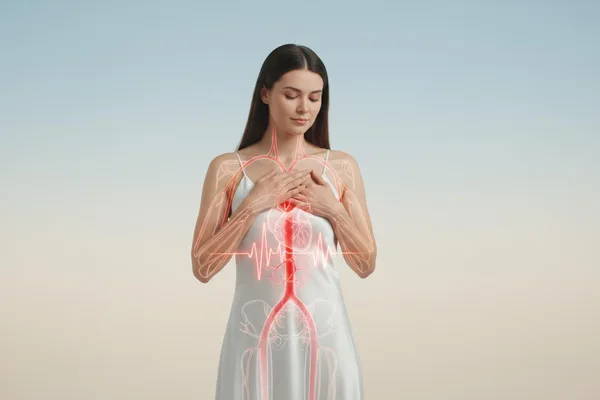
Simply put, the aorta is the largest blood vessel (artery) in our body. It is a tube that bends upwards, like a walking stick. It starts in the lower left chamber of your heart (the left ventricle). From there, it goes up a little towards your head, then curves down again. This tube goes through your chest and abdominal cavity, and ends near your pelvis.
This large artery branches off into smaller blood vessels, like side roads off a highway. It is through these branches that blood travels to every muscle, nerve, and organ in your body.
How big is this?
This is the largest blood vessel in our body. It's over a foot long . And it's about an inch in diameter at its widest point. As it goes down, that is, towards the pelvis, it gets thinner until it's about two centimeters thick.
What is the aorta made of?
This is a very complex structure. It has three main layers of tissue. Let's see what they are.
| Layer | Description and function |
|---|---|
| Innermost layer (Tunica Intima) | This is the tube through which blood travels. It contains smooth muscle, connective tissue, and a special type of cell called endothelial cells. These cells are responsible for keeping the oxygen and nutrients in the blood moving through the tube until they reach their destination. |
| Middle layer (Tunica Media) | This layer is made up of smooth muscle, elastin, and collagen proteins. These are what allow the aorta to adjust its blood flow according to the body's needs. It widens when the body needs more blood. It narrows when it needs less blood. |
| Outermost layer (Tunica Adventitia) | This is what keeps the aorta stable in place. It also connects to nearby nerves and tissues. |
The main function of the aorta and its importance
The main function of the aorta is to carry oxygen-rich blood from the heart to the rest of the body . Not only that, nutrients and hormones are also transported through this main vessel. Branches that branch off from the aorta ensure that these substances reach the internal organs and other tissues of the body.
Just think, this aorta is the main source of oxygen and essential nutrients for most of the organs in our body.
So, if the flow of blood through this vessel is obstructed due to some disease or accident, life can be at risk within minutes . The following are the serious conditions that can occur at such a time:
- Aortic aneurysm
- Bleeding inside the body (Hemorrhage)
- Aortic dissection
- Kidney failure
- Stroke
The structure of the aorta and its parts
The aorta can be divided into several parts. Let's see what those parts are.
| Part | Description |
|---|---|
| Aortic root | The part that connects to the heart. This is the widest part of the aorta. |
| Aortic valve | This is a valve made up of three flaps. These flaps open and close to release oxygen-rich blood from the heart to the body. |
| Ascending aorta | The part of the aorta that curves upward as it leaves the heart. |
| Aortic arch | The part that gives it a curved shape, like a walking stick. Like a bridge connecting the two parts that go up and down. |
| Descending aorta | The long, straight part that runs from the chest (thoracic aorta) to the abdomen (abdominal aorta). |
What are the branches that branch off from the aorta?
Many small blood vessels branch off from the aorta.
Branches of the ascending aorta
- Coronary arteries: These are the arteries that supply blood to your heart muscle.
Branches of the great aorta
- Brachiocephalic trunk: This again divides into two branches: the right subclavian artery, which supplies blood to the right arm, and the right carotid artery, which supplies blood to the brain, right side of the neck, and right side of the head.
- Left subclavian artery: Supplies blood to the left arm and the back of the brain.
- Left carotid artery: Supplies blood to the brain and the left side of the neck and head.
Branches of the descending aorta (in the chest)
- Bronchial arteries: Supply blood to the bronchial tubes deep within the lungs.
- Esophageal arteries: Supply blood to the esophagus, the tube that connects the throat to the upper part of the stomach.
Branches of the descending aorta (in the abdominal part)
- Inferior phrenic arteries: Supply blood to your diaphragm.
- Celiac trunk arteries: Supply blood to organs of the digestive system, such as the stomach, liver, spleen, and pancreas.
- Superior and inferior mesenteric arteries: Supply blood to your intestines.
- Renal arteries: Supply blood to your kidneys.
- Gonadal arteries: Supply blood to the ovaries in women and the testicles in men.
- Lumbar arteries: Supply blood to the vertebrae, spinal cord, muscles, and skin in the lower back.
- Iliac arteries: Supply blood to the legs.
What are the diseases that affect the aorta?
Various diseases, birth defects, and accidents can affect the function of the aorta. Let's look at some of these conditions.
Aortic valve disease
- Aortic regurgitation: A condition in which the valve flaps do not close properly, causing blood to flow back into the heart instead of out into the body.
- Aortic stenosis: Aortic valve becomes stiff and narrow, blocking the passage of blood.
- Bicuspid aortic valve disease: Although there should normally be three cusps, in this condition the valve has only two cusps. Although this is a congenital condition, symptoms may appear in adulthood.
Artery distension, tearing, and rupture
- Abdominal aortic aneurysm: A weak spot in the part of the abdominal wall that bulges out like a balloon.
- Aortic dissection: A tear in the innermost layer of the aorta, causing blood to leak between the inner and middle layers.
- Ruptured aorta: A tear in the aorta wall that occurs through all three layers. This is very dangerous because oxygen-rich blood leaks into the body.
Congenital heart disease
- Coarctation of the aorta: Abnormal narrowing of the aorta, which makes it harder for the heart to pump blood around the body.
- Hypoplastic left heart syndrome (HLHS): A group of birth defects that affect the left side of the heart. In these children, the aorta is too narrow to function.
- Patent ductus arteriosus (PDA): An opening between the aorta and the pulmonary artery that does not close on its own after birth, allowing oxygen-rich blood to flow into the lungs.
Other medical conditions
- Aortic atherosclerosis: Fatty deposits in the inner walls of the aorta.
- Aortitis: Inflammation of the walls of the aorta.
- Aortic trauma: Tearing or damage to the aorta due to a severe accident, such as a fall from a height or a high-speed car collision.
- Mural thrombus: A blood clot that forms in a large blood vessel, such as an artery, obstructing blood flow.
Who is at higher risk of developing these diseases?
In fact, some major artery diseases, especially aneurysms and dissections, can be hereditary . Also, some genetic diseases that affect connective tissue can cause major artery diseases.
Additionally, your risk increases if you have the following conditions:
- Increasing age: The risk increases with age.
- Chronic diseases that damage blood vessels:
- Chronic obstructive pulmonary disease (COPD)
- Diabetes
- High blood pressure
- High cholesterol
- Snoring (Sleep apnea)
- Lifestyle influences:
- Smoking or using other tobacco products
- Excessive drinking
- Stress
- Being the male side.
What should we do to stay safe from these diseases?
Birth defects, genetic diseases, and accidents are difficult to prevent. But there are many things we can do to protect ourselves from other types of coronary artery disease.
- Follow a healthy lifestyle. Eating a nutritious diet and being physically active are very important.
- If you have a chronic condition like high blood pressure, high cholesterol, or diabetes, follow your doctor's instructions exactly . Take your medications exactly as prescribed.
- Limit or stop drinking alcohol completely.
- Find ways to manage stress .
- Stop smoking and the use of other tobacco products completely.
If you are at risk for coronary artery disease or if your doctor has identified a small problem, regular medical checkups and monitoring are very important.
For this, your doctor may recommend tests such as `CT scan`, `MRI` or `Angiography`. Based on the information obtained from these, the likelihood of a complication can be assessed and, if necessary, treatment can be given in advance to prevent it.
Take-Home Message
- The aorta is the main and largest blood vessel in our body. It is the main highway that carries oxygen and nutrients to the entire body.
- Problems with this, such as aneurysm or dissection, can be very serious and life-threatening.
- High blood pressure, high cholesterol, diabetes, and especially smoking greatly increase the risk of developing coronary artery disease.
- The best way to protect yourself from these diseases is to live a healthy lifestyle and manage your chronic conditions well.
- If anyone in your family has these diseases, or if you have risk factors, be sure to talk to your doctor about it.




💬 Comments (0)
No comments yet. Be the first to share your thoughts here.
Add Your Comment